Fat Shaming: Socially Acceptable Bigotry

McCarthy Instagram

Fashion designer and Academy-Award-nominated actress Melissa McCarthy, second from left, shows off pieces from her new 7Seven fashion line, Summer, 2015

When gifted comic actress Melissa McCarthy was nominated for a Best Supporting Actress Academy Award, she went searching for an appropriately elegant evening gown to wear to the ceremony. “I asked five or six designers,” she told Redbook magazine. “Very high-level ones who make lots of dresses for people — and they all said no.” The designers demurred because Ms. McCarthy does not conform to the fashion world’s size-two-to-size-six ideal. Designers had no interest in having her wear their dresses, even though over 40 million people in the U.S. alone saw Ms. McCarthy on their TV screens in one night, because designers feared that being seen to create clothing for larger women would actually harm the reputations of their design houses.

It’s ironic that designers think designing for women size 14 and up degrades and debases their brands since fully two-thirds of women in the United States fall into that category. Over 90 million women in the U.S. alone wear size 14 or larger, yet they are relegated to smaller, sadder “plus-size” clothing departments. They are made to feel that they are not only unimportant but not worthy of attractive, comfortable clothing even though they purchase and wear billions of dollars worth of clothing and accessories each year. They are shut out of many stores and designer’s lines completely, and stores that cater to them often offer them less flattering products for more money. The funny but maddening WTF Plus Tumblr blog shows the range of hideous, sexless, embarrassing clothes designed for larger women that smaller women would never be expected to buy, let alone wear.

While Emmy-winning actress Melissa McCarthy is best known for being a popular comedian who is willing to bear the brunt of jokes about her large size, she actually started out as a fashion and textile design student at New York’s prestigious Fashion Institute of Technology before her career in entertainment took off. In August 2015 her new line of clothing, 7Seven, debuted a line of clothes ranging in size from 4 to 28. The line is in a relatively affordable price range that matches or meets the prices of retailers like Ann Taylor and Banana Republic. With her inaugural collection, McCarthy shows a great eye for proportion, fit, pattern and texture. Her designs are fashion-forward and very wearable.

McCarthy dislikes the term “plus-size.” “Seventy percent of women in the United States are a size 14 or above, and that’s technically ‘plus size,’ so you’re taking your biggest category of people and telling them, ‘You’re not really worthy.’ I find that very strange,” she says.

In response to the news of her fashion line’s availability, Internet trolls came out en masse on social media and news sites to denigrate McCarthy and others for “enabling” and celebrating larger women’s rights to enjoy their bodies. As always happens when women with bodies larger than a size 6 dare to show comfort or confidence in their appearance, people took to their computers to accuse McCarthy and others of glamorizing unhealthy lifestyle choices. Those self-elected arbiters of appropriate body shape and size would like all people size 8 and above to go about in sack cloth and ashes until they starve themselves down to a single-digit dress size.

Disapproval and disrespect shown toward plus-sized people doesn’t obviate their need to find clothes that fit, feel good and look attractive. Those who respond to Ms. McCarthy’s new business venture by denigrating those who are larger than themselves are essentially saying that allowing people to clothe themselves attractively, affordably and comfortably  is the wrong tack—that we should instead shame them into looking the way we want them to and tell them that having the bodies they have is a moral failing. I wonder whether these self-appointed body shamers go out of their way to shame smokers and alcoholics, too. Those who drink or smoke bring on early death from their habits in even greater numbers than overeaters do, but our society shows them more understanding. They have the option of giving up their habits and avoiding people and places that trigger their dangerous behaviors, but EVERYONE has to eat, and every metabolism is different, so larger people can’t just stop the behavior (i.e., eating) that disrespectful trolls find offensive. 

Many larger people are actually regular exercisers who are quite healthy—you can’t tell from looking who is truly unhealthy inside. Large people have higher rates of some deadly diseases, but so do coal miners, house cleaners and beauticians because they choose jobs that expose them to carcinogenic chemicals. Police officers and soldiers die in greater numbers and intentionally choose work that causes great stress that often requires taxpayer-funded medical and psychological intervention later. Do we judge them for putting their lives at risk? Do we denigrate them for their choices? 

Melissa McCarthy is a multitalented woman who designs chic, comfortable and fashion-forward clothing, much of it aimed at a market that comprises over two-thirds of the nation’s adult female population. People who want to shame those women into conforming to their personal preferences are nothing more than hateful bigots who spew venomous tirades in the self-righteous belief that their discomfort over seeing bodies larger than those featured in Vogue magazine justifies their using their supposed concern about health and setting bad examples for youth so they can clobber those with different body types and sizes over the head, shaming and shunning them and telling them that they are unlovable, undisciplined and unimportant, none of which is true.

An ever-growing body of scientific literature points toward the fact that people who are deemed overweight to obese usually have very different gut biomes (intestinal ecosystems) than thinner people do, and that the varieties and sizes of bacterial colonies in their guts have an enormous impact on the speed and effectiveness of their bodies’ metabolic rates, the intensities of their cravings for food, the ways in which they metabolize medicines, and their propensity toward depression, anxiety and other emotional and psychological disorders that may manifest in a compulsion to eat in order to find comfort.

In short, the gut biomes of larger people may send intensely powerful and frequent signals to their brains telling them what, when and how much to eat. We live in a culture in which almost everyone has taken multiple types of  antibiotics that distrupt gut biomes, sometimes with disastrous, even deadly results. We are also regularly bombarded with ads for unhealthy foods and drinks that further disrupt our gut biomes and our endocrine systems, making permanent weight loss exceptionally difficult for even the most determined people. But we are also surrounded with Photoshopped images of impossibly thin, unrealistically proportioned people on TV, in movies, in pornography and in computer games, making it easier to believe that there are actually many more “perfect” bodies in existence than actually occur on this or any other planet. So we compare ourselves to these pretend people we keep seeing, and to make ourselves feel less bad about our own imperfections, we glom onto the perceived failures of others and build ourselves up by ripping them apart and smarmily saying that we’re shaming and shunning them for their own good. How preposterous. It’s cruel, and it doesn’t help people to lose weight.

What does help? Making people feel confident and attractive enough to get up, get out and exercise and take good care of themselves. Helping them to feel less anxious or depressed about themselves by giving them access to clothes and accessories that allow them to feel more attractive, confident and appealing. Success breeds success; those who feel shame are more likely to retreat into self-defeating behaviors that compound difficult habits, while those who believe in their inherent worth and who have hope for a positive future are more likely to get up and take the actions that lead to healthier, happier lives. Shaming and shunning those who are heavy tends to push them toward habits that make them heavier still. Helping them to find attractive outfits for every occasion, including athletic and exercise wear, gives them ways to love the bodies they have and helps them to believe that their bodies are worth effort and care.

Yes, being obese is not healthy, but being slightly overweight actually leads to a longer life expectancy than being slightly underweight. Furthermore, many people who are significantly overweight exercise regularly and do not have either diabetes or high blood pressure, just as some very fit and thin women have serious diabetes from childhood onward and need daily insulin injections. You can’t tell by looking, and even if you could, others’ dietary habits are not your business.

Should we encourage healthy dietary and exercise habits throughout society? Yes! Should we work to eliminate junk food dispensaries from schools and increase the quality of school lunches and discourage teachers from using sodas and snacks as rewards for good work? Yes! But it does not follow from these societal goals that encouraging health requires disparaging and defaming those whose habits or bodies don’t conform to cultural ideals.

Rather than fat-shaming those among us with larger bodies, let us celebrate women like Melissa McCarthy who make larger women feel freer to be active, positive and comfortable in their bodies while living happy, productive, healthy and engaged lives.

I’ve a Bee in My Bonnet for Pop Sonnets

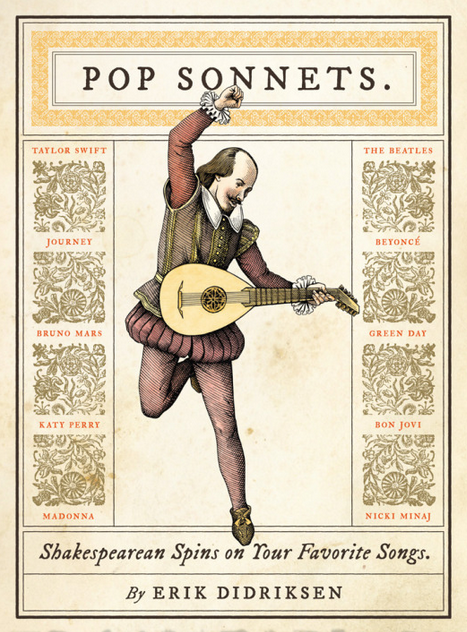
*Pop Sonnets - Eric Didricksen

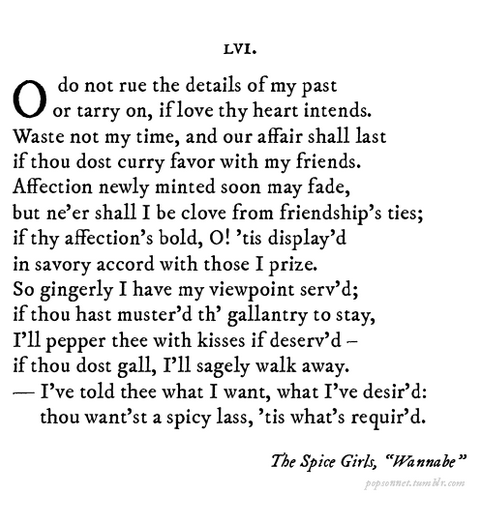
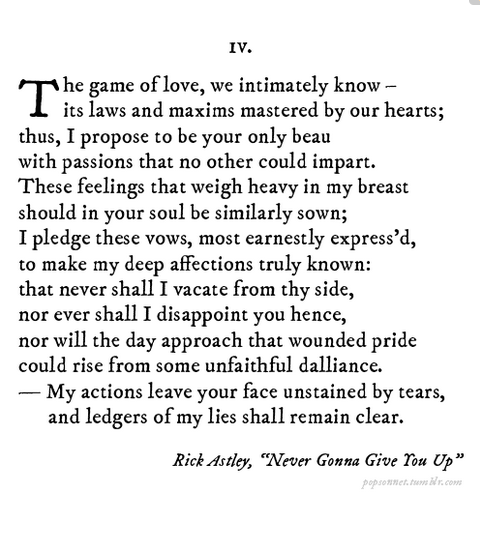
If William Shakespeare were alive today and writing lyrics to pop anthems, what would they sound like? Thanks to Erik Didricksen‘s Pop Sonnets blog, we now know. Pop Sonnets (popsonnet.tumblr.com) has given the Shakespearean treatment to dozens of tunes from Queen’s “Bohemian Rhapsody” (“My fate now seal’d, ’tis plain for all to see: The wind’s direction matters not to me”) to Daft Punk and Pharrell’s “Get Lucky” (“While ladies dance away the night for sport / So shall we too, their favor sweet to court”), to the lyrical demands of the Spice Girls, whose “Wannabe,” incorporates much spice-related wordplay:

Wannabe

Hast thou a hunger to hear the plaintive wail of Steve Perry exhorting, cajoling, nay, demanding that all and sundry hold fast to hope? Then thou art most fortunate, for Pop Sonnets doth present a poetic parody of “Don’t Stop Believing” which beginneth in this fashion:

A lonely maiden from a hamlet small—
A boy within a woeful city reared:
They both at midnight left their port of call
T’ward any destination volunteered.

The Ramones’ “I Wanna Be Sedated,” Ke$ha’s “Tik Tok,” Jason Derulo’s “Talk Dirty,” and songs by Katy Perry, Beastie Boys, Sir Mix-a-Lot, Green Day, even Britney Spears can be found among the Bard of Avon’s supposed works as channelled through Didricksen. Enjoy this rapturous take on “Uptown Funk” by Mark Ronson, featuring Bruno Mars:

Uptown Funk

Pop Sonnets is available as a tumblr blog, but it will also be released in book form on October 6 in the US and Canada, October 8 in the UK. Think what a delectable gift the book would make for thy nearest and dearest!

Before you do depart, O gentle men and ladies fair,
Think not that I’ve no heart and would not leave a treasure rare.
For here before you, friends, I place a gift as bright as gold:
And once you’re read it through, you’ll cry—

“Alas, I’ve been Rickrolled!”

Never Gonna Give You Up

On Loving Lyle Lovett

If you think Lyle Lovett is just a country musician, you’re missing out on so much. He’s a dryly witty lyricist and composer; a talented guitarist and singer; his songs have been featured in movie scores from “Toy Story” to “The Crying Game”; and he leads a fantastic big band, which Lyle calls his Large Band. Together their music combines country, big band/swing, jazz, blues, gospel and bluegrass. Lyle is a generous bandleader, giving ample time to his musicians to show their prodigious singing and playing skills on instruments from slide guitar to trombone to fiddle to cello. (Yes, cello—his longtime cellist John Hagen brings a beautiful richness to the Large Band’s sound and his solos are elegant and warm—and squeaky and wild when necessary.) Lyle’s backup singer Francine Reed has a big, bold, sexy alto voice and a devoted following of her own; she returns to Seattle for another stint as Teatro Zinzanni‘s resident chanteuse this winter.

I first saw Lyle and his Large Band in concert in 1987, and most recently saw them last weekend. Their professionalism, evident pleasure in performing, and ability to produce a tight and exciting 2-1/2-hour show after all these years together made them just as thrilling to watch this week as they were when I first enjoyed them all those years ago. The video above shows Lyle and his band displaying all the amazing influences they draw from in one terrific showstopping song. Don’t stop there—check out his albums (especially “Joshua Judges Ruth,” “The Road to Ensenada,” “Lyle Lovett and His Large Band” and “Pontiac“) and you’ll see what I mean.

Let Me Not to the Marriage of True Minds Admit Impediments

Laura Pride

Let me not to the marriage of true minds
Admit impediments. Love is not love
Which alters when it alteration finds,
Or bends with the remover to remove:
O no; it is an ever-fixed mark,
That looks on tempests, and is never shaken;
It is the star to every wandering bark,
Whose worth’s unknown, although his height be taken.

—from Sonnet 116 by William Shakespeare

All year long, I’ve anxiously and hopefully awaited the Supreme Court’s decision on the question of marriage equality, wondering every day for months whether they would do the just and proper thing by all LGBTQ citizens of the United States at last. This week, as the nation awaited the decision with bated breath, I hoped that the answer would come on Friday, June 26, since that was my late mother’s birthday, and I could think of no greater honor to her memory than to have a landmark civil rights decision giving millions of people financial, emotional, legal and medical protection be announced on her natal day. On Friday, my dream came true.

I’m a straight woman who has already been afforded all the benefits of legal marriage more than once. I have never had to worry that a partner would be excluded from my hospital room, disallowed from taking custody of our child in an emergency, denied inheritance rights or social security or medical benefits, or publicly humiliated, shunned and mocked for calling himself my partner without benefit of marriage. I have lived a privileged life because I happened to be born with the prevailing sexual orientation during a time and in a place in which I could choose my partner of my own volition without being abused, threatened or punished for my orientation or my choices. But while I am heterosexual, I also cherish a number of gay, lesbian, bisexual and trans friends and family members, and my life would be pale and hollow without them. Since childhood, many, at times most, of my nearest and dearest have been and continue to be homosexual or bisexual men and women. They always will be. To watch them be denied basic honor, dignity, respect and rights because of their orientation has sickened and disturbed me since I was a girl, and I have been a devoted ally to my darling LGBTQ loved ones (and to all the millions of LGBTQ strangers out there) for decades.

I cried with joy and relief early on Friday morning when I read the news minutes after the decision was announced, and I look forward to shedding more tears of joy at the weddings and anniversaries of my friends for decades to come. The world is so much brighter, fairer and more hopeful each time we extend justice and equality to those who have been denied it. We are so lucky to be alive to witness this beautiful day.

Happy Bloomsday

Lovers of literature celebrate today as Bloomsday in honor of the life and writings of Irish writer James Joyce. The events of his monumental novel Ulysses occur on June 16, 1904, a date made dear to Joyce’s heart because it was the day upon which he and his eventual wife and long-time love, Nora Barnacle, had their first outing together. The day’s name honors Joyce’s character Leopold Bloom, the protagonist of Ulysses.

In the late 1980s, eclectic and influential British singer/songwriter Kate Bush wanted to write a song based on Molly Bloom’s sexy, often censored soliloquy, which ends the novel. However, Joyce’s grandson Stephen Joyce, who has long held decision-making power over his grandfather’s estate, forbade it. He has been famously resistant to granting permission to other artists and writers who have sought to quote or incorporate elements of Joyce’s work into their own. Undaunted, Bush reworked the lyrics and created a beautiful work of art, her song “The Sensual World,” and released it as part of the album of the same name in 1989. The song is about Joyce’s character Molly Bloom stepping down off the pages of the novel into the real world of the senses, and it lifts phrases and ideas from Ulysses without quoting from the novel at great length or too directly.

In 2011, the Joyce estate at last granted Bush license to use her original material, and she rerecorded the song as “Flower of the Mountain,” and released it on the album Director’s Cut. Lovely as it is with Kate’s voice grown earthier with time, I prefer the lighter sound and lyrical flow of The Sensual World.

What Makes a Woman “Feminine”?

Vanity Fair

Caitlyn Jenner‘s photos were published in Vanity Fair earlier this week, as we all know by now. She looks beautiful in them, and I wish her only happiness in her life as the woman she has always felt herself to be.

Since she seems to have taken charge of all aspects of publicizing her transition from Bruce to Caitlyn, we must assume that Ms. Jenner had the final say regarding which of the photos taken by top celebrity portraitist Annie Leibovitz she wanted to have featured on the Vanity Fair cover. Of all the photos from that spread, the one on the cover shows Ms. Jenner in the most vulnerable possible state: sitting in white underwear with arms pinned behind her and her strong, beautiful legs awkwardly pressed together. All the others show her looking more in-charge and comfortable with herself, not to mention in prettier clothes. For example, here she is relaxing:

Sofa

Here she is about to drive her $180,000 sports car:

Red Dress

In each of these images, she shows herself to be in command of the moment and of herself. In one, she looks away from the camera as if unaware and unconcerned about its gaze; in the other she wears sunglasses and a body-conscious red dress, and she exudes power and control. Compare these to the cover image in which her wrists and ankles could be bound for all we know; they’re certainly pulled tightly back and out of the way, and she looks directly at the camera, unsmiling and very aware that she is being appraised by the viewer in her half-naked state.

After a lifetime of being lauded for physical strength and power, which were so often conflated with her appearing to many to be the epitome of manly attractiveness, it is understandable, but I think a bit disturbing, that she and Vanity Fair should see the opposite—a physical position of seeming powerlessness—as the apotheosis of feminine beauty. While it is true that stripping away clothes could also be taken as a symbol of stripping away what she felt were the public lies about her private self, both she and photographer Annie Leibovitz knew full well that by portraying her without clothes or visible hands or feet they were also using visual shorthand to get across the idea of her vulnerability as part and parcel of her newly-public femininity.

She is in fabulous physical condition, as one would expect a disciplined gold-medal-winning Olympic decathlete to be, and one can understand that she might want to show that off—it must feel great to show the world that she can look so conventionally attractive as a woman. And, of course, Vanity Fair wants to sex up the cover as much as possible to sell more issues. But I wonder: did Ms. Jenner or Vanity Fair think that placing her in as vulnerable a state as possible was a necessary part of making her look most feminine?

If people think that what makes Ms. Jenner appear to be “feminine” is the fact that her near nudity and constrained pose leave her looking vulnerable and fragile, that saddens me, since in that case the choice is clearly not about glamour (which can be strong and empowering) per se; it is instead about playing up weakness as a womanly trait. Caitlyn Jenner is plenty glamorous in all the photos, so the choice must have involved what she and Vanity Fair think makes her look most like a woman, and that appears to be weakness, vulnerability and the impression of greater sexual availability (i.e., fewer clothes, direct gaze, body seated rather than standing and legs and arms out of the way). I’m concerned about underlying sexist and disempowering messages about femininity and beauty that could be sent to the world by this photo spread when the most fragile and powerless-looking of all photos taken becomes the image chosen to symbolize feminine beauty out of all the beautiful, powerful images available.

I am not denigrating Caitlyn’s choice to transition from male to female, nor her desire to share her story and her first photos of herself in a beautiful and powerful way. I support and applaud her in this. I am merely questioning what this episode in popular culture tells us about how we may conflate powerlessness and vulnerability with ideals of female beauty.

Nordic Splendor: The Baldishol Tapestry

Baldy

I’m currently traveling in Scandinavia feasting my eyes on Nordic art and design, both ancient and modern. One of the highlights so far was the Baldishol Tapestry, a Medieval masterpiece dating between 1040 and 1190 AD. The tapestry was rescued from the Baldishol Church in Hedmark, Norway, when it came to light after the demolition of the church in the late 1870s. By then it looked like tattered old rags and was covered in dirt acquired from its previous use: protecting the feet of the church sexton from drafts. (Click on the photo below to see a more detailed image of the tapestry in its current setting.)

Baldeshol Tapestry

Now that it’s clean and displayed in a dark room under climate control, this brilliantly colorful tapestry (which is contemporary with the world’s most famous Medieval tapestry work, The Bayeux Tapestry, depicting the Norman Conquest of 1066) is in remarkable condition. This wall decoration, once of of a series meant to encircle a room, symbolizes the months of April and May, and is the only surviving early medieval tapestry believed to be of Nordic origin. It is on display in the National Museum of Art, Architecture and Design in Oslo.

Art History and Destiny Join Forces

Miller

“Manifest Destiny” by Michael Paul Miller

On the first Thursday of every month, Seattle’s Pioneer Square art galleries throw open their doors from 6 to 8 p.m. and hordes of art lovers rush in to admire (and often to buy) fresh works of art. Most galleries time their new exhibitions to open during these First Thursday Art Walks. Last night at the Linda Hodges Gallery I saw Michael Paul Miller‘s post-apocalyptic painting titled “Manifest Destiny” and was excited to recognize his inspiration right away. Take a look at Jules Bastien-Lepage‘s portrait of Joan of Arc:

Joan of Arc, Jules Bastien-Lepage, 1879, collection of the Metropolitan Museum of Art.

Painted in 1879, it hangs in New York’s Metropolitan Museum of Art, and it has always been a favorite of mine for Joan’s pale-eyed, thousand-yard visionary’s stare  and the barely visible images of saints in full armor floating above the ground and delivering their messages from behind her in the trees.

Michael Paul Miller’s “Manifest Destiny” clearly reverses this same visionary woman and shows her having a powerful experience that we can’t fathom, but it seems her destiny has become manifest before her. She grasps at a plume of smoke that originates far behind her but miraculously also appears to extend to the spot upon which she stands, seeming to indicate that she has an ability to reach into other dimensions, perhaps the future, perhaps the past, and to literally grasp things that others cannot. The destiny the title refers to is not the land of endless opportunity that 19th century expansionists envisioned when they coined the term “manifest destiny” and used it to justify their push westward across North American, smug in their belief that they were entitled to dominion over all the land’s riches. Instead, this seer stands amid the destruction and desolation left in the wake of those who “advance” by using their technology and greed to seize and destroy rather than to build, refusing to work within existing systems or integrate into the world around them.

I admire both the painting, difficult as it is, and the clever visual quotation within in it. Just as jazz (and classical) musicians often quote other compositions in their tunes, playing a quick riff that adds to the overall complexity of the piece and provides a fun in-joke to those in the know, artists often make reference to other artists’ works both in homage and to tease new meaning out of old tropes. It is this sort of technical skill and richness of symbolism that makes a study of art history so profoundly moving and rewarding.

My understanding of the history of art has enriched my life daily since I studied history and art history at Mills College decades ago. That is why I become upset when I hear people being so quick to dismiss art history degrees and castigate those of us who believe in the power and importance of exploring and understanding the creation of visual art. Even President Obama derided the attainment of an art history degree in a speech recently, joining in with many who seem to believe that any non-STEM (science, technology, engineering and math) or business-related major which does not lead directly to a $100,000+ annual salary in a technical field is  inferior and unnecessary to our culture and economy. Some colleges are even considering dropping their art history classes because students feel that anything that doesn’t lead to a likely increase in their earning potential does not seem important. (And who can blame them when a private undergraduate college education can cost $60,000 per year, and most students need to find remunerative jobs ASAP upon graduation to pay back their crushing student loans?)

The facts that such artistic studies enrich their hearts and souls, help them to better understand other times and cultures and allow them to make connections among disparate subjects and styles mean nothing to arts denigrators, even though studies show that people with a well-rounded liberal arts education not only benefit from their STEM studies but also benefit from their studies of the arts, since those studies make them better writers, researchers and synthesizers of information, all of which are skills in great demand in more technical fields. Many articles on this topic are popping up in popular media recently, including this one from the Washington Post.

How shortsighted and indeed stupid it is to assume that arts are mere fillers meant only for bourgeois, time-wasting rich people! The same people who disdain art historians often pay thousands of dollars per year to buy video game consoles and new games to play on them, and they download films and go to action movies that they enjoy specifically because the visuals are arresting and meaningful. They spend hours online each week looking at animal videos or comedy sketches, hungry for quick impulses of emotion that come from enjoying endearing visuals that provide instant sensory gratification. Because visuals matter. The arts in general matter deeply to people even if they don’t always recognize this. People listen to three-minute long songs at work or in the car or while running because they know that the power of acoustic arts gives them a rush, inspires a feeling, changes their attitudes and makes them feel more connected to the world or to their feelings. These are all arts created by sensitive people who believe in the importance of following their aesthetic dreams whether or not that leads to monetary riches, and we are all better for it.

If you are tempted to denigrate artists or those who seek to better understand them (such as teachers of poetry or professors of ancient Indian statuary),  remember that all of these arts and the appreciation of them are signs of mental and emotional advancement. They are the signs of a sophisticated civilization. They are the underpinnings of new thought, forms of expression and connections between people, times and cultures. These arts are what ancient civilizations (and the founders of the United States, incidentally) saw as signs of a great society. These are the fields of study that they believed proved that their cultures were truly great and not just concerned with how to put food on the table but also with how to see, feel and think with greater precision and insight. A world without art is one I would not want to live in, and a culture that does not honor its artists is at risk of losing its soul.

A Difficult Man

Dad

My father and his monkey friend, 1979.

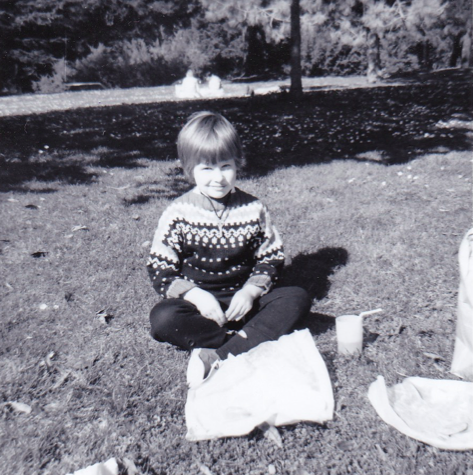
My witty, bright and difficult father would have been 76 today. He was creative and talented, and he had a way with words. He also had serious problems with alcohol and anger, and he treated his child, his wives and his siblings with sarcasm at best, with arrogance and disdain as a matter of course, and with violence at worst. He was very good at one thing, though: he was extremely generous to down-on-their-luck people to whom he owed nothing.

My parents met when they were students at UC Berkeley. When my father was a psychology teaching assistant at Cal, he worked with autistic kids before most people had ever heard of autism, but shortly after he married my mother he became disaffected with his professors and left his promising career in psychology behind. My parents fell in love and married quickly, before my mother realized what a volatile and combative man he could be. My father’s alcoholism became  apparent as soon as they were married, but by the time my mother realized what sort of man she had wed, she was pregnant with me. His violence toward her began even before I was born. By the time I was four months old, he had already hurled his glasses across the room in a fit of rage when I, who had been born two months prematurely and was still  tiny and fragile, would not stop crying. My mother had left me alone with with him for the first and only time during my infancy so she could go grocery shopping. She came home to find him fuming and holding his broken glasses. Mercifully, they separated shortly afterwards. His bad health and alcoholism  were already losing him jobs by then, and he stopped paying child support forever shortly after my first birthday. But my mother realized that even without his help, raising me on her own was the best decision she could have made.

Yet my father was not always bullying, threatening, drinking or shouting. When my mom was pregnant with me, he made me a beautiful cradle out of an old barrel. He was  good at making something useful and beautiful out of nothing. Years later, from discarded bicycle parts he created usable bikes for himself and his poverty-stricken friends so they could have free transportation to school and work. He was disabled by serious health problems and unable to work for more than short periods of time for most of his life, and the benefits he received for being a veteran with serious health problems (he’d lied about his age to enter the Navy at age 16) didn’t go very far. But out of a few hundred dollars a month in disability payments, he paid the rent for his room in a dingy, sad hotel and spent the rest on cheap canned foods, books and used clothes so he could keep himself and his neighbors warm, fed and educated. He fixed their broken appliances, helped them write their résumés, computed their taxes, babysat, and, occasionally, he hid their drugs for them when they were afraid of getting raided by the cops. He had almost no respect for authority, and this caused him enormous problems throughout his life but made him popular with his  troubled friends.

My mom had wisely left him as soon as she realized that his violent streak made him a danger to me, but she welcomed him to our house to pay me visits once I was a precocious toddler who could talk and follow orders. She figured I’d be physically safe around him at that point, and I was. But sometimes he’d show up two hours late, other times not at all. His brother, my beloved Uncle Steve, drove across the Bay Area several times a year to retrieve and sober up my dad, who was sometimes still drunk at 10 a.m.  Steve would make sure my dad took his desperately-needed medications, feed him and calm him. Then Steve chauffered my father to my home and chaperoned our meetings. Steve made jokes to lighten my dad’s spirits and distract me from my father’s dark moods and sarcasm, and he bought us deli sandwiches and took us to parks to walk and talk and look at nature. It was Steve who drove my dad back home and soothed him after we said goodbye. If it weren’t for my dear uncle, I would have almost no memories of my father, and my father would have had little idea of who his sensitive, expressive, hungry-for-approval daughter was.

Dad was angry, bitter, depressed and occasionally delusional, and for years at a time he’d refuse to see or talk to me when he was ashamed of his behavior. He would become angry at me for expressing dismay when he called me in one of his drunken stupors to promise things he would never deliver, to tease and sometimes mock me, and to tell me ugly stories about his raw adventures among the downtrodden. I had to trick him into seeing me and my daughter when she was a baby, and though he fell in love with her immediately, his mental problems caused him to withdraw from us again immediately afterwards. He died a few months later having only met her once. No matter how much I wanted to make him a part of my life, he usually refused. I tried to be as perfect, entertaining and gregarious as possible every time he showed up. I could not call him because he was often without a working phone, but I created elaborate cards and drawings for him, and spent hours decorating the envelopes I sent to him with intricate drawings to try to entice him to communicate with me. It rarely worked, and over time I finally realized that this rejection wasn’t about my value as a person but was based in his own fears, pain and self-loathing.

After he died, I spent a lot of time at the sad hotel in which his life had ended. He was a hoarder, so it took me weeks to clear out his single room of all the tall piles of possessions: the small appliances, the books that covered his bed two feet deep so that he was forced to sleep sitting upright; the canned goods and free weights and dressers full of warm clothes; the manuscripts and letters to the editor and the letters to himself that disclosed the depth of his mental illness to me after his death. But while clearing things out, I met several men who had lived in his building and valued his friendship immensely. They told me of the kindnesses he offered them, and after I’d donated most of his clothes to the thrift shop across the road, I realized I should offer everything else in his room to the men who lived alongside him. They were thrilled to have his typewriters, his radios, his food and books and Playboy magazines.

His friends spoke of him as being both cantankerous and immensely generous. My father’s siblings and my mother, who had known him in better times, were happy to learn that despite burning every familial bridge thoroughly and repeatedly, he had managed to salvage some essential good within himself and show it to a few souls even less fit for the world than he. These stories and his writings, which disclosed to us just how far his thinking had strayed from reality, helped us to recognize how much his retreat from us had been a response to his self-hatred and his fear of harming us again. Though he’d blamed us all for his distance and unkindness at one time or another, we knew that he was picking fights in part to have an excuse to keep away from us to avoid doing further damage to those whom he loved.

No matter how many years I spend trying to understand what made him break so many promises and do so many cruel things, I will never entirely understand what caused him to disintegrate so seriously. But I do know that within him was a man who cared deeply about the earth and about animals, who honored labor and learning, who championed progressive values and believed that we all deserved dignity and respect, even if he himself didn’t always treat others as he should have. He loved me as deeply as he could love anyone in the world, and he was delighted and soothed by having met my baby girl. And as hard as my life has  been at times, I am still grateful that he and my mother gave this life to me, in all of its painful, scary, magical, beautiful glory.

For all his many faults, my father helped to teach me to love nature, wordplay, movies and pickles and storytelling. He helped me to always hold a place in my heart for those who falter, who fail and who are too afraid to reach out for help. He helped me to see why some people self-medicate and don’t communicate with those whom they love most in the world, even when they want to. Through his failures I learned to be more careful about judging those who screw up, to have more respect for those who live on government assistance of one sort or another, and to have sympathy for those who come back from military service plagued with violent thoughts and dangerous tempers. Even when such people disappoint or scare or frustrate me, I can usually remember that underneath it all, they are just fragile people with fears, troubles and pains I can’t understand that cause them to do harm when they want to be helpful, and to break things when they want to build them.

Happy birthday, Dad. Thanks for giving me life.

Star-Lord, You Had Me at Hello

One of the best character introductions in the history of film has to be the title sequence in “Guardians of the Galaxy.” Though we meet young Peter Quill in a scene just before the title, when we first meet grown-up Peter (alias Star-Lord) he’s walking through a forbidding, bombed-out landscape conjuring holographic ghosts of the past before entering an enormous, dank ruin. Then he presses play on his Walkman, his hips start to sway, the title pops up and he joyfully spins, dances and splashes his way past skeletons, uses a hissing lizard-rat as a microphone and hops up a stone stairway to the strains of Redbone’s “Come and Get Your Love.” In two minutes you learn so much about his character: he’s a goofy badass, a joyous loner, a playful rebel. I’ll say one thing about Chris Pratt’s characterization of Star-Lord: it’s perfect.