Much is made of the “Greatest Generation”—the people who fought in World War II and kept the home fires burning. We owe them an enormous debt, and it’s right and good to remember and honor their memories, today and every day. But the generation that fought in World War I was the first to experience the terrible technology of modern war. The millions who fought and died in what was long known as The Great War experienced previously unknown horrors. Those who came home were forever damaged by what they saw and were made to do. The psychic and physical damage done to them was so great that writers of the 1920s like Hemingway and Fitzgerald became famous for their stories of the Lost Generation—people so damaged by the war that they could never again regain their footing on this earth.
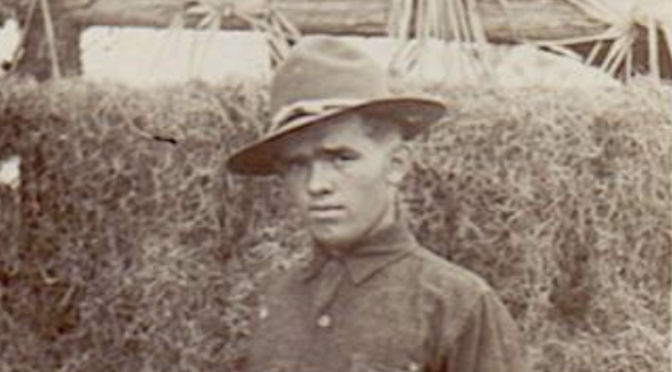
My grandfather was one of the men who went off to World War I, determined and duty-bound. These were his dog tags, given to him when he joined the U. S. Army in 1917. How his German-born mother must have ached as she watched her eldest child (of 10!) go off to fight against the children of those who were once her compatriots.
Grandpa George fought in France, fell in love, and said adieu to his French sweetheart when it was time to go. He sailed back home with his souvenirs, including a mortar shell and a German officer’s helmet. But, as the WWI-era song goes, how are you gonna keep ’em down on the farm (well, in St. Paul) after they’ve seen Paris?
Grandpa followed his younger brothers into the meatpacking business. He spent a little time as a butcher before wanderlust overtook him and adventure called. He rode the rails West, going weeks without bathing while hopping trains and looking for work. When he got to Montana, where he worked on a ranch for a while, he could finally take off his boots to let his feet relax. But when he did, the dime he’d so carefully stored inside his sock was gone! A dime was enough money for a meal, so he undertook a rigorous search.
After a while he realized that the callus he’d developed on his foot had actually grown around the dime. It had been so long since he’d removed his tight boots that his skin had stopped being irritated by the foreign body and just subsumed it. Good thing he had his Army knife on him to cut it out.
Eventually, my grandfather made it back to the Midwest. After a close call with an angry upside-down hog whose hoof nearly slit Grandpa’s throat before Grandpa could slit his, my grandfather left the slaughterhouse business and moved to Detroit, where he became a welder for General Motors. A staunch union member, he was part of a famous strike against General Motors in which GM attacked its own employees who were striking outside in the snow with high-pressure fire-hoses. The extreme pressure of the water knocked the wind out of strikers like my grandfather, who were forced onto the sidewalk and rapidly covered in ice.
When we think of the miseries of working for The Man nowadays, it’s good to keep in mind those who came before us. People like my grandfather stood up for the trade unions who fought successfully for eight-hour days, five-day work weeks, and safety laws that kept employees from dying on the job, or being hunted down by angry employers who didn’t like uppity employees who spoke out for what was fair and just.
Soon enough, Grandpa made the move to Ford Motor Company in nearby Dearborn. There he became their chief tool and die welder, and came up with many inventive improvements that helped Ford better their automobiles (but for which he received no credit or bonuses, of course). But in his decades at Ford, he could afford to buy a new car every few years, and he earned the pension that kept him and my grandmother going after retirement. What’s more, the company bestowed their much-coveted full scholarships on both of his daughters—the first time that two children from the same family ever won Ford Scholarships. They were the first people in their family to go to college, and both made much of their educations, and passed on their parents’ love of education to their own children.
He may only have had an eighth grade education, but my talented (if eternally cranky) first-generation-American grandfather fought for his country, raised and supported his family (and gave his girls the means to excel at college), and became a valued employee of the Ford Motor Company. He read Goethe in German, and Shakespeare in English for fun. Grandpa had seen abominable things, but felt he had no right to do other than fulfill his duty to his country, his family, and his company.
Much of his generation (my dreadfully poor grandparents included) grew up in deep poverty with little to fall back on but cussed determination to make things work. When fascists came to power in the 1930s in Europe, it was my grandparents’ generation who had prepared those of the “Greatest Generation” (like my Uncle Woody) to have the spine and steely determination to do what needed to be done. When we honor those who came before and fought to safeguard our way of life, let’s not forget them.