Let’s
talk about puberty blockers, an essential element of safe and successful
gender-affirming care for transgender youth. Social media, politicians, and
news outlets have shared a great deal of misleading information about what
these drugs do, how they work, and whether they’re dangerous or reversible.
This has even led some U.S. cities and regions to enact legislation against
their use. Tragically, some localities have even established punitive measures
against trans children and the parents who allow them this life-improving and
sometimes even life-sustaining care. So let’s take a look at what they really
are, how they really work, and why they’re such important mental and physical
health tools for many trans kids.
Puberty-blocking
drugs don’t stop puberty for all time; they just stop it for right now. Their
results are reversible. If kids stop using them, puberty resumes. There
is no evidence that puberty blockers affect future fertility, though taking
estrogen or testosterone with them may impact the ability to have children
later.
Puberty blockers were approved by the FDA in 1993. According to Cedars Sinai Medical Centers, they’re considered very safe by the medical community. They may possibly affect height (they may delay growth-plate closure, which can lead to taller adult height), and may slightly lower bone density for some. But so far, research shows the effects to be minimal. Doctors and hospitals are required to provide detailed information about risks and downsides to children and their families before providing them with these medications. People with severe gender dysphoria (i.e., who feel their genders to be different that the one assigned to them at birth) usually feel that living in a body that feels more like them is worth being a little taller, or worth taking bone-strengthening minerals and drugs to avoid osteoporosis later in life.
When children feel strongly that their genders don’t match the ones assigned to them at birth, going through puberty can feel crushing and tragic—a permanent sign to the world to treat them as someone they know they’re not. According to the Mayo Clinic, puberty blocking drugs keep kids from going through major changes (some irreversible) like the development of breasts, body hair, and male genitalia; deepening of the voice; and menstruation.
To
get rid of those signs, many people go through painful, expensive, and
difficult surgery later. But there are certain things that happen to the body
at puberty that may not be reversible even with surgery. Those who undergo
surgery later often experience complications, pain, great expense, and all the
risks that come with surgery and anesthesia. Yet they still don’t have physical
outcomes as successful as they might have if given puberty blockers at the
first signs of puberty.
Puberty
blockers have led to improved mental health, better social interactions with
other kids, and sometimes avoidance of future gender-confirmation surgeries.
The physician information portal HCPLive (which is part of the MJH Life Sciences publishing company) writes, “Investigators said that previous data showed gender-affirming hormones (GAH), puberty blockers (PBs), and gender-affirming surgeries have been found to be independently associated with reduced depression, anxiety and additional adverse mental health outcomes. Puberty blockers administered during puberty can actually reduce suicide risk in this population. A decreased lifetime incidence of suicidal ideation was also found among adults who received access to puberty blockers during adolescence.”
In
short, puberty blockers improve and even save lives. They don’t poison
children, or take away their choices later. These drugs give children the
freedom to delay major health and life choices until adulthood. They align
physical and psychological health, and let children feel more like themselves. Providing
them to children whose lives could be immeasurably improved—even saved—by them makes
them an essential element of pediatric healthcare.
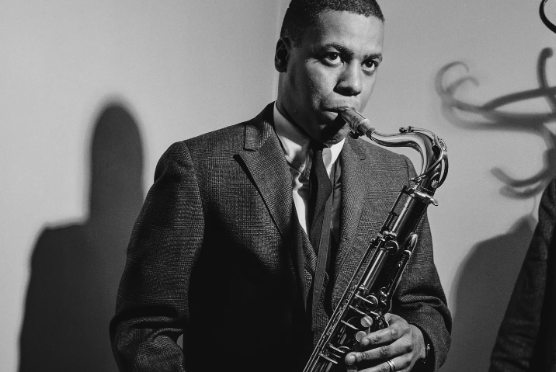
Wayne Shorter played on a number of Joni Mitchell’s best songs, including three tunes on her 1982 album Wild Things Run Fast
Jazz saxophonist and composer Wayne Shorter, who has died at age 89, played with many legends over his long career. An 11-time Grammy Award winner, Shorter played with Art Blakey’s Jazz Messengers, Miles Davis, and Steely Dan, among many others, and he co-founded the jazz instrumental group Weather Report. Although Shorter’s style is distinctive, he was versatile enough to integrate his sound seamlessly with straight-ahead jazz, fusion, progressive, and alternative jazz stylists, as well as with folk and pop soloists and groups.
Some of my favorite Wayne Shorter performances were with Joni Mitchell. Shorter joined Mitchell on ten of her albums, primarily during her middle and later period, after she replaced much of her early, reedy folk sound with a warm, intricate jazz style. As Mitchell’s voice moved into a lower, darker range, Shorter’s sax lines, soaring and sinuous, flew above her voice, tying it together with all the instrumental voices that swirled around her.
A fine example of their collaborative style is the song “Moon at the Window” from Mitchell’s 1982 album Wild Things Run Fast. Another is the moody, marvelous song “Yvette in English,” cowritten by Joni Mitchell and David Crosby for Mitchell’s Grammy Award-winning 1994 album Turbulent Indigo. I can’t imagine this song without Shorter’s trills, floating overhead like Yvette’s cigarette smoke.
The Washington Post obituary for Wayne Shorter describes him as “regarded throughout his career as a nurturer more than a leader.” While his distinctive playing certainly influenced untold jazz musicians over the past seven decades, he may well be best known for how beautifully he integrated his sound and style with others. His collaborations were made so much more beautiful, powerful, and lasting because of Shorter’s willingness to be part of a song’s tapestry, instead of needing to have all eyes and ears on him alone. Jazz and pop music are so much the richer for it.
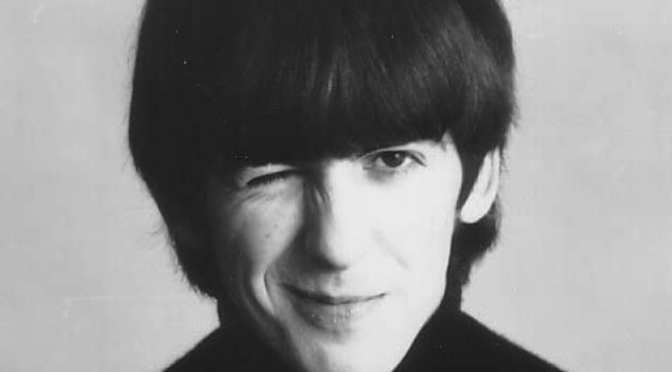
We all know how important George Harrison was to the Beatles’ sound and legacy. But he was also a generous friend, a major philanthropist, and a supporter of children and the arts who came to the aid of others time and time again. George was responsible for inspiring musicians to use their talents and influence to raise awareness and money for people in need, and he founded and funded major charities as well as several classic comedic and dramatic films. Here are just a few examples of George Harrison’s influence above and beyond his musical talents.
Ringo’s Big Brother
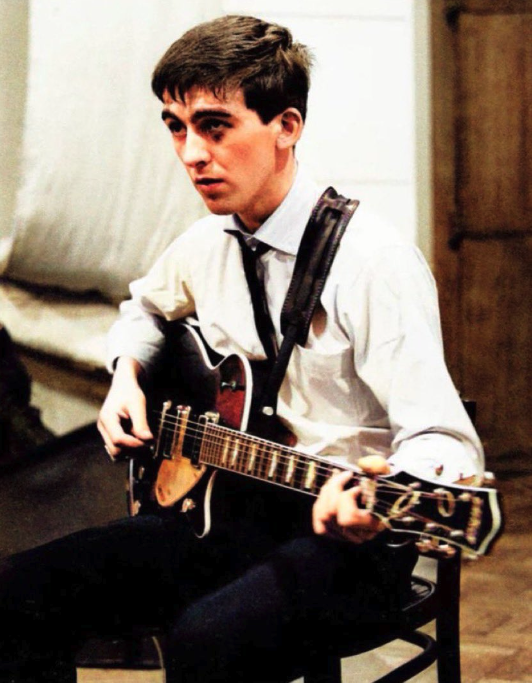
George sported a black eye during his first Abbey Road Studios session in 1962 after protecting Ringo from a violent fan.
During The Beatles’ very first recording session at Abbey Road Studios in 1962, George sported a black eye after getting into a fight defending Ringo from a violent fan who preferred The Beatles’ original drummer, Pete Best. George always had Ringo’s back.
The Concert for Bangladesh
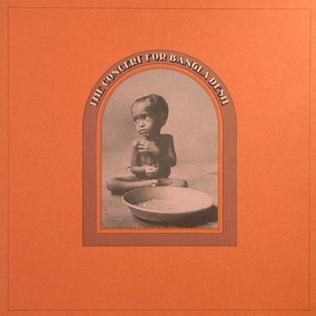
The cover of the three-record album The Concert for Bangla Desh. The concert, film, and album together raised over $12 million for refugees.
In 1971, Ravi Shankar told George about the dire genocidal situation in Bangladesh, and the refugees left homeless by the war there. He asked George if he could think of some way to help them. George said yes, he thought he could do something. That something turned out to be the world’s first giant musical benefit.
The Concert for Bangladesh (actually a pair of concerts) became a huge success and was the inspiration for later benefit events like Live Aid and Farm Aid. The concert and the live album of music performed there by major artists raised millions.
George’s idea inspired other musicians to use their talents to raise money to help others, and produced a megahit three-disc album featuring George, Ravi, Bob Dylan, Ringo Starr, Eric Clapton, Billy Preston, and Leon Russell.
George went on to be involved in a number of other awareness-raising and fundraising efforts as well, including raising money for and recording a song with the supergroup he co-founded, The Traveling Wilburys, to benefit Romanian orphans. He also donated income from several hit songs to Médecins Sans Frontières (Doctors Without Borders), Great Ormond Street Hospital (a major London children’s hospital), and Britain’s National Society for the Prevention of Cruelty to Children.
Major Film Producer
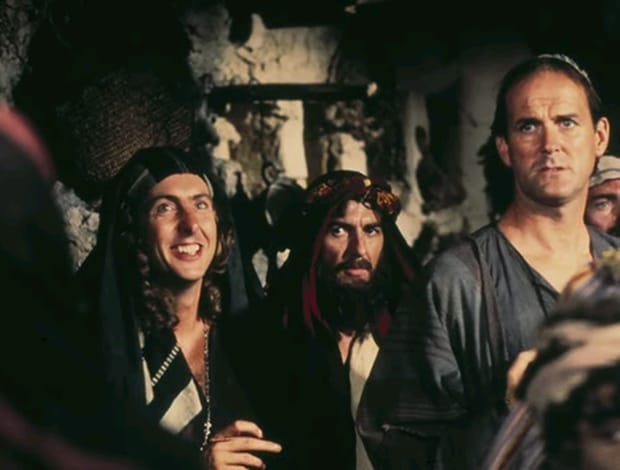
George’s cameo in Life of Brian—Eric Idle is at left, John Cleese is at right.
George befriended the members of Monty Python in the 1970s. He created the production company HandMade Films to produce the film Monty Python’s Life of Brian. His company also produced 22 other films, including The Long Good Friday, Time Bandits, and Withnail and I.
George was a brilliant artist and composer, a loyal friend, a major philanthropist, an example to and supporter of other artists, a popularizer of world music, and a kind and generous soul.
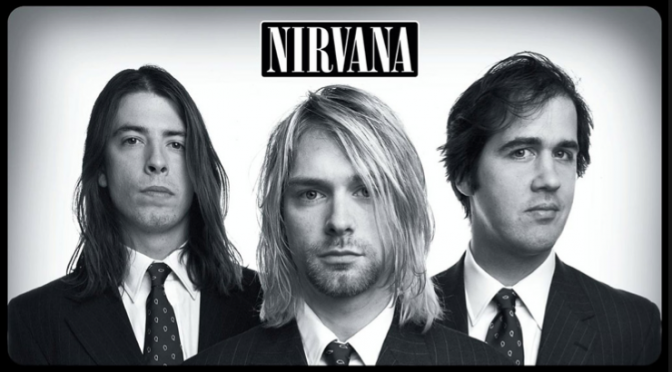
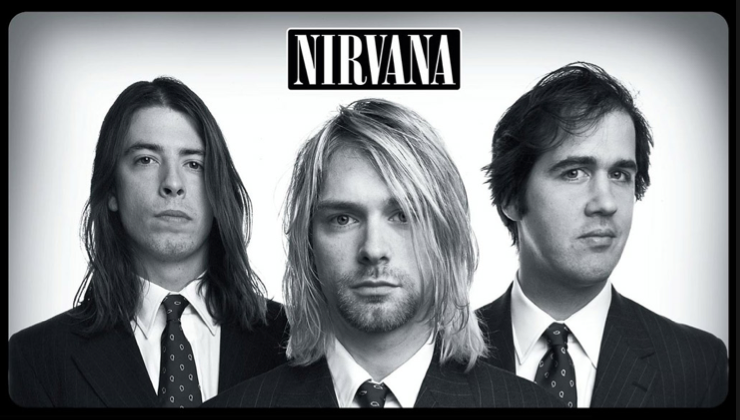
Above: Dave Grohl, Kurt Cobain and Krist Novoselic of Nirvana.
[Revised from the version originally published on this site in 2014.]
With the lights out, it’s less dangerous
Here we are now, entertain us
I feel stupid and contagious
Here we are now, entertain us
A mulatto
An albino
A mosquito
My libido
Yay!
When Nirvana released the song “Smells Like Teen Spirit” in 1991, it helped make them into rock gods. Ironic, isn’t it, since the song was Kurt Cobain’s dig at mainstream culture. According to Nirvana bassist Krist Novoselic, “Kurt really despised the mainstream. That’s what ‘Smells Like Teen Spirit’ was all about: the mass mentality of conformity.” But the song, which Rolling Stone magazine ranked ninth in its list of the 500 Greatest Songs of All Time, was too catchy, sexy, moody, hard to understand, hard-edged, frayed and nearly perfect to escape the clutches of the mainstream. Its hard-to-decipher lyrics were skewered by Weird Al Yankovic in his parody, “Smells Like Nirvana,” which featured lines like:
What is this song all about?
Can’t figure any lyrics out
How do the words to it go?
I wish you’d tell me, I don’t know
In a 1994 MTV interview, Kurt Cobain said of the parody, “Oh, I laughed my butt off. I thought it was one of the funniest things I ever saw. He has some good people working for him. . . . They really know how to reproduce things to the T. He had the exact same setup. It’s the same video with him in it. It’s great.”
The original “Smells Like Teen Spirit” is a perfect blending of droning, captivating, chant-like repetition; buzzing power chords; barely understandable but still compelling lyrics and ragged-voiced angst. It encapsulates suffering, cynicism, dry humor and teen alienation. It felt fresh 15 years ago, and it still sounds fresh and raw today, despite being named the Most Played Video on MTV Europe in the 2000 Guinness Book of World Records. Even though it’s one second over five minutes long, it doesn’t feel drawn out; its pacing, its bridges, even its repetition make it somehow stronger rather than monotonous. The layering of instruments makes for a great, pulsing wash of sound, but within the layers are subtleties, long-held and echoing guitar notes, a threatening bass line, and Cobain’s growling voice matching the bending notes and jagged timbre of the instruments around him, so his voice becomes an instrument to match them. The melding of his own voice and the growling guitar when he says “Yay!” is spookily satisfying, and gave me the same little shiver after the hundredth listen that it gave me the first time.
While the music on Nirvana’s second album, “Nevermind,” from which “Smells Like Teen Spirit” comes, is classified as grunge, it’s really just a polished, pure and more accessible form of punk, slowed down enough to be grabbed and ridden on, but it channels the anarchic spirit of British punks like the Sex Pistols, whose seminal album “Never Mind the Bollocks, Here’s the Sex Pistols” probably inspired Cobain to name the Nirvana album “Nevermind” in their honor. (Some say it’s also a tribute to the Replacements song “Nevermind.”) Unlike American punk bands like the wonderful Ramones, whose screamingly fast-paced songs about sniffing glue and teenage lobotomy patients, punk rockers and beating on brats with baseball bats were essentially all in good, mindless fun, the Sex Pistols really were about anarchy, giving the finger to the establishment, protesting the moral bankruptcy of middle- and upper-class British twits, the monarchy and the conservative political leaders of the 1970s and 1980s. They were the real deal, and Cobain admired that twisted, angry, anarchic vibe.
That punk vibe was bent, reformed and polished into some of Nirvana’s best work, and their songs were musically inventive and attractively melodic enough to grab people who would never give straight punk a second thought while being honest enough to appeal to pure punks as well. “Smells Like Teen Spirit” was essentially a crossover hit, and its success rather embarrassed Cobain, since it made him and Nirvana superstars beyond imagining and, it seems, beyond Cobain’s ability to handle the attention, the adulation, and being co-opted by the mainstream until he became a media darling largely against his will. His drug problems and ultimate suicide of course only fueled his legend and turned him into a mythic figure of alienated youth and artistic purity tarnished by too much interaction with the filthy mainstream, the same mainstream which his widow Courtney Love alternately woos and trashes.
So where does the title come from? Kurt Cobain dated Tobi Vail of the group Bikini Kill, she used Teen Spirit, a deodorant marketed to teen girls. Bikini Kill member Kathleen Hanna painted “Kurt Smells Like Teen Spirit” on his wall to imply that he was marked with his girlfriend’s scent, but Cobain didn’t realize the reference and thought he was being complimented on his spirit of youthful rebellion. Again, how ironic: his anti-mainstream screed also served as inadvertent advertising for a Colgate-Palmolive product aimed at the teen masses.
[2014 version revised from an article originally published in Laura Grey’s Little Hopping Bird blog.]
[Revised from version originally published in April 2015.]
Load up on guns, bring your friends It’s fun to lose and to pretend She’s over bored and self assured Oh no, I know a dirty word
Long before Kurt Cobain displayed the depth of his hopelessness to the world by taking his own life, his fans had known he was suffering. Anyone who has listened to Kurt Cobain sing “Smells Like Teen Spirit” has heard the pain in his voice. Every Nirvana song is built upon a platform of angst—the music, the lyrics, the growls and wails all make the turmoil and drama inside Cobain’s head quite clear and accessible for anyone to hear. This transparency of feeling is what makes Nirvana’s music great and greatly beloved: it taps into a primordial well of anxiety, anger, longing and disillusionment in listeners and makes us feel as if our own personal, raw feelings are being scooped up, wallowed in and worn like warpaint by a rock god for all the world to see.
The obviousness of Cobain’s extreme pain was so evident to millions of people years before his suicide in 1994, so it comes as a shock to watch interviews with his friends and family and see how many cries for help they ignored, how little aid they sought for him, how limited were their resources in guiding him toward hope even after he became one of the most famous people in the world. The very elements of his psyche that made his art so powerful and meaningful to others were the parts that caused him the most misery. His charisma, stubbornness, insularity and difficult personality seem to have paralyzed those who should have seen him clearly and helped him most directly. These same characteristics and his remarkable ability to build a bridge between himself and other disaffected souls brought him a level of scrutiny that made him feel trapped in a dangerous tidal wave of success that he was constantly trying to ignore and retreat from. It’s as if he was hiding in plain sight.
All of this becomes devastatingly clear in Brett Morgen’s excellent HBO documentary Kurt Cobain: Montage of Heck. The first film about Cobain to have the support of his daughter Frances Bean Cobain (who is also one of the film’s executive producers) and her mother, Kurt’s widow Courtney Love, this documentary could never have been made without their treasure trove of audio recordings, videos, home movies, drawings and family photos and access to Cobain’s diaries and notebooks. All of these elements come to life in stunning animated montages that make us feel as if we’re in the room with Kurt, his mom, his wife, his baby and bandmates Krist Novoselic and Dave Grohl. Sometimes we feel as if we’re inside Kurt’s head as well.
His violent and disturbing drawings, his remembrances of distressing moments in his personal history and the pained, sad stories of those with whom he lived and worked make abundantly clear how lonely, frightened and angry he was from a very early age. But the home movies of him as a baby and child show a heartbreakingly sweet and pretty little boy with a beautiful voice. He was hungry for attention and constantly in need of deep soothing that he rarely received. It hurts to see him so fresh and so loved, and to know that his overwhelmed parents, stepmother, siblings and friends had no idea how to deal with his enormous kinetic energy, his destructive impulses or his lack of self-control. The things he needed most—stability, understanding, unconditional love and safe ways to soothe himself—seemed nearly always out of reach, so he went for one dangerous activity, addiction or relationship after another, and that resulted in self-loathing and mental disintegration.
Two interviews really stand out among those in the film. One was with his stepmother, with whom he had a very difficult relationship. She recognized how abandoned and unwanted he must have felt when he was kicked out of his parents’ houses and moved from one to the other, then went off to a grandparent and moved back around through the family again. She expressed regret that she hadn’t recognized his pain at the time but could only be frustrated by his acting out and worried about the effect of his behavior on his siblings. Bandmate Krist Novocelic, long his close friend, expressed great sadness that he was unaware of how serious Kurt’s problems were during his life even though he saw evidence of Kurt’s rage and watched him self-destruct. He says in hindsight it is obvious that Kurt was in extreme pain and that there were numerous red flags and cries for help, but he wasn’t able to recognize their seriousness at the time.
Novocelic also noted something crucial to an understanding of Kurt’s enormous antipathy toward fame and success: he said Kurt had a huge fear of being humiliated. As we watch Kurt in films and videos and hear his words, it becomes clear that he hid his fears with bravado, dark humor, dramatic performances, drugs and acting out. He derided establishment values and behaviors and deliberately set up barriers between himself and those who might have been best able to recognize and help him. And of course, it is that raw, urgent ugliness inside of him that sometimes comes out in gruesome drawings, in his bashing his guitar to smithereens on the battered wood floor of his own house, or in refusing to bathe or wash his hair for days, or living in squalor and backing out of major tours so he could go home to do little but play guitar, have sex and shoot up for days or weeks on end.
It is that very grunginess in his personal life that bled, sometimes almost literally, into his music, and made it so accessible, thrilling and fresh to a youthful audience tired of the smooth, highly produced technopop of the 1980s. Cobain’s squalor and literal stink combined with a vulnerability, a gritty poetic streak and a compulsion to create helped him build a dirtily sexy persona, but they also pushed him into a dangerously intense public world that made him endlessly terrified of being exposed, embarrassed, ridiculed, overadored and ultimately used up. So he used himself up in a hurry before life had a chance to do it to him.
The urge to create and the urge to destroy, including the urge to self-destruct, were always living side by side within Kurt Cobain, and his overwhelmed family members shunted him back and forth among houses a number of times during his childhood, recognizing his neediness but experiencing it always as a destabilizing and dangerous force that they couldn’t control and couldn’t stand. He also had a long history of serious and excruciating abdominal pains that caused extreme and frequent pain and sometimes bloody vomiting, but there was little money available until the end of his life for psychological help or appropriate medical care. So he developed dangerous ways of self-medicating with food, drink and drugs that exacerbated his ill health. By the time he had the money for proper mental health support and medical care, his dangerous habits were well ingrained, and his beloved companion and wife Courtney Love was herself so drug-addled, angry and self-destructive that she could only feed into his addictions and his rejection of others’ attempts to offer help. When her eye started to wander and he recognized that even she, the partner whom he thought understood and loved him better than anyone, was on the verge of betraying him, he lost all hope, attempted suicide, and then successfully finished the job with a gun a few days later.
Why would someone want to sit through two hours of this dark story with so many regretful loved ones sitting stricken in front of the interviewer and recounting their memories with wringing hands and guilty eyes? Because the pain of his story, like the pain in his music, is compelling even as the details are sometimes repellent. Some of his memories, words and images are grim and disturbing, but watching the intimate dynamic between him and Courtney, drug-addled and gritty as it often was, shows why they were drawn to each other—admiration, understanding and humor are all evident, as is a certain pleasure in courting death and mayhem. It hurts to watch him hold his baby Frances with such loving tenderness and read and hear his words of devotion, then later see him barely able to hold her on his lap, so drugged-out and nearly incoherent is he in one awful scene. It is hard to watch knowing that Courtney, a friend filming the scene and another helping with the baby were all present, and, like everyone else in the film, they observed the clear self-destruction of the man but no one either would or perhaps could do anything to pull him back from the brink.
I saw the film in Seattle’s Egyptian Theater, which is right in the neighborhood where Cobain had his last meal. One block from the theater is Linda’s Tavern, where he was last seen alive on the night before he shot himself through the head. The film is currently in a few theaters around the U.S. and in the U.K., and is garnering high praise for its intimate portrayal of the man and his life and his ardent, nearly compulsive need to create. I’m glad to have enjoyed it in a cinema where the never-before-seen concert footage was especially powerful and immersive and the intimate moments felt even more immediate. I’m even gladder that it will be available to so many more via HBO television showings.
While the film has received mostly very good reviews, some have complained that it is uneven and a bit jumbled because of the lack of a narrator and the sometimes abrupt switches between interviews with those who knew him, private film footage, concert footage, images of his writing and art and montages of animation and recordings. Boyd van Hoeij of The Hollywood Reporter wrote that the film is “impressive in parts, but wildly uneven as a whole.” I found this unevenness and the montage style particularly appropriate for the story of a hyperkinetic, often drugged-out man with serious mental and emotional problems. I might have found the style more annoyingly disjointed had it been used to tell the story of a different subject, but in this case the style illustrates how overwhelming it must have felt to live inside of Cobain’s brain and body. The barrage of images and sounds approximate the cacophany of a grunge concert, a life of rock and roll excess and the disabling and endless waves of chronic and extreme physical and emotional pain he felt. All of that is shown amid reminders of how much love and admiration those around him felt and wanted to share with him alongside the frustration and confusion they felt over his extreme emotions and behaviors.
A denial, a denial,a denial,a denial.
The film, which gets its name from a musical collage made by Cobain with a four-track cassette recorder before Nirvana became famous, is no feel-good movie. It is often funny, sometimes darkly beautiful and occasionally mesmerizing, but it is also a very raw view of the life of a dangerously mentally ill and emotionally damaged human being. Even though it shows how difficult and ugly he and his life could be, it also helps us see his vulnerability, humanity and his hunger to create, and it makes clear his devotion to his wife and child.
This film helps to humanize Kurt Cobain without lionizing him. Seeing how far back his deep emotional illnesses went also helps us to empathize with him and feel sympathy along with the disgust his actions sometimes inspire. The film shows how off-puttingly, determinedly filthy, squalid and unhealthy his lifestyle often was (though he and Courtney did sometimes live in luxury hotels in Seattle and elsewhere once they became wealthy), and interviews with his mother and his widow give some glimpse into their own sometimes impaired ability to see how much of a part each of them played in his feeling unsupported and betrayed.
David Fear of Rolling Stone described the film as “the unfiltered Kurt experience,” noting that Cobain is shown “not [as] a spokesman for a generation,” but as “a human being, and a husband, and a father.” Frances Bean Cobain said at the documentary’s premiere in Los Angeles, “After seeing it, I thought I could only watch it once. But the film that [Morgen] made—I didn’t know Kurt, but he would be exceptionally proud of it. It touches some dark subjects, but it provides a basic understanding of who he was as a human, and that’s been lost.”
Looking for effective ways to stop self-defeating behaviors, discover and acknowledge underlying fears and motivations, and build new thought patterns that will improve your confidence and lower stress levels? I know, I know—this sounds like a snake-oil spiel. Actually, cognitive behavioral therapy can teach you to recognize patterns of negative self-talk, then respond to those nasty voices in your head with realistic, fact-based positive alternatives.
By acknowledging your challenges and history, and recognizing the positive elements in the steps you’ve already taken, you can discover hidden strengths and build on unacknowledged successes. You can recognize skills you didn’t realize you had, set realistic goals, and attain them more readily. You’ll learn to recognize negative, judgmental, or defeatist thought patterns, then adjust the way you respond to things that used to trigger you. Building these new skills allows you to be more accepting and kind to yourself and to others. This improves relationships, increases empathy, helps you create stronger bonds with others, and even boosts productivity.
Don’t feel you’re ready to see a therapist? I highly recommend reading the work of psychiatrist and cognitive therapist David D. Burns, MD. His behavioral modification methods have been at the heart of many cognitive behavior programs for over 30 years. His techniques involve recognizing and altering negative and self-defeating behavioral patterns, and you can learn them easily from his book Feeling Good.
Burns, who has taught at Stanford’s School of Medicine, has written several excellent best-selling books on fighting negative self-talk with realistic, fact-based positive alternatives. Years ago, my own therapist recommended his book Feeling Good to me, and I have found his techniques hugely helpful in my own life.
Burns’s work is not about spewing mindless platitudes and bland I-can-do-it positivism. It requires looking directly at the negative things we say to ourselves (and others), then peeking underneath to see what fears and distorted thinking cause such situations. Burns shows us how to counter automatic negative thoughts with relevant, accurate, truthful alternatives; he teaches that we can train ourselves to limit our unconscious and automatic negative self-talk. He shows that there are nearly always alternative ways to see situations that can lead to more positive outcomes in the future.
This book doesn’t take the place of a strong relationship with an excellent therapist. That can go much farther in helping you to develop important insights into your history and your behavior patterns. But Feeling Good is a great place to start, and will give you a wealth of valuable information that you can put into immediate use. And it’s readily available online for under $10.
Feeling Good can help you to better understand the power of cognitive reframing, and discover methods that can help you permanently improve your relationship with yourself and others.
As the holidays approach, I’m reminded of multiple painful Thanksgiving dinners years ago during which I felt forced to spend time with a relative who repeatedly bullied me. She insulted me in my own house, picked fights with me in front of others and blamed me for actions I hadn’t taken, and for words I never said. Ultimately, I refused to be treated that way anymore, and stopped spending holidays with someone who insisted on telling lies about me and attacking me for things I didn’t do. Having to refuse to see her at holidays was very painful, but spending time with someone who claimed to love me yet also berated, insulted and lied to me and about me was worse.
If you find yourself in a situation in which you are dreading holidays because you fear that you will be insulted or attacked, or worry that you will feel trapped and helpless, remember: there is no rule that says you must be with other people at holiday time. We have all been told that spending a holiday alone is terrifying and awful, and that holiday solitude means we are bad or worthless, unloved or unloving. None of that is true.
If you dread the holidays because you fear you have no alternative but to walk into the lion’s den and be eaten, know that it is perfectly okay to stay home (or go away someplace) and celebrate the day in your own way. You can be thankful and be a good person even if you eat a bowl of soup by yourself or with only your partner or immediate family, then take yourself out to a movie. You can sleep in and catch up on your novel, or binge watch your favorite TV show, or listen to podcasts while you do puzzles, or take a long walk with your favorite dog. You can eat spaghetti instead of turkey. You always have options.
The biggest concern about opting out of powerfully painful social interactions is often about how others will view you afterwards: will they shun you, punish you, talk about you behind your back if you don’t attend? They might. Your refusing to attend an event could cause a family rift. Not attending Thanksgiving with your in-laws or sister or dad might mean getting angry phone calls about it later, so there is a trade-off and a risk of future pain. But if you are miserable being with other people because they treat you with contempt or disregard, is that a healthy dynamic to perpetuate? If they (or you) become abusive when provoked, especially in the current political climate when so many of us are fragile, thin-skinned and worried about the future, engaging with others in anger after one too many glasses of holiday wine could be not only emotionally but physically unsafe.
If being with a person, even one whom you love, makes you feel sick, sad, worthless, angry or frustrated and efforts to interact in a healthier way haven’t worked, clinging to that relationship even though it brings out the worst in you and others can be very damaging. Being unwilling to accept another’s bad behavior just because it comes from a family member does not make you monstrous. Avoiding abusive situations is just good self care.
Depression is often exacerbated over the holidays when we compare what we think we need to feel fulfilled with what seems to be available to us. We may be reminded of past hurts, losses, shame and regrets, and they may overwhelm our feelings of love, happiness or safety. If you fear that being with certain people is not safe for you and will bring on destructive feelings toward yourself (or them), remember: you don’t have to engage. You don’t have to attend events. You can have a quiet holiday on your own without falling apart. Others may respond with hurt feelings, and you may have to deal with your own feelings of guilt (often not deserved) if you prioritize your own mental health above placating those who cause you distress. But if you’re an adult, you do have a choice about where you spend your time and with whom. Please don’t put yourself or others in harm’s way.
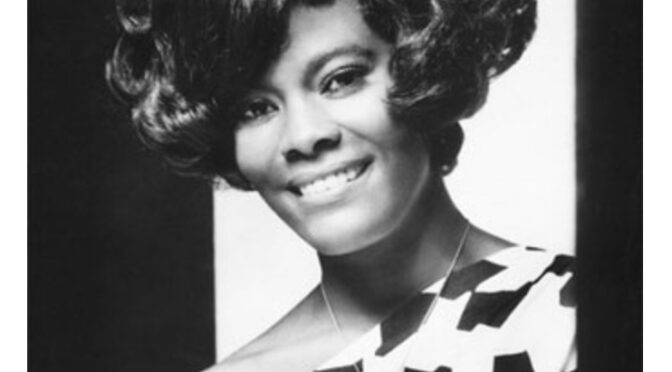
The melding of Dionne Warwick’s voice with songs by Burt Bacharach and Hal David was one of the loveliest things to happen to music in the 1960s. Like her younger cousin Whitney Houston, Miss Warwick had a natural elegance and seeming effortlessness to her performances that belied the skill and preparation behind her work. This serene stylishness was played up in studio recordings and TV appearances. In an exciting video of a very young star performing the hit “Walk on By” live in 1964, that cool grace is mixed with a freshness and verve that really makes me wish I’d seen her perform in person.
But we can still enjoy her wit—her Twitter feed shows that the superstar now affectionately known by many as “Auntie Dionne,” still has plenty of humor and joie de vivre to go around.
Thomas Jefferson was a brilliant but deeply flawed man who viewed only white men as being deserving of the rights of full citizenship. To further his expansionist plans, he began the process of Indian tribal removal from the newly acquired Northwest Territory, which began genocidal policies that ravaged native populations and stripped native people of their rights, homes, and lives. Knowing that slavery was evil, he forced his children born of Sally Hemings, whom he enslaved and impregnated, to live their lives as slaves instead of freeing them.
Jefferson was also a inventor, scholar, writer, and, of course, one of the most prominent of our so-called Founding Fathers. He is considered all-wise and beyond reproach by many Second Amendment fetishists. The so-called originalists on the Supreme Court say we must follow “the founders’ intent,” and base their rulings on the explicitly expressed opinions of rich, white, largely slave-owning men like Jefferson. Justices Alito, Thomas, Gorsuch, and Kavanaugh in particular express a determination to follow the intent of men dead for two centuries unwaveringly, as if they were infallible and holy. This backwards view assumes that no new understanding of humanity or science or the world around us, no historical or cultural shifts—in short, nothing has happened in the past 250 years might justly influence how we see the world.
For all his many grave faults, Jefferson was an educated and worldly man obsessed with expanding his understanding of statecraft, science, human nature, and the world around him. It takes no stretch of the imagination to recognize that the world view of the originalists is antithetical to his values. The idea that all human enlightenment that might influence jurisprudence and improve the new nation he so cherished should end with his own life experience would have shocked and appalled him.
If we play devil’s advocate and assume for a moment that sticking to “the founders’ intent” is a valid way to mete out justice, what Jefferson actually said he believed is of great consequence. If we are to follow his guidance, shouldn’t we consider his intent as expressed in his own writings?
One prominent example of his intent can be found in the words carved into the Jefferson Memorial itself:
“I am not an advocate for frequent changes in laws and constitutions, but laws and institutions must go hand in hand with the progress of the human mind. As that becomes more developed, more enlightened, as new discoveries are made, new truths discovered and manners and opinions change, with the change of circumstances, institutions must advance also to keep pace with the times. We might as well require a man to wear still the coat which fitted him when a boy as a civilized society to remain ever under the regimen of their barbarous ancestors.”
Wired UK and other media outlets report that computer scientists Ahmed Elgammal and Babak Saleh from Rutgers University have developed a visual algorithm which they believe can accurately rank historical artworks according to their creativity. Elgammal and Saleh define creativity as “the originality of the product and its influential value.” They use this definition to create what has been called an art network based on paintings’ (and some sculptures’) similarity to earlier works. Their experiment evaluated a variety of elements including color, texture and type of scenes depicted. Elgammal and Saleh compiled a database of art works from the 1400s to the present and used their algorithm to draw parallels between creative works.
This study, which purports to use computer science to measure the absolute creative worth of over 62,000 original works of art, is highly subjective and filled with inherent bias despite the programmers’ efforts to tease out evaluative absolutes by setting strict criteria. They seem to have assumed that their criteria covered the most important elements of what makes a work original or creative. Sadly, the whole enterprise and is at best flawed and at worst counterproductive to an accurate appraisal and understanding of what makes great works of art great.
A primary problem with such a test is determining what works to include and by which artists. For example, one artist who fared poorly in this project’s evaluation is August Rodin, an immensely popular French sculptor who has had an extraordinary impact on sculptors who came after him. Rodin is best known by the general public for two works, “The Thinker” and “The Kiss,” which are, to my mind, among his less exciting pieces. Indeed, “The Thinker” was conceived as a small part of his masterwork, “The Gates of Hell,” a monumental sculptural bronze work which depicts scenes from Dante’s Inferno, and versions of “The Thinker” appear in each of the cast bronze versions of the gates on display in museums around the world. Those who study and collect art are generally much more excited about “The Gates of Hell” and Rodin’s “Burghers of Calais,” which are considered his most emotionally powerful works. Each was cast in multiple versions and is displayed in numerous locations around the globe.
“The Gates of Hell,” a bronze gate covered in writhing bodies, and the somber collection of chained men dressed in rags that makes up “The Burghers of Calais” are, I would argue, more important to the development of 20th century sculpture than “The Thinker” or “The Kiss.” They are, however, much less well-known among those who only have a cursory interest in art. These more influential works are deeply psychological and disturbing sculptures featuring people in torment, not the placid, pleasing sculptures that those who know little of Rodin’s work may think of when they hear his name. Rodin, who lived a long, passionate and prolific life, created thousands of heads, bodies and body parts of clay and bronze and he created portrait sculptures that sometimes offended those who posed for them with their raw, unfinished, often ugly qualities. For more than a century, serious students of art have studied and copied Rodin’s work and techniques, and his more distorted and disturbing sculptures have been among the most influential works of the last 150 years among modern artists.
If your specialty is programming and not art, you might not know to include those works among your sample. You might choose only his more generally popular works and assume that because they are more frequently copied, photographed or parodied, they are the more important pieces. And if you do that, you’ll get a skewed result, which is exactly what happened.
This study is getting a great deal of attention because of what was written about it by Daniel Culpan of Wired UK and in careless quotations of his work by other publications. Mr. Culpan is not conversant enough with art history to know basic terminology about the discipline. He did not appear to know enough about the subject to challenge some of the computer scientists’ biases and assumptions, and he apparently did not fully read even the short precis of the paper which he seems to have skimmed. He failed to mention, for example, that the artworks include not only paintings but also sculptures. The republication of and references to his article by Ars Technica and Smithsonian both repeat this error. Also, the art historical term “old masters,” which Mr. Culpan apparently erroneously believes means all important artists of the pre-20th century period, actually has a more specific meaning and commonly refers to works painted from approximately the 13th to the 18th centuries, up to about the year 1800.
Two of the artists Culpan describes as “old masters” who rated poorly in the computer assessment of their creativity actually lived and worked significantly after the “old masters” period: Ingres painted in the late 18th and early 19th centuries; Rodin sculpted in the late 19th and early 20th centuries. They are artists we consider to be part of the canon, but Ingres predates the modern era by only a few decades, and Rodin worked during what most art historians would consider to be the modern era.
Some wonder whether this study “proves” that some long-lauded artists might have been overvalued by those who lived before computer-aided evaluations were available. In the cases of Ingres and Rodin, their works (and Rodin’s in particular) are so unlike any others by their contemporaries that they are easily recognizable as having been created by those masters. I would argue that Ingres and especially Rodin were powerfully influential and that they saw things with a different eye than those who came before them. However, they worked primarily with traditional subject matter—figurative portraiture—in recognizable ways; i.e., their subjects’ body parts are generally recognizable as such and appear in the name locations as real body parts do, unlike paintings or sculptures by artists like Picasso, say, who moved eyes and limbs around on the bodies of the subjects he painted.
Sometimes Picasso painted multiple views of the same body part from different angles and incorporated them all into one portrait. Artists like Matisse distorted the colors of body parts, painting faces green or red when it suited him. Such altering of basic elements of human anatomy in one’s art could be considered more creative, and showing creativity (according to this definition) could be considered to be a better or more advanced form of art, or more impressive or important than producing images based more closely on figurative norms. Making recognizable portrait paintings of nobility, as Ingres did, could be seen as less “creative” than building most of one’s oeuvre out of stacked boxes and lines, like Mondrian, or collages, like Braque, or simplifying figures to their essential shapes and distorting them, like Munch or Picasso or Dali or Lichtenstein. But reducing creativity to such simplistic, easily measured or described metrics is unfair and damaging if it allows us to discount the importance, beauty, influence and ineffable magic found in historically earlier, more subtle or more “mainstream” works of art.
Taking these works out of their historical settings does them a disservice in determining how influential they were on the art that followed. The creators of this study tried to determine the influence of artists on those who followed them and to determine how different they were from what came before. But such differences were much more subtle during earlier centuries, and changes in style usually came about more slowly in past centuries than they did from the mid-19th century onward. Changes in art sped up throughout the 20th century, and now there are so many competing styles, media, techniques, mindsets, methodologies and concepts that one can no longer describe a prevailing artistic sensibility as being representative of the modern era. Technology and speed of communications changed artists’ ability to influence each other, and that sped up creativity, by one measure of the term. But since we modern types tend to think of “creativity” as an inherently positive term, I fear conflating the idea that something is “different” and therefore more “creative” in some ways with the idea that it is therefore better or more valuable.
In past times, the differences between two styles of art could be seen as monumentally important to earlier artists or to professional art historians, but those differences might be almost imperceptible to modern people without training and context. For example, Early Renaissance master sculptor Donatello and High Renaissance master sculptor Michelangelo each created important statues of the biblical figure David between about 1440 and 1504, and those who study art history see them as vastly different in feeling, symbolism, strength, influence and style. Someone without training, however, might very well see them as two boring, traditional nude dudes. Someone with no training at all can look at paintings by Salvador Dali, Rene Magritte and Andy Warhol side by side and see that each is different from the other and none is like anything seen before, and by that measure they could be seen as much more original, creative or even valuable than the works of Michelangelo. Each of those artists is hugely important and influential, but to put Magritte into the same category as Michelangelo would be ridiculous and unfair. Michelangelo’s works’ relative similarity to sculptures done by Roman artists 1500 years earlier does not make him a less creative or important or original artist for having copied and appropriated techniques from ancient works so well.
I fear any project that would use loaded terms like “creative” to rank, describe or value artists is likely to mislead those outside of the art world into believing that there are absolutes and discernible metrics that one can use to boil artworks down to their essence and take the guesswork out of determining meaning or value or rank. Such a ranking tool cannot exist because an essential element of art is that it can be valued in multiple ways, and that a work’s value is not solely the price for which it can be sold but is also derived from the meaning it has for the creator and its viewers. One can no more value a work of art than one can a human life. Yes, it can technically be done in a court of law or an auction showroom, but each of us holds a particular person or possession dearer than any court or auction house would, and we would argue that that person’s or thing’s imputed value has nothing to do with the value we sense within our head and heart. That is what makes art great and more complex in meaning than a garden hose or a box of cash. Each of us brings our own meaning to and derives our own value from a work of art in a unique way, and a computer program cannot do that for us.
According to this computerized assessment of relative creativity, Munch’s “The Scream” is on a par with Velazquez’s entire artistic output. In actuality, Munch’s dark, disturbed paintings owe much to the interior moodiness of 17th and 18th century masters like Velazquez and Goya, just as the nihilistic artists and writers of the late 19th and early 20th centuries could not exist without the influence of the writers and artists who came before. To take them out of context and rank them in this raw and bloodless way feels, to me, preposterous.
Margaret Keene’s big-eyed portraits of the 1950s and 1960s were distinctive and immediately recognizable and they inspired many copies. These aspects of her work could be considered signs of great creativity according to descriptions of elements considered by this study. Keene’s works are, however, generally considered to be kitschy, shallow and lacking in artistic merit. Rodin, on the other hand, created rough, lumpy, often ugly portraits that many believed looked half-finished or hideous, but this freshness and openness to a reassessment of what constitutes a completed form had huge influence on modern sculpture. However, most people who know little about art history are only familiar with his statues “The Thinker” and “The Kiss,” which are more smooth, finished and conservative in their style than most of his works and are less appropriate examples of the originality and influence of his work on artists themselves. I think his scoring so poorly on this “test” of creativity better shows the weakness of the creators’ understanding of which works of his should be evaluated and included in the test than it does the level of his creativity.
The project is interesting, and it is heartening to see people in tech fields showing an interest in the fine arts. However, the metrics the project uses to measure artistic merit are biased more toward novelty than quality, and they discount many of the key elements of artworks most prized by professional art historians and collectors. Elgammal and Saleh make so many value judgments based on personal opinion that the result is a controversial evaluative tool of very limited use.