All posts by Laura Grey

Mary Lambert Has No Secrets

Seattle singer and poet Mary Lambert is best known for writing and singing the musical element of Macklemore and Ryan Lewis’s gay rights anthem “Same Love,” a beautiful paean to marriage equality overlaid with Macklemore’s spoken word performance. She performed the song alongside Madonna at this year’s Grammy awards ceremony while Queen Latifah presided over a mass gay wedding. Lambert has also recorded an expanded version of the song without Macklemore’s spoken voiceover called “She Keeps Me Warm.”

Before becoming a singer, Lambert had some success as a spoken-word artist and poetry-slam regular in the late 2000s, and much of her music has that same sort of coiled, hurting, on-the-verge-of-tears feeling to it that is an important element of the poetry slam tradition. Her latest hit song, “Secrets,” is significantly more bouncy than “Same Love,” but no less heartfelt. She begins by listing personal traits that others might be ashamed to own, including her bipolar disorder, her emotionalism, her weight and her lesbianism. But she then embraces these labels, refuses to hide who she is anymore and says she doesn’t care if the world knows what her secrets are. “So what?” she asks with repeated, cheerful defiance. It’s such a positive, openhearted celebration of self-acceptance and tolerance. Shame? Self-loathing? Denial? We’re so over it.

The Bottom Line

Meghan Trainor has been making a lot of money lately, but she’s also been getting flack for her big hit “All About that Bass,” with some reason. The ultra-catchy song and its cute, candy-colored video celebrate women with curves and encourage women to appreciate whatever bodies they have, saying “Every inch of you is perfect from the bottom to the top.” So far, so good. But the song also puts down “skinny bitches” and tells women and girls with a more prominent bass line to feel good about themselves because “boys like a little more booty,” as if their value comes from being ogled by men. So, sadly, the supposed song of empowerment still encourages feelings of competition between women and buys into finding one’s value in another’s gaze. I like it when pop culture moves in the direction of acknowledging beauty in all its forms, and I think it’s great that we’re gaining a greater diversity of cultures under one national roof with the rise of populations of people who don’t value bony booties as much as white folks have tended to do over the past fifty years. It’s great when standards of beauty rise beyond size 2 booty shorts. Songs of praise for bountiful bums are all over the radio right now, and more power to the big-bootied among us. But let’s not turn right around and shame slimmer folks or boil it all down to women’s value coming from body parts and man-pleasing. It’s great to want to please others, but your worth doesn’t derive from the size of your thighs.

Maybelle’s Copper Fixation

Maybelle's copper fixation

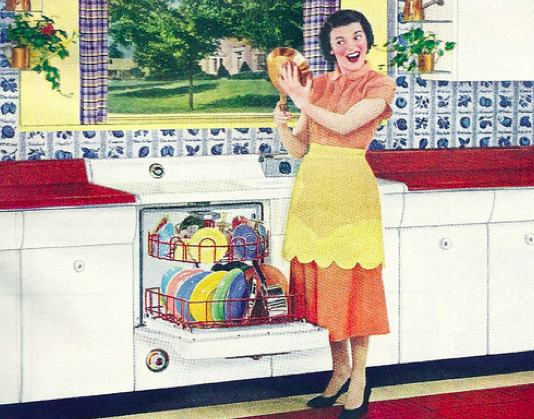
Maybelle hovered over her dishwasher, pleased that she’d coordinated her dress and apron so successfully with her assortment of Fiestaware. Of course the dishes were already clean when she’d arranged them in the appliance, but she so loved the constantly-changing array of cheerful colors that she enjoyed moving them from cupboard to washer to table multiple times throughout each day. And now that the colors were staggered just so and each plate was nestled against its neighbor for a morning nap, she had time to indulge in her special pastime: caressing her copperware! How it gleamed in her hands, reflecting her inner glow and bringing a satisfied blush to her cheeks. This was the life she’d always imagined. In her kitchen filled with metal cabinets, red Formica counters and fruit-themed wallpaper, all she needed to do was don her favorite hostess apron and lifelong happiness was guaranteed. Wasn’t it?

Print ad image circa 1955.

Reading Between the Lines—An Imaginary Romance Novel Excerpt

Bert & Myrtle

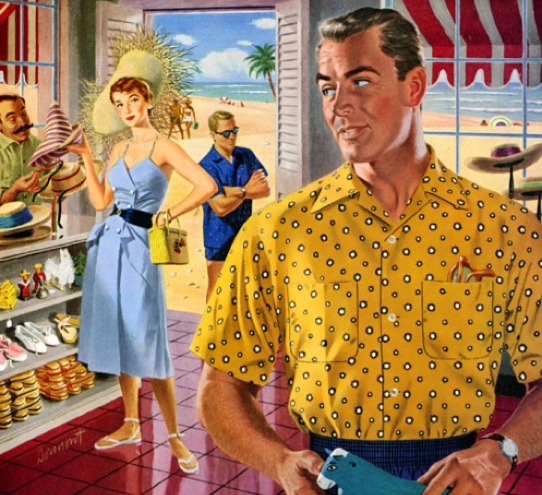
Bert and Myrtle caught each other’s eyes as they absentmindedly ran their fingers over the wares at the beach resort gift shop. Bert fell into a reverie as he imagined a private walk on the beach with the statuesque redhead in the jaunty giant-potato-chip hat. A connoisseur of oversized headgear, Bert longed to present the alluring stranger with the stunning conical striped straw hat currently enjoying her favors—nothing piqued his interest more than a carrot-top in a clown cap. Of course, Myrtle thrilled to the sight of a man in a spotted goldenrod shirt, and the hint of matching tortoiseshell hornrim spectacles in his breast pocket made her light-headed. She found herself terribly distracted by the way he clutched the blue wooden toy to the front of his elastic-waisted plaid shorts, and she wondered dreamily how a toy effigy of Paul Bunyan’s sidekick, Babe the Blue Ox, had ended up on a Mexican beach? So intrigued was she that Myrtle had to steady her trembling hand against her elongated torso, hoping the straw handbag resting against her slim hip set off her figure to good effect. But just then Gunther entered the shop behind her—would he spoil all the fun?

Image by Philip Dormont, late 1950s.

Feeling Good

Nina Simone’s dark, rich, beautifully bluesy version of the song “Feeling Good” is a classic, and with good reason. The version I grew up listening to is also extraordinary, but quite different. The song was written by Anthony Newley and Leslie Bricusse for the musical “The Roar of the Greasepaint—The Smell of the Crowd” and was sung on the original 1965 Broadway cast album by baritone Gilbert Price. His delivery is nothing like Nina Simone’s, yet I find it just as beautiful and arresting as her cover of the song. Few people nowadays know Price’s warm and powerful voice; give it a listen and hear what you’ve been missing.

U2: The Most Popular Unpopular Band in the World

U2 teens

The teenagers who formed U2 in 1976: Adam Clayton, Larry Mullen, Bono (then Paul Hewson), The Edge (then David Evans)

I’m rolling my eyes over the recent international Internet brouhaha over the free download of U2’s latest album “Songs of Innocence” to half a billion iPhone users. People are spewing such torrents of venomous virtual spittle in the direction of both U2 and Apple that one would think Apple had automatically deducted $100 from everyone’s iTunes account or forced a computer virus onto us all to destroy our iPhone software instead of providing millions with a musical gift created by one of the most popular musical groups on earth. I find this manufactured outrage ridiculous and feel embarrassment for the complainers. It’s like finding a magazine you didn’t order in your mailbox or a free box of cookies in your grocery bag—would you complain? Honestly, getting those free gifts would be worse—if you don’t want them, they waste resources, where as digital downloads need only be ignored or erased if they don’t strike your fancy: no calories, no wasted paper, just an intended treat that you can leave alone if it doesn’t bring you pleasure. In most cases, wouldn’t you be delighted to get a little something for nothing that you could sample and perhaps even enjoy?

New Yorker Cartoon of the Day Sept 16

The New Yorker’s Cartoon of the Day, September 16, 2014

Nobody would call this U2’s finest album, but it’s not a flaming pile of garbage, either, and critical response to the actual music is generally positive. It doesn’t have the urgency, intensity, pathos or power of their best work, but some of the songs (“The Miracle (of Joey Ramone),” “Raised by Wolves”) are catchy, pleasant enough and have some of the satisfying, pleasing style and characteristic sounds that have helped U2 sell over 150 million albums worldwide and won them 22 Grammy awards. Bono says they returned to the music of their youth for inspiration. “Songs of Innocence” is a nostalgic look back by the band toward their early years, and its title is an apt reference to a book by the great mystical Romantic poet and artist William Blake. “I found my voice through Joey Ramone,” Bono said in an interview with Rolling Stone, “because I wasn’t the obvious punk-rock singer, or even rock singer. I sang like a girl — which I’m into now, but when I was 17 or 18, I wasn’t sure. And I heard Joey Ramone, who sang like a girl, and that was my way in.”

Yet growing legions seem to be taking great delight in deriding the immensely popular band for, well, everything. But U2 has always had detractors who turned up their noses at their religious, political or social views; hate Bono’s glasses; find the band’s latest tunes derivative; mock Bono’s passionate squawks at the top of his register; find Bono’s warm baritone register pompous; make fun of the Edge’s hidden hairline; thought the band was too rebellious; think the band is too bourgeois; hate them for being too popular; hate them for not supporting the pet cause of the moment; hate them for supporting pet causes too loudly, et cetera, et cetera.

So why the anger at Apple over a surprise gift? Some complain that their privacy was invaded when Apple downloaded content to their phones. (Such silliness; you users agreed to downloads from Apple when you bought your coveted iPhones, and you each got a free present—poor you.) Others are angered because they think that giving away an album for free says somehow that music is worthless and undercuts the value of all downloaded music everywhere. But U2 was paid for their music, just directly by Apple instead of by iPhone owners. Apple and U2 certainly didn’t think the music was worthless—Tim Cook and U2 were proud and excited and felt that they were offering something of great value that would bring people joy. And people did check it out: 33 million users listened to the album in just the first six days after its release. Yet some complained that Apple chose to feature a 38-year-old band whose best years are likely behind them instead of giving a big boost to the career of a new group that hasn’t already earned over a billion dollars in sales of albums and concert tickets. (Pharrell Williams was mentioned in some quarters, but after writing and performing on “Blurred Lines,” “Get Lucky” and “Happy” among other big hits over the past 18 months, hasn’t Pharrell received plenty of attention on his own?)  Apple was trying to share music by a band that already had a huge following, something that many people have shown a great interest in, a band with millions of fans who might otherwise have to shell out good money to buy their latest album, which would have sold respectably had it been sold on iTunes instead of given away. They specifically wanted to feature a really big band because it has a really big fan base, so more people would likely find it a gift of greater value. Furthermore, U2 has a long history of association with the iPod and iTunes. There was even a special U2 edition of the iPod sold in 2006. It seemed to Apple and U2 like a nice nod to their shared history. But thousands of iPhone owners are moaning as if Bono personally deleted Candy Crush Saga and all the contacts from their phones.

Most of the vituperation being shared online is aimed at the band itself, as if it had sent out boxes filled with live snakes instead of agreeing to share its music with vast numbers of listeners, something nearly every band in the world would have been happy to do if given the chance. Why be angry with a group of popular and talented musical artists for trying to widen their reach at no cost to fans or potential fans? The indignation and U2-hatred filling the ether over mass free distribution of art seems to me to be the folly of spoiled owners of luxury goods who are in a mad hurry to find something to rip apart.

To be fair to U2’s detractors, I haven’t owned a new U2 album since I was given “The Joshua Tree” in 1987. While that album was a massive hit, garnering accolades, rave reviews and endless awards, it was never very popular with me. I didn’t dislike it, but it didn’t have the driving, intense fire I had loved in their earlier albums, and from then onward I haven’t followed them very carefully, though their radio ubiquity has meant that I was familiar with all their big hits. I’ve liked most of them well enough. But they didn’t move me like the earlier albums did. By the time U2’s members became international superstars with “The Joshua Tree,” I had been a fan for a long time, listening frequently and with great pleasure to their album “Boy” from 1980 and “War” from 1983. I loved the raw, fresh intensity of their earliest albums, which sounded like no one else’s. Bono’s voice had an urgent power, a ringing, plaintive quality that forced you to listen to it and made you want to know the story behind each lyric. Larry Mullen Jr.’s drums had the precision of a military cadence at times mixed with stunning syncopation. The Edge played with shimmering waves of reverb, his mesmerizing six-note arpeggios washing over each other as they echoed, crashing into each other like waves. Adam Clayton‘s ominous bass lines on songs like “New Year’s Day” grounded all the tenor wailing, squealing guitar and rat-a-tat snare drums that floated above it.

war

U2’s 1983 album “War,” which features the protest song masterpiece “Sunday Bloody Sunday”

The group channelled the Angry Young Man energy that was washing over New Wave and Punk at the time via groups like The Ramones and The Clash and singer-songwriters Elvis Costello and Joe Jackson, and they spun it in their own utterly distinctive way.

By far their greatest song to me, the one that breaks my heart, is “Sunday Bloody Sunday.” The opening track from their 1983 album “War,” “Sunday Bloody Sunday” began with a syncopated, militaristic drumbeat. To get this sound, drummer Larry Mullen did his drumwork at the base of a staircase to produce more natural reverberation in the stairwell. The driving, marching cadence was soon joined by The Edge’s strange banshee guitar howls and piercing electric violin by guest artist Steve Wickham. Then came the plaintive, questioning voice of young Paul Hewson, by then known as Bono Vox (“good voice”) and later just as Bono, asking, demanding, pleading for an end to the brutal  violence and terrorist acts that were then tearing Ireland apart. The song was inspired by the sectarian and nationalist conflict based in Northern Ireland known as The Troubles. Now often referred to as the Northern Ireland Conflict, The Troubles heated up and caused enormous enmity among various British, Northern Irish and Republic of Ireland factions from the late 1960s until the Belfast “Good Friday” Agreement of 1998, and sporadic violence continued afterward despite the official end of the conflict. Terrorist bombings were all too common during this period, and the massive number of closed-circuit video cameras throughout London today are in part the legacy of British efforts to stamp out paramilitary terrorist attacks on London’s popular public gathering places by those who resented what they considered illegitimate rule by Britain over Northern Ireland. Brutality by government forces toward protesters inspired great hatred and many terrorist events and acts of resistance across ethnic, national and political lines. More than 3,600 people were killed during the conflict.

The U2 song is primarily a response to the “Bloody Sunday” incident in Derry, Northern Ireland (known to the British as Londonderry), in which British troops shot and killed unarmed civil rights protesters and bystanders who protested imprisonment without trial. The band said that the song was in response to sectarian violence in general, and they were careful to emphasize that the song was not a rebel song, took no political stance and did not advocate for either side. U2 was anxious to discourage people from hardening their attitudes based on political lines. They hoped to remind people to consider the humanity of all involved and to put treasuring human life above treasuring political philosophy. In concert, Bono has often introduced the song by waving and planting a white flag, the symbol of an end to hostilities and violence. The song became one of their signature tunes, and is among their most beloved songs and most frequently performed concert tunes. Rolling Stone rates it 272nd on their list of “The 500 Greatest Songs of All Time.”

None of the tracks from “Songs of Innocence” is likely to make it onto anyone’s list of 500 greatest songs, but the album doesn’t need to be a milestone in music history to be a worthy effort. And while the members of U2 may be rich and famous and powerful enough to inspire resentment and jealousy from those less fortunate, they are still intensely competitive, creative, talented people whose hunger to perform and share their music has kept them touring and recording for nearly 40 years. They have worked hard and thrilled millions to earn their success; why denigrate them for wanting to continue to do what they love so much and have done so well? I don’t see Paul McCartney being thrown to the dogs for continuing to make albums full of pleasant but certainly not earth-shattering songs sung in a voice well past its prime; why can we not extend the same appreciation to a group of performers who are still creating lovely works that a huge percentage of the world’s population just received as free gifts and many will enjoy? Why not thank the gift horse that has provided us with beauty for all of these years instead of kicking it in the shins?

LauraGrey.com: A Fresh Start

Cuppa

With help from my crack web design team (thanks, Jeff and Lily!) I’m relaunching LauraGrey.com with a new look and new functionality. Now you’ll be able to find my essays, galleries of my artworks and links to interesting videos all in one place instead of going from one site to another. I’m reintroducing the site by including some essays from my blog’s archives; they’ve all been revised and include fresh new links. You’ll also find highlights from my previous online art galleries as well as new images of my recent paintings and assemblages. I look forward to sharing new content with you soon. Enjoy!

Low-Key Lustre, Elegant Beyond Price: Women’s Magazines of the Sixties

Beauty Shop

[Revised from an article originally published in Laura Grey’s Little Hopping Bird blog.]

I recently purchased a great selection of vintage magazines dated from 1960 to 1971 and I’ve been enjoying stepping into the past each time I sit down to read them. My latest vintage magazine adventure has been with the June 1966 issue of McCall’s, the long-running popular women’s magazine. It’s been fun to compare it to the Good Housekeeping magazine from 1960 I wrote about a few weeks ago. In just that six-year span, the advertising copy grew much more florid, less concerned with keeping a perfect household and more concerned with personal sex appeal. I don’t know if it was the popularization of the birth control pill in the early 1960s that caused the subsequent cultural obsession with sexiness that sprouted in the 1960s and 1970s (as many social historians suggest), but the move from wanting a sparkling oven and a perfect meatloaf for one’s husband and children to the quest for bouncier hair, more luxurious nails and more kissable lips for an unnamed man is quite pronounced.

I love the over-the-top ad copy: “Suddenly everyone’s all eyes (and sighs!) over [Max Factor] Shadow Creme. The new glowy-eyed eye shadow that slips on like a dream, because it’s cream!” Adjectives morph into ad-copy-ready verbs to try to add youth and vigor to a phrase: with dreamy creamy eye shadow one can “sleek on a shy narrow line of color.” Or how about the nail polish which will apparently change your life with its heart-stopping, eye-catching beauty? You don’t just brush it on, you slither it on. Not slather, slither: one must apply it sexily, with the thrilling undulations of a snake. Yes, with Revlon Crystalline Nail Enamel, “Even before you slither it on, you’ll see the big difference. . . . On your nails it glows with a soft, low-key lustre. A quiet kind of chic. You’ll be smitten with the deep, velvety quality of it. The plushness. The cover. The delicate—but definite—color. Elegant beyond price.” I’m practically having palpitations just thinking of it.

Not getting enough action, you brown-haired beauties? The problem is with your makeup: you need Clairol Flicker Stick. “This is only for the brunettes who rather enjoy having their hair mussed occasionally. The very first lip gloss for Brunettes Only. Give your lips a lick of something new.” That’s wildly suggestive compared to the ads of 1960 and before. Another rather bold ad features a photo of a man in a business suit with his head and one hand both cropped away and his other hand holding a telephone. The focus of the photo is the man’s crotch, which is shown splay-legged sitting on an office chair. The headline? “If your husband doesn’t lift anything heavier than a telephone, why does he need Jockey support?”

The ad goes on to say that “During a normal day, a man makes a thousand moves that can put sudden strain on areas that require male support. Climbing stairs. Running to catch a bus. Bending. Reaching. Simple things, yet they are the very reasons why every man needs the support and protection that only Jockey brand briefs are designed to provide.” Otherwise, what, he might get a wedgie? Or lose his ability to sire a child because he ran up the stairs too fast? They seem to imply that his very manhood is in peril should he wear the wrong underpants.

The fashion emphasis by 1966 is on younger, fresher, livelier styles. The concern isn’t so much about using the latest and greatest (and shortly-thereafter-to-be-determined dangerous) drugs, pesticides and cleaning agents around the house in an effort to be more chemically controlled and germ-free, as had been so popular in 1960. By 1966 there was more of a desire to spend money and time on disposable products that made living more convenient and fun. The hedonism index rises dramatically during the 1960s, and there’s more of a desire to consume new, specialized products and live for today without concern for the cost or waste involved. There’s definitely a keeping-up-with-the-Joneses kind of jonesing for the latest, hippest disposable new thing.

For example, paper napkins and towels and coordinating tissues and became popular, and having one’s scented, dyed toilet paper match one’s scented, dyed facial tissues was a must. Ads offered bright, bold bath towels with garish flower power colors and patterns, then showed coordinating Lady Scott bathroom and facial tissue with colored flowers printed onto the paper in Bluebell Blue, Camellia Pink, Fern Green and Antique Gold. It’s a “color explosion in towels and napkins.” “Pop! go the colors of Scotkins—newly pepped-up to bring zing to table settings” and “gay bordered towels.” Don’t forget to “Scheme your tables with the vibrant new designs in the first cushioned paper placemats by Scott.” Scheme your tables?

Best of all, “Color explosion flashes into fashion with the paper dress!” For $1 plus a 25 cent handling fee you could buy a paper shift dress in a red and white bandana print or a black and white op-art geometric design. Original “Paper-Caper” dresses, still folded in their original envelopes, are now quite collectible; one of the bandana print was recently available on eBay for $25; another auction house is asking $150 for the op-art version. “Dashingly different at dances or perfectly packaged at picnics. Won’t last forever . . . who cares! Wear it for kicks—then give it the air.” Campbell’s soup cashed in on the disposable dress craze while demonstrating their pop art cred: they sold their own Andy Warhol-inspired paper “Souper Dress” printed with images of Campbell’s soup cans. Each sold for $1 plus two Campbell’s Soup labels in the sixties. Want one now? Ebay recently listed one with a starting price of $749; it sold for $1,125. Missed out on that one? Don’t worry; another has been listed for sale for $2,000.

Paper dresses were available in very simple styles, which were much like most fabric dresses of the day. Most women did at least some home sewing in an effort to economize, and almost all girls were taught to sew and cook in school, so essential were those skills deemed for females of the day. Many dresses were shapeless, boxy shifts, easy for any home sewer to whip up with a pattern bought at the nearest department store. My mother, an accomplished seamstress and knitter, never stopped with simple shifts; she made me wonderful pintucked blouses, perfectly tailored little coats, intricately cable-knitted sweaters and lovely dresses. We spent many happy hours in all the department stores’ sewing sections from as far back as I can remember. We visited the fabric departments of five-and-dimes like TG&Y (which was affectionately nicknamed “Toys, Garbage and Yardage”), popular stores like Mervyn’s and Penney’s, and slightly tonier establishments like the Bay Area’s Emporium-Capwell stores. Every good department store had a fabric section with a wide variety of materials, notions and patterns. Nowadays it’s hard to find fabric stores that aren’t superstore fabric-and-craft chains, and sewing is a niche market attended to by specialty stores only.

I don’t mean to get too personal, but do you remember spray deodorant? Wet and smelly, it got all over everything, spewed fluorocarbons into the air and ended up wasting a lot of product due to overspray, but it was oh, so popular in the sixties and seventies. But how do you market something like that to women? Like this: “Slim, trim, utterly feminine, hardly bitter than your hand . . . new cosmetic RIGHT GUARD in the compact container created just for you.” “Elegant . . . easy to hold, Right Guard is always the perfect personal deodorant because nothing touches you but the spray itself.” What a prissy little product, huh? And for those not-so-fresh moments that can’t be discussed in polite company, there was Quest, “a deodorant only for women.” It was a powder that “makes girdles easier to slip into,” among other things.

Having a separate female version of a product with prettier packaging was very popular: all sorts of spray cans and discreet boxes featured what looked like miniature wallpaper designs, floral themes and delicately drawn feminine profiles of wispy women who appeared unaware that they were being watched while they sniffed daisies (which are rather stinky flowers, actually).

I wish I could still send a quarter to Kotex for the fact-packed booklet titled “Tampons for Moderns.” One can only imagine the bouncy, well-groomed young women in the line drawings that must have illustrated the booklet, which I see in my mind’s eye as having a turquoise cover bearing a confident-looking brunette wearing a fresh white dress. (Such products are often advertised by women in white to emphasize their fresh, clean, pure quality and the idea that you won’t be the unclean mess you’ve been made to think you are if you’ll just use their products.) The booklet must have read a lot like the brochures and booklets I got at school during the seventies, full of “gee, it’s great to be a woman!” ad copy that played up the ease with which one could stay well-groomed, pretty and presentable even when afflicted by the horror of the condition that could barely be hinted at but which every female experienced. A “really, it’s not so bad!” tone lay behind every phrase and the subtle instructional nature of each conversational paragraph was supposed to allay concerns. I think it actually emphasized the unmentionable quality of the subject matter: this stuff is so important and secret, the text implied, you need official instruction books to deal with what every woman from time immemorial has gone through—but we still can’t address any of it head-on.

Before reading this magazine I’d forgotten just how popular hairpieces were in the sixties. They were quite common accessories and supplemented many women’s wardrobes, often with rather ridiculous results. Remember, many women still went to the hairdresser for weekly perms, blow-outs, cuts and curls and slept with their hair in hard plastic or itchy metal-and-nylon brush curlers or pincurls every night, spraying their coifs afresh with new coats of sticky Aqua Net hairspray each morning and avoiding washing their hair for as long as possible between beauty parlor visits. Adding fluffy, braided, curly, straight or poufy switches, falls or wiglets (don’t you love that word?) to the mix wasn’t a big stretch. Long hairpieces, braided or twisted, or fluffy poufs added onto the top or back of a hairdo weren’t uncommon; teasing hair up into domes, small head hillocks or B-52-large beehive cones was a regular thing. I remember women with hair that rose a good four to six inches above their heads and never moved, no matter what the weather did. Women only entered swimming pools without bathing caps in movies; public pools wouldn’t allow a woman or girl to swim unless a rubber cap, often covered in ridiculous colored rubber “petals” that came off and floated in the water, completely covered her head.

Of course, a women’s magazine couldn’t be simply about making oneself prettier for one’s man. A good housewife also had to feed him (using lots of prepared food products) and heat or chill the leftovers in appliances that came in sexy new colors and promised easy-care features. The Admiral Duplex Freezer/Refrigerator ad features eight—count ’em! eight!—exclamation points on one page, so you know it must have been a sensational product. With this fabulous appliance’s automatic ice maker, there’s “no filling, no slopping, no mess.”

But what to feed a hungry man on a hot summer night when you don’t have time to whip up a big batch of sloppy joes with Shilling’s or Lawry’s sloppy joe mix? Meat-laden salads! When housewives of the sixties grew tired of the same old coleslaw, Best Foods Mayonnaise had the answer: hollow out a cabbage, scallop the edges of the emptied cabbage head (with kitchen shears, apparently) and pack it to the brim with coleslaw into which you’ve mixed canned tuna. Or maybe you’d prefer to dollop cottage cheese, celery seeds, shredded carrots and green peppers into your coleslaw? Cottage cheese was plopped on everything in the sixties and seventies, as I remember. The iconic healthy breakfast depicted on TV shows or in ads always included a half-grapefruit with a mound of cottage cheese astride the fruit flesh and a maraschino cherry popped gaily on top. Why anyone would want to consume those three items at the same time was always a mystery to me. What if you’re not into tuna slaw or cottage cheese and cabbage? California coleslaw includes crushed pineapple and quartered marshmallows. To wow the guests at your next picnic, serve this candy-sweet coleslaw in a cabbage cut to look like an Easter basket, complete with orange peel “bow,” as shown in the ad, and you’ll “perk up wilted appetites.”

Of course, not every woman alive in the 1960s was a housewife. Many, like my single mother, worked, whether out of pleasure, necessity or both. But the jury was still out on whether those who didn’t strictly need to work to pay the basic bills had either reason or right to do so. Paying women less than men for equivalent work because it was assumed that their work wasn’t essential to their family’s income was common; refusing to promote them or extend them personal credit that wasn’t cosigned by a husband or other man was also an everyday thing. When my mom bought her own house with her own savings in 1970, it was quite an accomplishment and unusual among the people we knew.

This issue of McCall’s has a letter related to an article about working women published in a prior issue. A reader writes of having worked steadily her whole life out of necessity, but angrily derides the choices of women who work out of a desire to serve, for career fulfillment or for personal satisfaction. “I have nothing but contempt for the wives of prosperous men who, in their own boredom and greed, take jobs away from those who really need to work.” She can’t see the validity of working for personal satisfaction or from a desire to help others or to extend one’s world beyond one’s husband’s sphere. These opposing arguments played out regularly in the court of public opinion (and in courts of law) throughout the next couple of decades as women fought to be allowed the same access to education, employment and advancement without respect to whether they had as much “need” to work as men.

When the woman of 1966 worked too hard and felt depressed over her inability to get ahead on the job, whether at home or out in the world of paid employment, what could she do to find the vim and vigor she needed to get through the day when her get-up-and-go and gotten up and gone? McCall’s had the answer for that, too. Anacin, then a popular over-the-counter headache medicine (and still available at drugstores today), was touted as not just a pain reliever but a mood elevator in an ad with the headine “Casts away gloom, depression . . . as it relieves headache pain fast! Anacin has a combined new action that actually casts away gloom and depression as headache pain goes away in minutes. . . . [F]ortified with a special ‘mood-lifter’ or energizer that brightens your spirits, restores new enthusiasm and drive. With Anacin you experience remarkable all-over relief.” Wow! How did this remarkable wonder drug effect such miraculous changes? What super-effective secret ingredients were at work? Anacin’s remarkable active ingredients amounted to nothing more than aspirin and caffeine. Yes, taking two cheap aspirin and a few cups of coffee would “cast away gloom” and relieve headaches just as quickly. After all these years, now you know.

Sunday on the Pot with George

Sunday on the Pot with George

[Originally published on Laura Grey’s Little Hopping Bird blog .]

We’ve all seen ghastly paintings and prints at garage sales and thrift shops—sad clowns, unflattering portraits, homely florals and trite landscapes—and wondered not only why someone could have considered hanging them in the first place, but also who in the world could have wasted time making such things?

Most bad art is regrettable but forgettable, something we look past rather than at. But some masterpieces of bad art are so remarkably awful, so tasteless, awkward or outlandish that they deserve to be displayed in all their horrific glory. Pieces that bad deserve to hang in a museum of bad art. Happily, there is such a place, just outside of Boston.

The Museum of Bad Art is an actual physical place and is also a wonderful virtual space with its own highly entertaining website. Established in a Boston basement in 1993, MOBA moved to Dedham, Massachusetts, and has expanded and grown into one of the most entertaining sites on the Web. Their collection runs the gamut from shockingly bad portraits to awkward landscapes to disturbing animal pictures. MOBA’s website states, “The pieces in the MOBA collection range from the work of talented artists that have gone awry to works of exuberant, although crude, execution by artists barely in control of the brush. What they all have in common is a special quality that sets them apart in one way or another from the merely incompetent.”

Oh, they’re special all right. An early acquisition and one of two masterworks in the collection is “Lucy in the Field with Flowers,” a vivid and stirring portrait of an elderly woman whose head looks uncomfortably like Norman Mailer’s. Lucy prances through a field of flowers, her legs arrayed as if seated but her body clearly in motion. Her breasts sway in opposite directions under her bright blue dress, which appears to be floating off to one side for no apparent reason.

The Athlete” features a discus thrower described by MOBA’s curatorial staff as “A startling work, and one of the largest crayon on canvas pieces that most people can ever hope to see. The bulging leg muscles, the black shoes, the white socks, the pink toga, all help to make this one of the most popular pieces in the MOBA collection.” I’m also quite fond of “Peter the Kitty,” a painting found in a Salvation Army store, which is, I agree, “Stirring in its portayal of feline angst. Is Peter hungry or contemplating his place in a hungry world? The artist has evoked both hopelessness and glee with his irrational use of negative space.”

Of all the pieces in the collection, my favorite has always been a pointillist tour-de-force done in homage to the genius of George Seurat, whose “A Sunday Afternoon on the Island of La Grande Jatte” was the inspiration for the beautiful Stephen Sondheim musical “Sunday in the Park with George.” MOBA’s “Sunday on the Pot with George” features an rotund older gentleman wearing naught but Y-front underwear sitting on top of what is either a chair swathed in thick blue folds of fabric, or perhaps a melting blue toilet. George’s sagging flesh drips slowly toward his nonexistent feet in cascading red and peach colored blobs of paint, the canvas sizzling and jittering before our eyes. The painting has a lively, psychotic quality. I love it so that I’ve enjoyed it in book, calendar and notecard form—items from the MOBA online store make excellent holiday gifts!

Much as I love the images, the oh-so-serious “interpretations” of the pieces are equally enjoyable. Here’s the caption from a pastel and acrylic piece titled “Inspiration“: “The organ master stares, transfixed by twin mysterious visions: the Neanderthal saint in the setting sun and the Gothic monk proceeding out from the cathedral’s sanctum, each framed by a halo of organ pipes, reminiscent of #2 pencils.”

MOBA truly lives up to its tag line: “Art too bad to be ignored.”

Uninsulated Wires Laid Bare: The Genius of Joni Mitchell

Joni

In 1993, Joni Mitchell painted an impressive self-portrait in the style of Vincent Van Gogh, with Joni wearing the same clothes, in the same position, and even with the bandaged ear shown in one of Van Gogh’s most famous self-portraits. The following year, she released an album with this self-portrait on the cover: Turbulent Indigo. The song of the same title is a dark, angry, stunning homage to Van Gogh. Bold strokes of surprising bass, the brooding undercurrents in Joni’s guitar playing and Wayne Shorter’s splashes of golden sax shimmer throughout the song, sparkling as Van Gogh’s yellows do against his swirls of indigo.

Even without lyrics it would be delicious to listen to, with the roiling darkness and the occasional splash of reedy sax, but the words are some of Joni’s best. She taunts the people who know Van Gogh only for his cheering sunflowers and golden wheatfields and who want a mindless, untortured, chirpy version of Van Gogh in their homes, an easy, breezy Vincent. She mocks those who can afford to collect him now, who have his work in their homes and feel as if they’re somehow close to him as a result, but who would have bolted their doors against the actual man, the depressive, angry, brooding Vincent who sometimes fell into bouts of insanity. In the final verse, she lets him speak:

“I’m a burning hearth,” he said” / People see the smoke / But no one comes to warm themselves / Sloughing off a coat / And all my little landscapes / All my yellow afternoons / Stack up around this vacancy / Like dirty cups and spoons / No mercy Sweet Jesus! / No mercy from Turbulent Indigo.”

Some found Joni bold to paint herself into his most pained self-portrait and to allow herself to speak in “his” voice, as if she were equating her genius or her pain to his. The self-portrait is startling, but well-executed and witty; the song is evidence that she is a genius in her own right.

Those who only paid attention to Joni when she had big radio hits in the 1960s and early 1970s but found her too hard to follow during her later, jazz-infused period missed out on a whole world of beauty. The reedy soprano of her “Blue” album (sometimes touching, sometimes too piercing painful for me to listen to) and her marvelous 1974 album “Court and Spark” mellowed over the years into a burnished, glowing alto. I can hear the cigarettes in her voice, which saddens me, but I do love the richness and warmth of the register she slid slowly into over the years like a hot, perfumed bath.

Her lyrics are intricate, dark and sometimes upsetting, but they’re true poetry, not singsongy filler, like so many songwriters’ words. Some work better for me than others; several songs on the “Turbulent Indigo” album have lyrics that feel forced in places (such as “You Were Not to Blame” in which she lashes out at men who abuse women), while one, co-written with her old friend David Crosby, is a real gem: “Yvette in English.” The tune and words are lyrical and lovely, but the lyrics are especially captivating and poetic. Mitchell and Crosby write of a “wary little stray,” a woman who slips into a Paris café and catches the eye of a man who falls for her instantly, taken by her fragility, her insecurity and the delight of dancing with her. We feel his sadness at having her leave him by a “bony bridge between left and right,” one of the lovely, slender bridges that cross the Seine between the left and right banks. The words and images of this song, the rhythms of Mitchell’s guitar, and Wayne Shorter’s ethereal sax floating above it all make it a song I can rarely listen to without listening to it again, immediately afterward, because I so hate hearing it end. A little taste of it:

“Burgundy nocturne tips and spills / They trot along nicely in the spreading stain / New chills, new thrills / For the old uphill battle / How did he wind up here again? / Walking and talking / Touched and scared / Uninsulated wires left bare / Yvette in English going, / ‘Please have this / Little bit of instant bliss.'”

Mitchell writes movingly, painfully, hauntingly about depression and loss. She can write with humor and joy and raw power, too, but the deep understanding she has of difficulty and vulnerability, of those uninsulated wires laid bare, and the way she underscores them with that slightly ravaged voice, those amazing tunings and chord voicings on her guitar, the surprising rhythms, the way she leaves us hanging with unresolved lyrics or chords at the end of a line—she’s so much more than the folkie of “Both Sides Now” or the esoteric jazz fan of her Mingus years.

Wild Things Run Fast from 1982, and Night Ride Home from 1991 are perhaps my favorites among her albums. Wild Things Run Fast was a revelation after hearing the sometimes screechy, folky Joni of the 1960s. It was an delightful, sometimes funny, sometimes pensive mix of rock and jazz and pop, not what I expected at all. Night Ride Home is an album I can listen to endlessly without tiring of it, especially “Passion Play (When All The Slaves Are Free),” a surprising song about the relationship between Mary Magdalen and Jesus; “Cherokee Louise,” about having a best friend from the wrong side of the tracks who lives a life in turmoil; and the lilting, contented “Night Ride Home,” about the joy of riding through a dark night with a lover over the open road, with the thrumming of crickets all around. When I haven’t heard the rolling, insistent guitar that ripples through “Passion Play” for a few months and I listen to it once more, I get chills all over again.

[Revised from an article originally published on Laura Grey’s Little Hopping Bird blog.]