
Tag Archives: Garage Sales

Why Do People Collect Things?

Since I was a very little girl, I’ve always enjoyed collecting things. I started with books, craft supplies, and stuffed animals, but it soon blossomed into a more expansive and extensive collection. By the time I’d turned 10, I’d already begun going to thrift shops, antique stores, and yard and garage sales to see what treasure I could find among others’ cast-offs. By the time I was in middle school, I was already buying velvet cocktail dresses and 1950s prom dresses from the Salvation Army for $5 apiece. I’d started collecting 1940s perfume bottles, powder compacts, and high heels at hospital thrift shops and the local St. Vincent de Paul outlet by then, too.

None of my friends were into this hobby. But I understood the appeal of it when I saw the things my Aunt Betty found on her weekly garage sale rounds. She was so skilled at finding cast-off treasures to shower the rest of the family with at holidays that the family took to calling her Garage Sale Santa. If you needed something, all you had to do was tell Betty, and she’d find one for you at a garage sale for 50 cents in no time at all.

Though some chic young things were already buying cool old clothes in the 1970s (the Pointer Sisters’ gorgeous 1940s vintage ensembles come to mind), I never heard talk about collecting “vintage” pieces until decades later when the term grew popular. When I was a kid, old clothes were old clothes, and my mom rolled her eyes at my penchant for bringing home a Chinese silk brocade jacket made before I was born, or asking her to turn the beaded satin handmade dress I’d bought into a Halloween costume for me. Why on earth, she asked me, did I want to wear old junk when I could have something new?

Discovering, researching, and learning about histories of objects made before my time has always brought me joy. So much beauty is lost every day when people damage or destroy things they no longer see any point to. I love keeping those things out of the waste stream, cleaning and polishing and mending them, and giving them a new life.

Enjoying more things has always meant more opportunity for discovery and fun, it seemed to me. That more-is-more maximalist streak continued as I got older and began collecting stamps, coins, and records, and later dishes, glassware, and artworks. Along the way I’ve found and dragged home all sorts of odd and interesting old objects, from Edison lightbulbs to antique sewing machines to 75-year-old booklets full of banana recipes. Often they have little to no inherent value to anyone else. But I still treasure them. Other times I’ve found rare and special objects that collectors actually do prize. They were sold or even given away by people who thought they had a garage full of junk. Junk! Can you imagine?

But when does a charming collecting hobby become a hoarding habit? When is it a noble desire to save overlooked handmade beauty from oblivion? And when is it evidence of unbecomingly covetous materialism?

I recently wrote an article about why people collect, what it means, and how their collections affect their lives for At Home with Style, the free online interior design magazine I’ve edited and published for the past few years. I thought it might be interesting to readers beyond my design website’s usual audience, so I’m sharing a link to the article with you here. I hope you enjoy it.

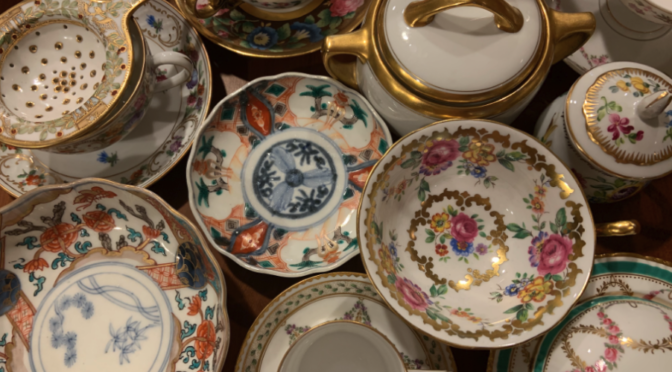
At top:

A few of my favorite vintage and antique porcelain pieces gathered over the years | Photo by Laura Grey
Sunday on the Pot with George

Sunday on the Pot with George

[Originally published on Laura Grey’s Little Hopping Bird blog .]

We’ve all seen ghastly paintings and prints at garage sales and thrift shops—sad clowns, unflattering portraits, homely florals and trite landscapes—and wondered not only why someone could have considered hanging them in the first place, but also who in the world could have wasted time making such things?

Most bad art is regrettable but forgettable, something we look past rather than at. But some masterpieces of bad art are so remarkably awful, so tasteless, awkward or outlandish that they deserve to be displayed in all their horrific glory. Pieces that bad deserve to hang in a museum of bad art. Happily, there is such a place, just outside of Boston.

The Museum of Bad Art is an actual physical place and is also a wonderful virtual space with its own highly entertaining website. Established in a Boston basement in 1993, MOBA moved to Dedham, Massachusetts, and has expanded and grown into one of the most entertaining sites on the Web. Their collection runs the gamut from shockingly bad portraits to awkward landscapes to disturbing animal pictures. MOBA’s website states, “The pieces in the MOBA collection range from the work of talented artists that have gone awry to works of exuberant, although crude, execution by artists barely in control of the brush. What they all have in common is a special quality that sets them apart in one way or another from the merely incompetent.”

Oh, they’re special all right. An early acquisition and one of two masterworks in the collection is “Lucy in the Field with Flowers,” a vivid and stirring portrait of an elderly woman whose head looks uncomfortably like Norman Mailer’s. Lucy prances through a field of flowers, her legs arrayed as if seated but her body clearly in motion. Her breasts sway in opposite directions under her bright blue dress, which appears to be floating off to one side for no apparent reason.

The Athlete” features a discus thrower described by MOBA’s curatorial staff as “A startling work, and one of the largest crayon on canvas pieces that most people can ever hope to see. The bulging leg muscles, the black shoes, the white socks, the pink toga, all help to make this one of the most popular pieces in the MOBA collection.” I’m also quite fond of “Peter the Kitty,” a painting found in a Salvation Army store, which is, I agree, “Stirring in its portayal of feline angst. Is Peter hungry or contemplating his place in a hungry world? The artist has evoked both hopelessness and glee with his irrational use of negative space.”

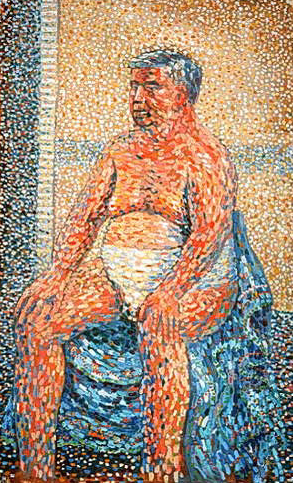
Of all the pieces in the collection, my favorite has always been a pointillist tour-de-force done in homage to the genius of George Seurat, whose “A Sunday Afternoon on the Island of La Grande Jatte” was the inspiration for the beautiful Stephen Sondheim musical “Sunday in the Park with George.” MOBA’s “Sunday on the Pot with George” features an rotund older gentleman wearing naught but Y-front underwear sitting on top of what is either a chair swathed in thick blue folds of fabric, or perhaps a melting blue toilet. George’s sagging flesh drips slowly toward his nonexistent feet in cascading red and peach colored blobs of paint, the canvas sizzling and jittering before our eyes. The painting has a lively, psychotic quality. I love it so that I’ve enjoyed it in book, calendar and notecard form—items from the MOBA online store make excellent holiday gifts!

Much as I love the images, the oh-so-serious “interpretations” of the pieces are equally enjoyable. Here’s the caption from a pastel and acrylic piece titled “Inspiration“: “The organ master stares, transfixed by twin mysterious visions: the Neanderthal saint in the setting sun and the Gothic monk proceeding out from the cathedral’s sanctum, each framed by a halo of organ pipes, reminiscent of #2 pencils.”

MOBA truly lives up to its tag line: “Art too bad to be ignored.”