
Tag Archives: Collecting

Why Do People Collect Things?

Since I was a very little girl, I’ve always enjoyed collecting things. I started with books, craft supplies, and stuffed animals, but it soon blossomed into a more expansive and extensive collection. By the time I’d turned 10, I’d already begun going to thrift shops, antique stores, and yard and garage sales to see what treasure I could find among others’ cast-offs. By the time I was in middle school, I was already buying velvet cocktail dresses and 1950s prom dresses from the Salvation Army for $5 apiece. I’d started collecting 1940s perfume bottles, powder compacts, and high heels at hospital thrift shops and the local St. Vincent de Paul outlet by then, too.

None of my friends were into this hobby. But I understood the appeal of it when I saw the things my Aunt Betty found on her weekly garage sale rounds. She was so skilled at finding cast-off treasures to shower the rest of the family with at holidays that the family took to calling her Garage Sale Santa. If you needed something, all you had to do was tell Betty, and she’d find one for you at a garage sale for 50 cents in no time at all.

Though some chic young things were already buying cool old clothes in the 1970s (the Pointer Sisters’ gorgeous 1940s vintage ensembles come to mind), I never heard talk about collecting “vintage” pieces until decades later when the term grew popular. When I was a kid, old clothes were old clothes, and my mom rolled her eyes at my penchant for bringing home a Chinese silk brocade jacket made before I was born, or asking her to turn the beaded satin handmade dress I’d bought into a Halloween costume for me. Why on earth, she asked me, did I want to wear old junk when I could have something new?

Discovering, researching, and learning about histories of objects made before my time has always brought me joy. So much beauty is lost every day when people damage or destroy things they no longer see any point to. I love keeping those things out of the waste stream, cleaning and polishing and mending them, and giving them a new life.

Enjoying more things has always meant more opportunity for discovery and fun, it seemed to me. That more-is-more maximalist streak continued as I got older and began collecting stamps, coins, and records, and later dishes, glassware, and artworks. Along the way I’ve found and dragged home all sorts of odd and interesting old objects, from Edison lightbulbs to antique sewing machines to 75-year-old booklets full of banana recipes. Often they have little to no inherent value to anyone else. But I still treasure them. Other times I’ve found rare and special objects that collectors actually do prize. They were sold or even given away by people who thought they had a garage full of junk. Junk! Can you imagine?

But when does a charming collecting hobby become a hoarding habit? When is it a noble desire to save overlooked handmade beauty from oblivion? And when is it evidence of unbecomingly covetous materialism?

I recently wrote an article about why people collect, what it means, and how their collections affect their lives for At Home with Style, the free online interior design magazine I’ve edited and published for the past few years. I thought it might be interesting to readers beyond my design website’s usual audience, so I’m sharing a link to the article with you here. I hope you enjoy it.

At top:

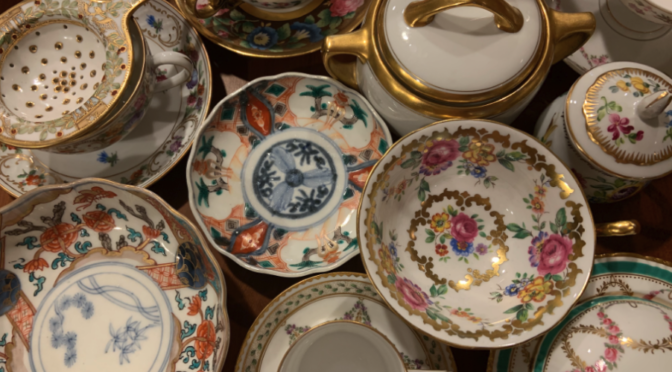
A few of my favorite vintage and antique porcelain pieces gathered over the years | Photo by Laura Grey
Horror Vacui: The Fear of Empty Space

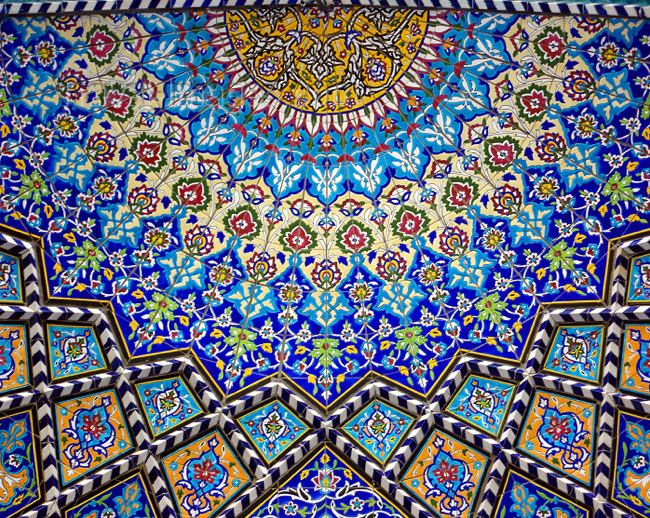
Horror vacui - Mosque Tiles

[Revised from the original article published on Laura Grey’s Little Hopping Bird blog.]

I once heard the late jazz pianist and singer Shirley Horn say that her mentor, trumpet legend Miles Davis, always liked the way she used space in her singing and playing. I liked that description so well, since Shirley Horn was a master of slow, careful, pared down musical expression. There was never an extraneous note in her playing, and she could never be accused of playing anything too quickly. Sometimes there are such long rests between her lyrics that I worry, Shirley, may, never, get, to, the, end, of, the, phrase. But I have to admit that her singing and playing were very elegant, and the lack of adornment does focus the ear and the mind on the sound and the meaning. (And her version of Kermit the Frog’s anthem, “(It’s Not Easy Being) Green” is exquisite.)

I admire minimalism in architecture and fashion, too, but I’d be bored out of my mind living in minimalist clothing and surroundings all the time. My visits to W Hotels and to Ian Schrager’s Paramount and Hudson hotels in New York left me thinking how fun it was to be in such stark, angular spaces for a little while, and how chic and clean the lines are, how pure and streamlined the sensibility was—and how I could never live like that at home.

In autumn and winter I wear a lot of black, and I feel very good in it. I love to travel in black so that strangers can’t tell that I’m a tourist, or where I come from, or what I sat in on the subway. I love the classic, crisp, elegant anonymity of it. But my lavender shoes and my bright pink coat and the crazy, oversized floral patterns on some of my favorite skirts are just as necessary to my wardrobe, and to the vision I have of myself and how I must sometimes present myself to the world.

I think a lot of us fill up the spaces in our lives carelessly to make ourselves and those around us less afraid. We feel we have to talk through an entire visit with a friend, have the TV on in the background, fill every shelf, and try every dish at the buffet. My mom, who found the study of art and art history thrilling, as I do, laughed with me when she realized that the Latin term “horror vacui,” which describes the fear of empty space which makes some artists decorate every inch of a surface, applied to her and to her life as well. She feared too much quiet or extended contemplation in much the same way that she feared a bare wall. She found it too easy to project her fears of inadequacy, loss and emptiness into those spaces, both literal and metaphorical. A lack of adornment meant a lack of value to her; less was less and more was always more. I’m often guilty of this sort of thinking, too. I collect too many things and crave too many distractions, accumulate to fill up voids in my life and avoid winnowing my collections so I can focus on novelty and expansion, on all the things I might do with them in the future, all the possibilities open to me because I have such a collection of stuff. Winnowing would mean admitting that there are limits to my life and its possibilities, that I may never need that unused German language workbook, might not create a work of art incorporating vintage mah jongg tiles and dominoes after all, probably won’t review my Chinese history notes from 1983 again, and don’t need a dozen Depression glass candlestick holders after all, even if they are 70 years old and very cool.

I think there’s an optimism to accumulation and void-filling, a belief that I’ll use this, I’ll enjoy that, my life will be better if I expand and decorate and dress it up with one more thing. I really will be fluent in French someday! It’s not too late to learn to become a goldsmith! Those broken plates could make an amazing mosaic top for a bedside table! I’d always be sad if I got rid of that Singer sewing machine from 1924! But of course, this sort of self-confidence through accumulation bases value on the ephemeral and external rather than on the lasting and innate. Emphasizing that expansive optimism is how our culture justifies binge spending, over-extended credit (both personal and governmental) and constant expansion. It’s a sign of fear and a lack of discipline, I believe; evidence of a fear of growing older, of growing bored or boring, of appearing outdated to others, of having to make do or invest more energy or time in something or someone, of facing what we really are, have, need, or are capable of. Stuff dulls the senses and brings comfort. I love it, but I think it’s time to stare down that horror vacui a little bit, and see what riches I’m missing in my life by focusing too much on the riches that cost me money.