Barcelona’s Sagrada Família, Antoni Gaudí’s Masterpiece

Architect Antoni Gaudí’s masterpiece, Barcelona’s enormous Basilica of the Sagrada Família (Basilica of the Holy Family)—as of 2026, the tallest church in the world—is impressive, original, remarkable. Its light-filled and colorful interior is vibrant and crisply carved; it’s hard to miss the beauty in the interior’s exuberant expressions of joy. But is its agitated, unorthodox, unsettling exterior with its surprising juxtapositions of elements in unexpected shapes, combinations, and mud-colored materials beautiful? Yes, though not in the expected, formal way that medieval Gothic cathedrals or 19th century New England Greek Revival buildings are. It is the strangeness of Sagrada Família’s beauty that makes it so extraordinary. Does that odd beauty amplify the basilica’s message of the power of Christian love? I think it does.

Though I am no longer a person of faith, I was raised in the Christian tradition. I still delight in many aesthetic elements of it—art, architecure, music, storytelling. Today, I approach religious structures like basilicas primarily as artistic and cultural marvels. However, I still feel their emotional resonance, and sense the deep spiritual impacts they have on believers. They still evoke in me strong feelings of respect and awe.
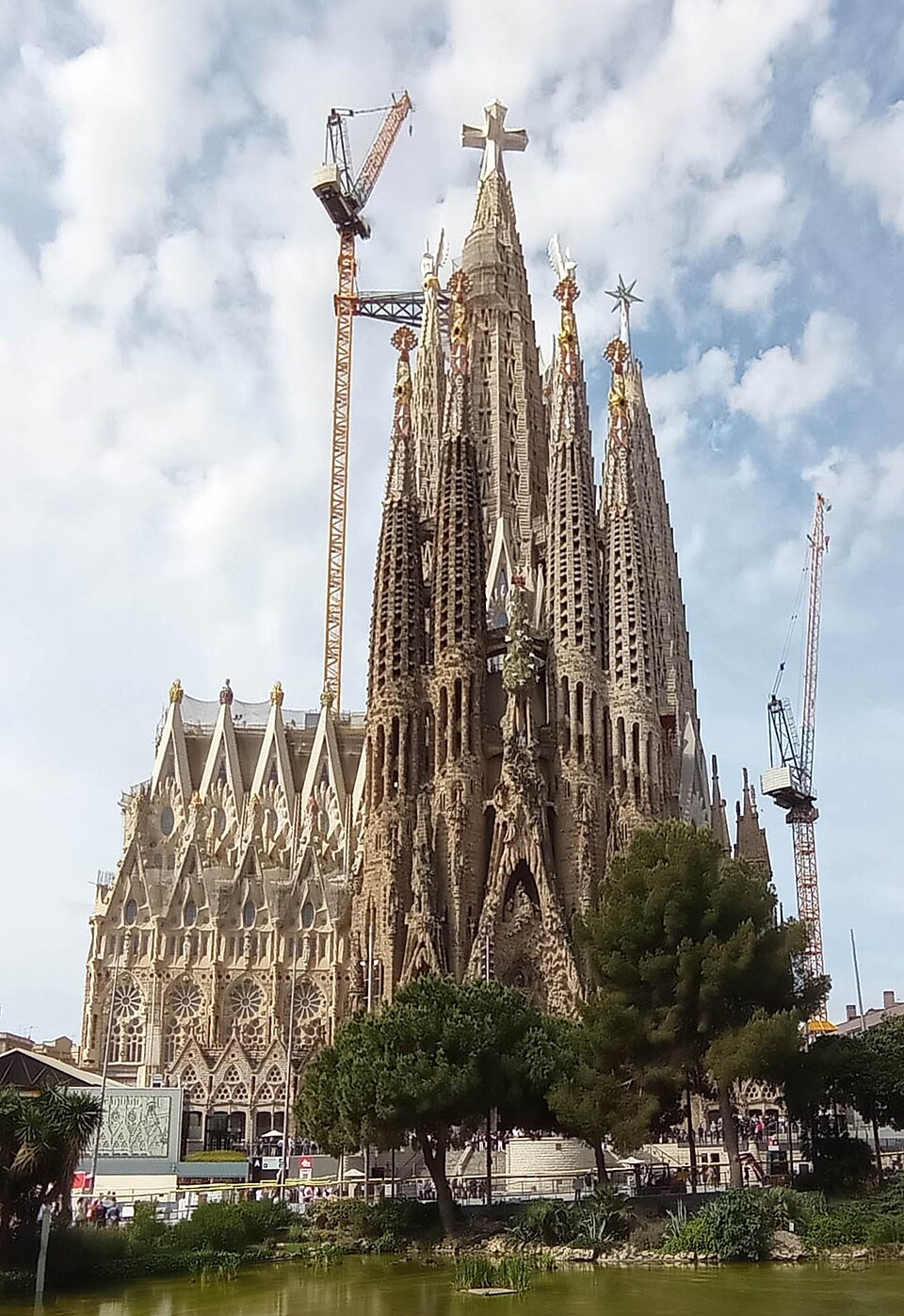
The full height of Sagrada Família is viewed in May 2026, just after its tower was erected. Construction cranes are still in place.
Sagrada Família, in Barcelona, Catalonia, Spain, as seen in May 2026, just after its tower was erected, making it the tallest church in the world | Image via Wikimedia Commons by Canaan, CC BY-SA 4.0

To eyes trained on the crisp lines and exact precision of medieval Gothic cathedrals, the organic and indistinct quality of this Catalan basilica’s undulating and hard-to-decipher surfaces can be confusing, bizarre—even off-putting. The Nativity Façade in particular is full of irregular figures and materials that blend strangely into one another. They do not have the crisply rendered formal expressions of Heavenly majesty and might that medieval stone cathedrals do.

Gothic cathedrals had precise verticals and evenly spaced flying buttresses, each one perfectly reproducing the one before. Gaudí’s religious dioramas are accumulations of images and shapes, some obscured by the sheer volume of activity around them. Though also carefully carved, Gaudi’s basilica gives the sense of being freely sculpted, not carved slowly and precisely into wood or stone. The three-dimensional people and scenes on the exterior feel as if they’d been gathered like mud by human hands, then pressed into the cathedral facade, instead of carved from stone. These sculpted façades have a definite gravity and weight to them; they seem to drip downward from Heaven rather like (forgive me) a muddy and collapsing hillside.
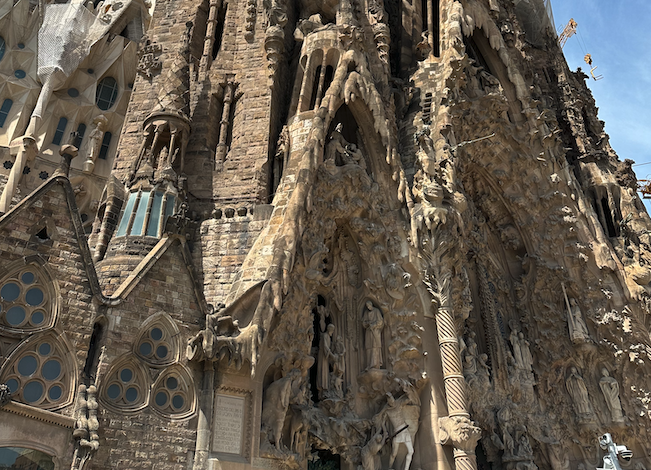
The extreme detail and irregularity of the Nativity Façade is shown in detail. Made of monochromatic mid-toned brown stone, its Gothic windows are pressed closely together, bumping up against chaotic masses of botanical, human, and architectural details over doorways that incorporate columns, turrets, and other structures.
The chaotic Nativity Façade of the exterior of the basilica embeds tiny characters in highly detailed downward cascades that resemble melting clay when viewed from a distance | Laura Grey

Is such an erratic, unexpected, and distinctive agglomeration of elements ugly, bad, or wrong? No! Not to the millions who love Gaudí’s personal, human, and singular vision of the beauty and wonder of his faith and his God. For them, Gaudí’s basilica accomplishes things that such grand structures rarely can. These include evoking feelings of both grandeur and intimacy, and precision and irregularity. The basilica combines the unusual combination of feelings and forces to celebrate the elevation of a human family into a holy one—the beatification and glorification of the most elemental elements of human society: a mother, a father, and a child. In Gaudí’s religious imagery, visitors can recognize their own families, as well as themselves. The greatest, most all-encompassing story in a Christian life, the story of Jesus, is made personal, real, and human by telling it through a structure both more vast than is comprehensible, and also deeply intimate and personal.

Instead of static, precisely defined features, Gaudí’s surfaces feel hand-sculpted and in motion. This quality gives Sagrada Família the feel of a living, breathing entity. It entrances some visitors, and makes them feel closer to the emotional core of Christianity—a very deep and very human love of God inspired by the sacrifice of his human son. Of course, for others, the building’s style and structure evoke feelings of the instability and impermanence that come from relying on humanity’s irregularities and imperfections.

Some visitors revel in Gaudí’s expression of the humanity of God made man in the body of Jesus. They feel the undulating unevenness of the building materials and decorations signify the humanity of Jesus, Mary, and Joseph—the Holy Family for whom the basilica was named.

Others find greater security, awe, and majesty in the precision of more traditional cathedral architecture. They look at a structure like St. Peter’s Basilica in Rome, or Our Lady of Chartres Cathedral in France, and are awed, yes. But they are also amazed that such a remarkable and precise celebration of the glories of Heaven could be accomplished on Earth by thousands of human hands over hundreds of years. They feel the humanity inherent in the majestic structure, too. Just not in the same way.
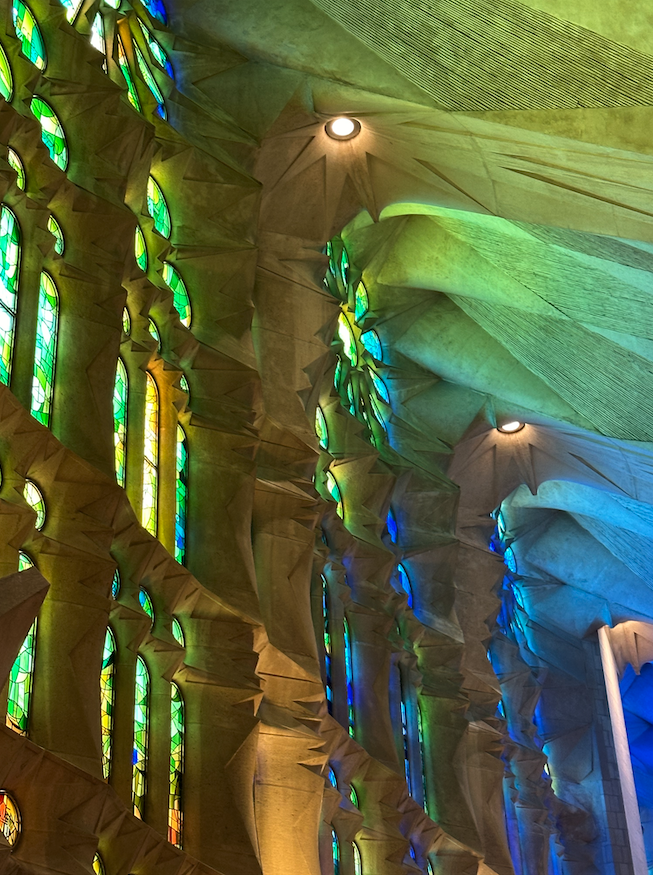
A view halfway down a wall from the ceiling of the Sagrada Família shows the variety of the window sizes, large and small, and the intricately carved stone walls that create hundreds of small angular shadows as lights beam down from above and inward through the glass
Light rushes into the basilica’s interior through blue, green, and yellow stained glass, painting the ceiling and walls with vibrant washes of color | Laura Grey

But whatever one thinks of Gaudí’s exteriors, the interiors of Sagrada Família are another thing entirely! What magical spaces full of jewel-toned light! Standing inside that magnificent space, so different from any other, one can understand how it so often inspires people to feel devotion, awe, and the sensation of a divine presence. Gaudí’s basilica may evoke discomfort because of the organic, undulating, even unstable quality of its exterior. But during the very same visit, its interior brings a sense of delight, ease, and glory through the surprisingly naturalistic forms and colors created inside, thanks to the play of light through its windows and its forest of unusual columns.

In one particular, Sagrada Família has something charming in common with the medieval cathedrals of 900 years ago. One sees evidence of lighthearted humor in Gaudí’s sculpted tortoises and turtles, small but devoted guardians of the basilica that can be found holding up several pillars. The creatures provide welcome lightness and comic relief, as gargoyles or self-portraits of sculptors and architects did on medieval façades. 
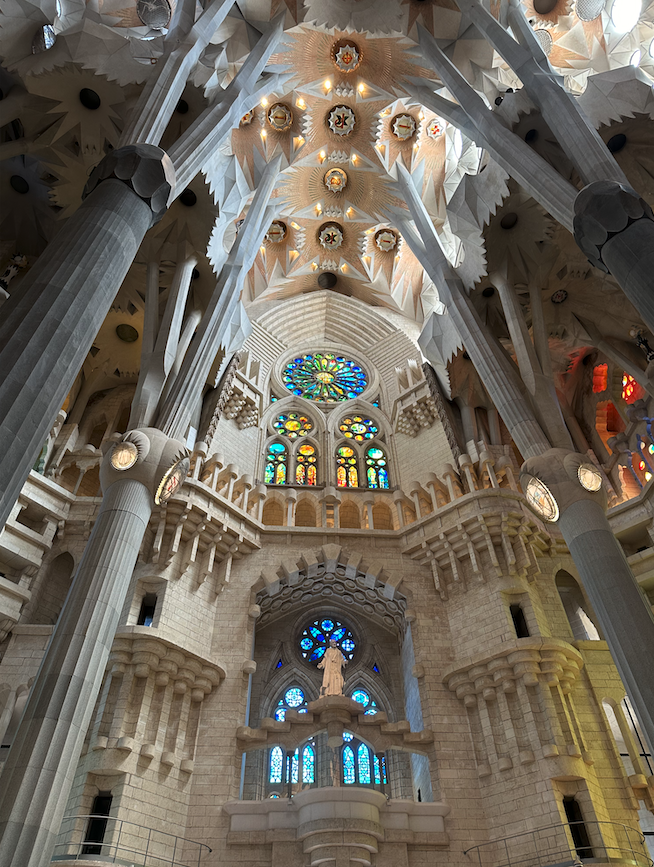
A tall view showing the interior of the basilica from ceiling downward, including Gothic arches and a rose window, a smaller circular window behind a white marble carving of a saint, and tall columns with strange, abstract lights with glass lenses that look rather like eyes surrounded by eyelashes
The basilica incorporates some traditional cathedral structures—rose windows, ceiling bosses, columns, religious sculptures, and Gothic arches—while also introducing distinctly modern architectural details and abstract botanical shapes | Laura Grey

Gaudí had an extraordinary vision for the basilica, for which he became chief architect a year after building was begun in 1882. By the time he died as a result of a tram accident in 1926, he had spent 44 years reshaping the plans and implementing his Gothic and Art Nouveau-inspired designs for the building, which was only one-quarter complete at the time of his death. The basilica is still unfinished, but it is nearing completion. As of 2026, with the raising of the 566-foot-high central Tower of Jesus Christ, Sagrada Família became the world’s tallest church. It was inaugurated and blessed by Pope Leo XIV on June 10, 2026, in honor of the centenary of Gaudí’s death.

Though the cathedral was his greatest work, Gaudí managed to design and oversee the construction of a number of other major buildings, several of which hold UNESCO World Heritage status. These include the Park Güell, the Palau Güell, and the Casa Milà, Casa Vicens, and Casa Batlló; Sagrada Família’s Nativity façade, crypt, and apse; and the crypt of the Colònia Güell in Santa Coloma de Cervelló. The architect is so beloved in Catalonia that a sainthood guild has attempted to canonize him since 1992. In 2025, shortly before his death, Pope Francis declared Gaudí venerable; the Vatican described him as possessing “heroic virtue.”
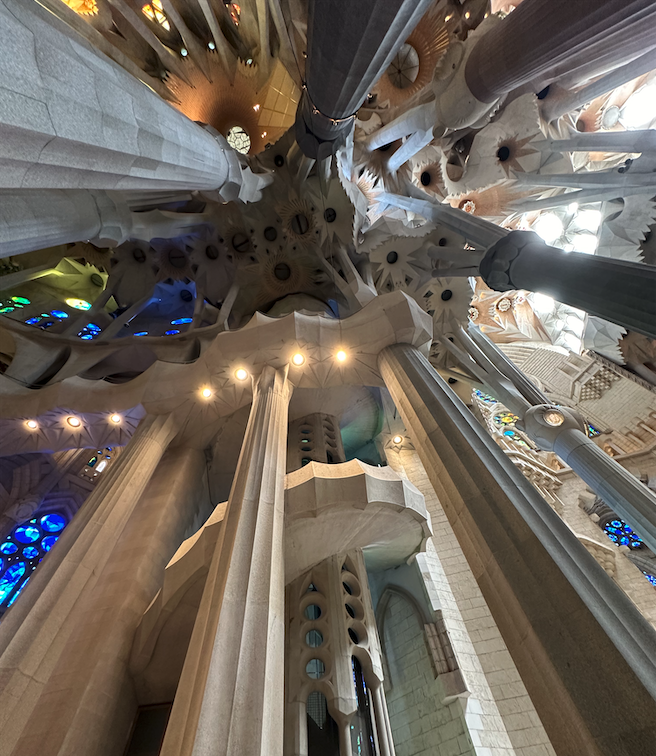
A view of the ceiling includes views of the curving stone stairwells that climb to the ceiling among tree-like columns under bright floodlights that evoke stars in the sky
The sense of controlled chaos, movement, and intricacy of detail that plays out in monochromatic tones outside continues inside, but in a more linear way, and awash in color | Laura Grey

Before visiting Barcelona, I had never experienced such diametrically opposed aesthetic impressions about the interior and the exterior of a house of worship. That dichotomy is part of what makes this structure a masterpiece. There’s the fresh, strange wonder of the mind that envisioned it. And there’s his willingness to escape the linear precision of traditional cathedral architecture and explore a new, if sometimes lumpy, indistinct, even unsettling vision. The softened shapes bring this sacred space closer to the imprecise and organic shapes of nature, human bodies included. Visiting it may even make imagining the experiences of The Holy Family feel more personal and immediate to some visitors, while still expressing the grandeur of God. 

But, of course, what really brought the cathedral to life was a century of talent and faith expressed by the thousands of craftspeople who forced it into being. For an architectural plan is only a dream until the muscles and sinews, eyes and mind, and sweat and strain of those who build it combine to make it real.  

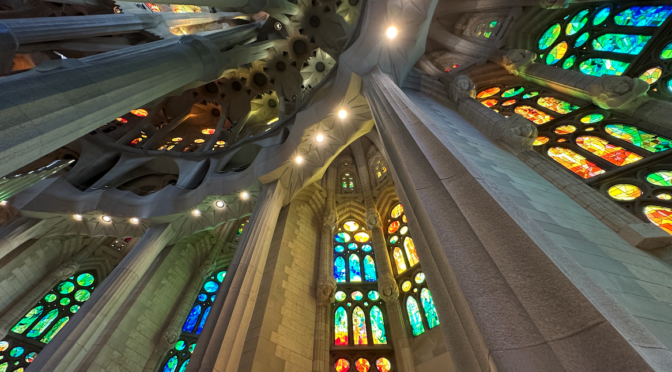
At top:

The interior of the basilica was designed to evoke a forest. According to Gaudí’s vision, each type of column represents a different species of tree. The light that floods the interior reminds one of a colorful garden, or the changing of light from dawn to dusk, or, for some, the glory of God | Laura Grey
Ms. Magazine & Gloria Steinem

Yesterday, journalist, feminist, and activist Gloria Steinem died at her home in New York City at the age of 92. As a profoundly honest, articulate, well-reasoned, tireless, and infinitely patient avatar and explainer of the need for gender equality and women’s rights, particularly during the 1970s and 1980s, Ms. Steinem was a powerful and influential voice. As founding editor of Ms. magazine, Gloria Steinem had a profound and positive impact on U.S. culture.

Last year’s HBO documentary about Ms. magazine, Dear Ms.: A Revolution in Print, explored the history and importance of Steinem and the magazine. Like Ms. Steinem herself, the documentary honestly addressed some of the magazine’s (and mainstream U.S. second-wave feminism’s) shortcomings, particularly the white, straight, middle-class focus of the magazine and the movement in its early days. Steinem and other Ms. founding mothers recognized and acknowledged that they needed to have a broader, more inclusive view of women and feminism, and relinquish some of their own personal vision in order to make room for the views of others under the wide umbrella of feminist thought.

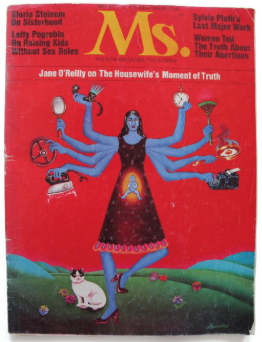
The cover of the first issue of Ms. magazine from spring 1972 features an illustration of a woman with eight arms and blue skin based on the Hindu deity Kali, but wearing a knee-length sleeveless contemporary dress and holding the avatars of modern life for women: a clock, a rake, a pan with a fried egg, a typewriter, a clothes iron, a steering wheel, a hand mirror and a telephone, under the worlds Jane O'Reilly on The Housewife's Moment of Truth. The woman stands on a green hillside next to a pet cat, the sky behind her bright red. The word Ms. is at the top of the cover in golden yellow.
The first issue of Ms. magazine was published in spring 1972

My mother was a charter subscriber to Ms. magazine, the groundbreaking feminist publication that premiered in Spring 1972. As a kid, I read every single copy the minute it arrived every month. I remember when that first issue arrived in the same mail delivery as Women’s Day, Family Circle, and McCall’s, three of the most popular women’s magazines of the day. The difference between those standard, established, housewife-oriented magazines—with their emphasis on homemaking, child rearing, cooking, cleaning, and husband-pleasing—and the empowering, infuriating, and exciting articles in Ms. was as clear as the difference between midday and midnight.

I was a latchkey kid back then, and a precocious one. My serious adult interests made me popular with teachers, but deeply unpopular with my peers. I spent a lot of time by myself at home, reading all manner of things, from literary novels and magazines to the naughty books Mom hid (not very effectively) under her bed. My young, divorced, single mom—a high school English teacher—arrived home about an hour after I did every day from the time I was six years old onward. As the first person home, I was always the one to get the mail, and that gave me first crack at Mom’s magazines. Much as I loved flipping through TIME and LIFE magazines, and searching the back pages of McCall’s to find and cut out the Betsy McCall paper dolls every month (I was, after all, still a little girl), Ms. was the first magazine I read every month. That habit continued from the initial Spring 1972 issue until I gave up on it when it was sold and changed its focus in the 1987.

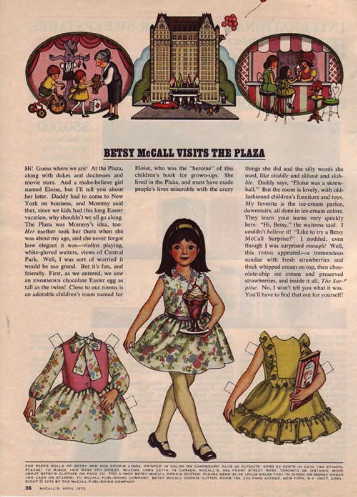
A page from a 1972 issue of McCall's magazine features an illustration showing a little girl in a dress holding an ice cream sundae. This is a paper doll, and she's flanked by two other dresses meant to be cut out and placed over the central image. The surrounding text says Betsy McCall Visits the Plaza and includes two paragraphs explaining the story of the fictional Betsy McCall's New York City adventure at the Plaza Hotel. At the top of the pge are three images from Betsy's day at the Plaza.
Every monthly issue of McCall’s magazine featured a page of Betsy McCall paper dolls for children to play with, like this one from 1972

For fifteen years, I flipped to the back of the magazine before reading another word so I could begin with the “No Comment” page. It consisted of photos of sexist, misogynistic, woman-dominating, infantilizing or pedophilic, insulting, even brutal imagery and messaging from TV, magazines, billboards, corporate PR documents, and other popular media. Seeing evidence of the relentless and ubiquitous yet socially acceptable advertising offensive against women was always shocking and enraging. The images were infuriating, and sent powerful messages about how pervasive sexism was (and still is).

Thus primed to recognize how baked into the system sexism was, I’d start over, returning to the beginning of the issue and reading through every article. There were features on sisterhood, nonsexist child rearing, abortion rights (remember, abortion wasn’t legal across the U.S. until 1973, nearly a year after Ms. first appeared on newsstands), opposing positions on pornography, cultural stereotypes of women, and gender inequality. I’d also read the interviews with feminist writers of different bents, from Andrea Dworkin to Betty Friedan to Angela Davis. I compared my nascent feminist opinions with theirs, often evolving over time as I grew up and saw the world and experienced sexual harassment directly and repeatedly in school, on the job, and simply walking down the street. Ms. helped me see that there were many different flavors, types, and branches of feminism, sometimes in opposition to each other. The magazine took the general position that opinions could, should, and did differ among people of goodwill about what feminism could and should address.

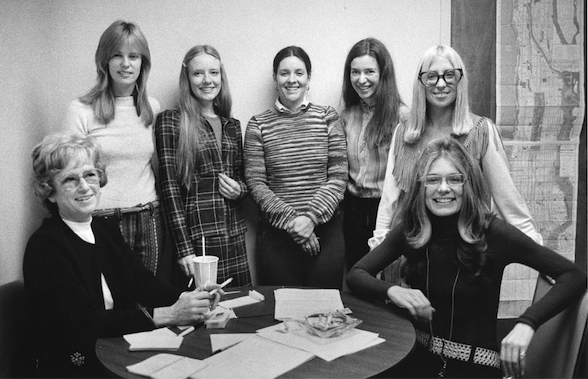
Seven of the founders of Ms, magazine smile and face toward the photographer in this staged photo by Jill Krementz. Gloria Steinem in a black turtleneck sits in a chair next to a round table at right. Letty Cottin Pogrebin and four other women stand behind the table. Another woman sits at the left of the table.
Gloria Steinem with some of the founders of Ms. magazine in 1971, shortly before the publication of the first issue of Ms. in spring 1972 | Photo by Jill Krementz

In the early era of Ms. magazine, two topics in particular were raised repeatedly. One was the definition of feminism, since so many people had negative associations with the word but didn’t understand its actual definition. The other was the proposed ratification of the Equal Rights Amendment (ERA.)

In those days, and even today, many people have refused to call themselves feminists, associating the term with loud, rude, anti-male opinions. However, the textbook definition of feminism is anything but outlandish or offensive to most of us. Feminism is simply the belief in and advocacy of social, political, and economic equality not based on gender. That’s really the whole shebang.

The proposed Equal Rights Amendment would have amended the U.S. Constitution to guarantee equal legal rights for all citizens regardless of gender. Often misrepresented as an effort by man-hating loonies to give women “special rights” or unfair advantages over men, here’s what the ERA actually said, in its entirety:

Section 1. Equality of rights under the law shall not be denied or abridged by the United States or by any State on account of sex.

Section 2. The Congress shall have the power to enforce, by appropriate legislation, the provisions of this article.

Section 3. This amendment shall take effect two years after the date of ratification.

That’s it. The ERA was a simple request for nothing more than legal equality regardless of gender or sex.

First drafted by women’s rights leaders Alice Paul and Crystal Eastman, and first introduced in Congress in December 1923, the proposed ERA went through decades of discussion and debate. In 1971, it was at last approved by the U.S. House of Representatives. After the U.S. Senate approved it the following year, in 1972, it was submitted to U.S. state legislatures for ratification, as required by the U.S. Constitution. Congress required ratification by at least 38 states within seven years. It would seem a foregone conclusion that ratification of such a simple, obviously fair, true, and just statement would have been accomplished well before that deadline. However, Congress had to extend the deadline from 1979 to 1982. And even after ten years of public debate, both deadlines passed and the ERA was still three votes short of the necessary 38 states in 1982. As of 2026, the ERA has still not been ratified, and the Constitution still does not guarantee equality to all without regard to gender.

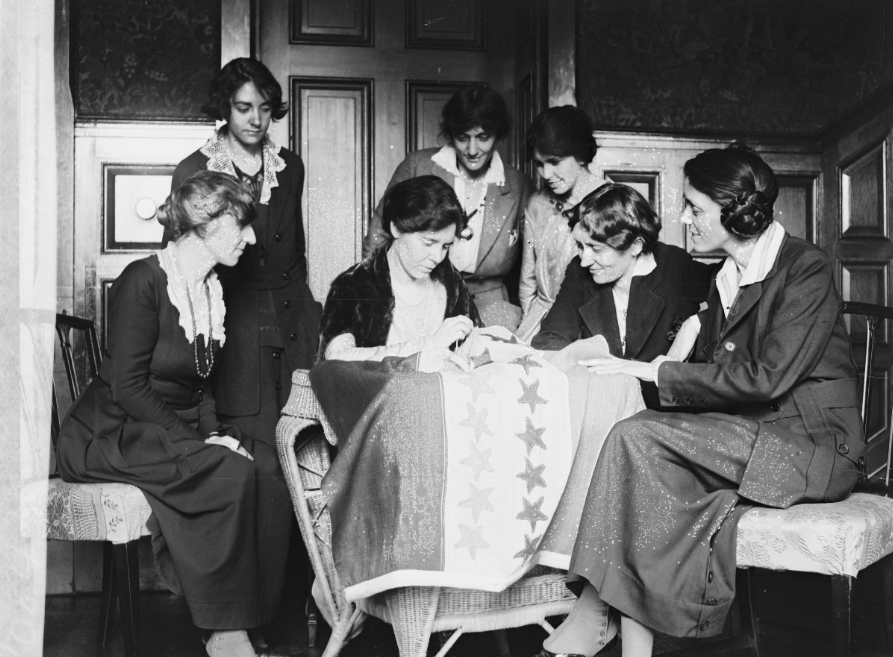
A black and white photo of seven young women sitting or standing around a wicker table over which is draped a suffrage flag, representing the fight for votes for women. Alice Paul sits at the center sewing a star on the flag.
Alice Paul, Crystal Eastman, and others sew a suffrage flag in support of votes for women, early 1920s

Gloria Steinem was certainly not the only well-spoken feminist of note to emerge as a thought leader and influencer (to use annoying contemporary terms) in the 1960s and 1970s. However, Ms. Steinem had great charisma, impressive composure and gravitas, and an uncanny ability to receive and deflect even the most egregiously offensive, condescending, insulting, infantilizing, and sexist attacks—many of them quite personal—in any setting. As the most prominent U.S. proponent of feminism in that era, she was seemingly everywhere, always responding with reason, wit, and specificity that left those who sought to degrade and wound her sputtering, red-faced, and laughable. They couldn’t hold a candle to her factual, well-reasoned, dignified message or delivery.

Ms. Steinem was conventionally beautiful enough to have passed as a Playboy bunny while undercover to write an expose about Hugh Hefner’s Playboy empire in the 1960s. But her physical attractiveness and beautifully modulated voice were actually stealth weapons against her detractors. Combined with her preternaturally calm demeanor and her skill with debate, her skills and attributes attracted positive attention, first to her, then to the subject of women’s rights and gender equality. They also gave the lie to the sexist stereotypes of feminists as being shrieking, irrational, and unattractive. It was always a joy to watch her surprise her ignorant antagonists by skillfully defending feminism in debates with everyone from sputtering attack columnists to sexist public intellectuals like Norman Mailer and William F. Buckley.

Today’s U.S. feminist discourse is more balanced, varied, and integrated across racial, cultural, and gender lines, and is more inclusive of all sexualities and multiple types of opinion than it was during Gloria Steinem’s most public era. But her life’s work continues to have a deep and lasting positive influence on feminist discourse. Ms. Steinem expanded and expressed her understanding of different feminist viewpoints, lifted up others who support the goals of feminism, and educated, inspired, and built a more egalitarian and respectful world for us all provide us all. What a powerful and lasting legacy.

At top:

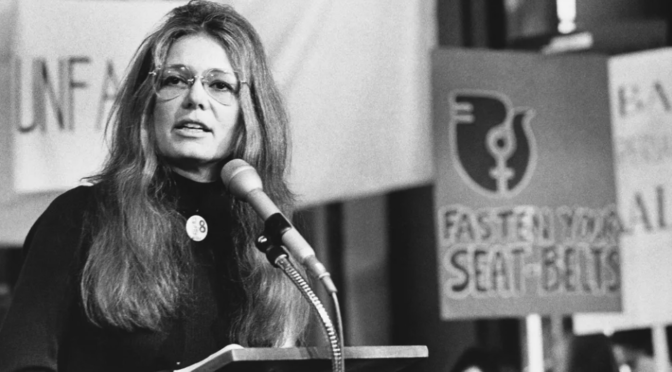
Gloria Steinem addresses a feminist rally, early 1970s