Tag Archives: Seventies

Ms. Magazine & Gloria Steinem

Yesterday, journalist, feminist, and activist Gloria Steinem died at her home in New York City at the age of 92. As a profoundly honest, articulate, well-reasoned, tireless, and infinitely patient avatar and explainer of the need for gender equality and women’s rights, particularly during the 1970s and 1980s, Ms. Steinem was a powerful and influential voice. As founding editor of Ms. magazine, Gloria Steinem had a profound and positive impact on U.S. culture.

Last year’s HBO documentary about Ms. magazine, Dear Ms.: A Revolution in Print, explored the history and importance of Steinem and the magazine. Like Ms. Steinem herself, the documentary honestly addressed some of the magazine’s (and mainstream U.S. second-wave feminism’s) shortcomings, particularly the white, straight, middle-class focus of the magazine and the movement in its early days. Steinem and other Ms. founding mothers recognized and acknowledged that they needed to have a broader, more inclusive view of women and feminism, and relinquish some of their own personal vision in order to make room for the views of others under the wide umbrella of feminist thought.
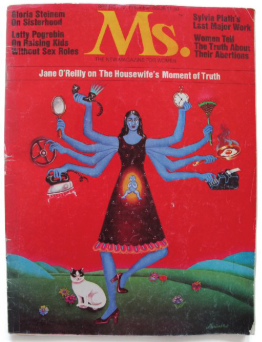
The cover of the first issue of Ms. magazine from spring 1972 features an illustration of a woman with eight arms and blue skin based on the Hindu deity Kali, but wearing a knee-length sleeveless contemporary dress and holding the avatars of modern life for women: a clock, a rake, a pan with a fried egg, a typewriter, a clothes iron, a steering wheel, a hand mirror and a telephone, under the worlds Jane O'Reilly on The Housewife's Moment of Truth. The woman stands on a green hillside next to a pet cat, the sky behind her bright red. The word Ms. is at the top of the cover in golden yellow.
The first issue of Ms. magazine was published in spring 1972

My mother was a charter subscriber to Ms. magazine, the groundbreaking feminist publication that premiered in Spring 1972. As a kid, I read every single copy the minute it arrived every month. I remember when that first issue arrived in the same mail delivery as Women’s Day, Family Circle, and McCall’s, three of the most popular women’s magazines of the day. The difference between those standard, established, housewife-oriented magazines—with their emphasis on homemaking, child rearing, cooking, cleaning, and husband-pleasing—and the empowering, infuriating, and exciting articles in Ms. was as clear as the difference between midday and midnight.

I was a latchkey kid back then, and a precocious one. My serious adult interests made me popular with teachers, but deeply unpopular with my peers. I spent a lot of time by myself at home, reading all manner of things, from literary novels and magazines to the naughty books Mom hid (not very effectively) under her bed. My young, divorced, single mom—a high school English teacher—arrived home about an hour after I did every day from the time I was six years old onward. As the first person home, I was always the one to get the mail, and that gave me first crack at Mom’s magazines. Much as I loved flipping through TIME and LIFE magazines, and searching the back pages of McCall’s to find and cut out the Betsy McCall paper dolls every month (I was, after all, still a little girl), Ms. was the first magazine I read every month. That habit continued from the initial Spring 1972 issue until I gave up on it when it was sold and changed its focus in the 1987.
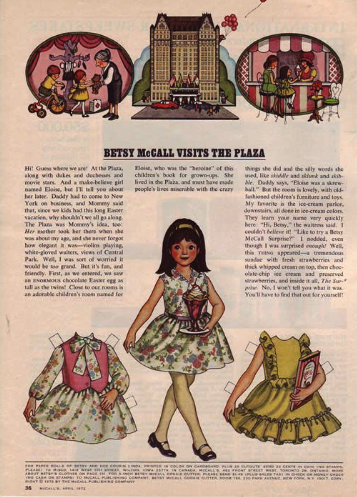
A page from a 1972 issue of McCall's magazine features an illustration showing a little girl in a dress holding an ice cream sundae. This is a paper doll, and she's flanked by two other dresses meant to be cut out and placed over the central image. The surrounding text says Betsy McCall Visits the Plaza and includes two paragraphs explaining the story of the fictional Betsy McCall's New York City adventure at the Plaza Hotel. At the top of the pge are three images from Betsy's day at the Plaza.
Every monthly issue of McCall’s magazine featured a page of Betsy McCall paper dolls for children to play with, like this one from 1972

For fifteen years, I flipped to the back of the magazine before reading another word so I could begin with the “No Comment” page. It consisted of photos of sexist, misogynistic, woman-dominating, infantilizing or pedophilic, insulting, even brutal imagery and messaging from TV, magazines, billboards, corporate PR documents, and other popular media. Seeing evidence of the relentless and ubiquitous yet socially acceptable advertising offensive against women was always shocking and enraging. The images were infuriating, and sent powerful messages about how pervasive sexism was (and still is).

Thus primed to recognize how baked into the system sexism was, I’d start over, returning to the beginning of the issue and reading through every article. There were features on sisterhood, nonsexist child rearing, abortion rights (remember, abortion wasn’t legal across the U.S. until 1973, nearly a year after Ms. first appeared on newsstands), opposing positions on pornography, cultural stereotypes of women, and gender inequality. I’d also read the interviews with feminist writers of different bents, from Andrea Dworkin to Betty Friedan to Angela Davis. I compared my nascent feminist opinions with theirs, often evolving over time as I grew up and saw the world and experienced sexual harassment directly and repeatedly in school, on the job, and simply walking down the street. Ms. helped me see that there were many different flavors, types, and branches of feminism, sometimes in opposition to each other. The magazine took the general position that opinions could, should, and did differ among people of goodwill about what feminism could and should address.
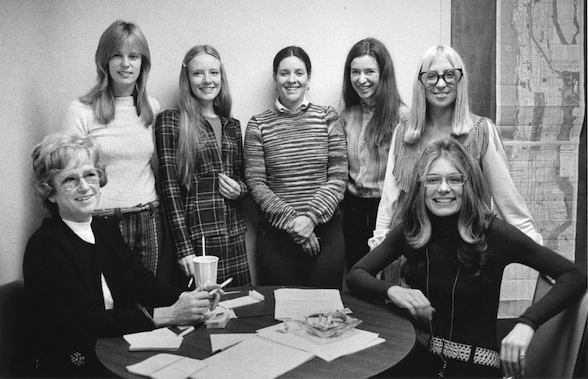
Seven of the founders of Ms, magazine smile and face toward the photographer in this staged photo by Jill Krementz. Gloria Steinem in a black turtleneck sits in a chair next to a round table at right. Letty Cottin Pogrebin and four other women stand behind the table. Another woman sits at the left of the table.
Gloria Steinem with some of the founders of Ms. magazine in 1971, shortly before the publication of the first issue of Ms. in spring 1972 | Photo by Jill Krementz

In the early era of Ms. magazine, two topics in particular were raised repeatedly. One was the definition of feminism, since so many people had negative associations with the word but didn’t understand its actual definition. The other was the proposed ratification of the Equal Rights Amendment (ERA.)

In those days, and even today, many people have refused to call themselves feminists, associating the term with loud, rude, anti-male opinions. However, the textbook definition of feminism is anything but outlandish or offensive to most of us. Feminism is simply the belief in and advocacy of social, political, and economic equality not based on gender. That’s really the whole shebang.

The proposed Equal Rights Amendment would have amended the U.S. Constitution to guarantee equal legal rights for all citizens regardless of gender. Often misrepresented as an effort by man-hating loonies to give women “special rights” or unfair advantages over men, here’s what the ERA actually said, in its entirety:

Section 1. Equality of rights under the law shall not be denied or abridged by the United States or by any State on account of sex.

Section 2. The Congress shall have the power to enforce, by appropriate legislation, the provisions of this article.

Section 3. This amendment shall take effect two years after the date of ratification.

That’s it. The ERA was a simple request for nothing more than legal equality regardless of gender or sex.

First drafted by women’s rights leaders Alice Paul and Crystal Eastman, and first introduced in Congress in December 1923, the proposed ERA went through decades of discussion and debate. In 1971, it was at last approved by the U.S. House of Representatives. After the U.S. Senate approved it the following year, in 1972, it was submitted to U.S. state legislatures for ratification, as required by the U.S. Constitution. Congress required ratification by at least 38 states within seven years. It would seem a foregone conclusion that ratification of such a simple, obviously fair, true, and just statement would have been accomplished well before that deadline. However, Congress had to extend the deadline from 1979 to 1982. And even after ten years of public debate, both deadlines passed and the ERA was still three votes short of the necessary 38 states in 1982. As of 2026, the ERA has still not been ratified, and the Constitution still does not guarantee equality to all without regard to gender.
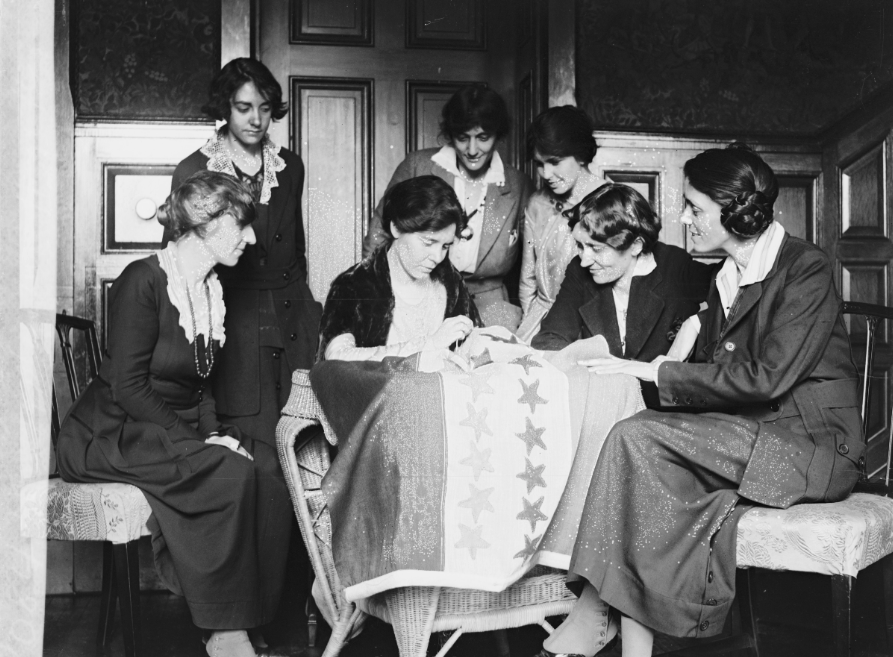
A black and white photo of seven young women sitting or standing around a wicker table over which is draped a suffrage flag, representing the fight for votes for women. Alice Paul sits at the center sewing a star on the flag.
Alice Paul, Crystal Eastman, and others sew a suffrage flag in support of votes for women, early 1920s

Gloria Steinem was certainly not the only well-spoken feminist of note to emerge as a thought leader and influencer (to use annoying contemporary terms) in the 1960s and 1970s. However, Ms. Steinem had great charisma, impressive composure and gravitas, and an uncanny ability to receive and deflect even the most egregiously offensive, condescending, insulting, infantilizing, and sexist attacks—many of them quite personal—in any setting. As the most prominent U.S. proponent of feminism in that era, she was seemingly everywhere, always responding with reason, wit, and specificity that left those who sought to degrade and wound her sputtering, red-faced, and laughable. They couldn’t hold a candle to her factual, well-reasoned, dignified message or delivery.

Ms. Steinem was conventionally beautiful enough to have passed as a Playboy bunny while undercover to write an expose about Hugh Hefner’s Playboy empire in the 1960s. But her physical attractiveness and beautifully modulated voice were actually stealth weapons against her detractors. Combined with her preternaturally calm demeanor and her skill with debate, her skills and attributes attracted positive attention, first to her, then to the subject of women’s rights and gender equality. They also gave the lie to the sexist stereotypes of feminists as being shrieking, irrational, and unattractive. It was always a joy to watch her surprise her ignorant antagonists by skillfully defending feminism in debates with everyone from sputtering attack columnists to sexist public intellectuals like Norman Mailer and William F. Buckley.

Today’s U.S. feminist discourse is more balanced, varied, and integrated across racial, cultural, and gender lines, and is more inclusive of all sexualities and multiple types of opinion than it was during Gloria Steinem’s most public era. But her life’s work continues to have a deep and lasting positive influence on feminist discourse. Ms. Steinem expanded and expressed her understanding of different feminist viewpoints, lifted up others who support the goals of feminism, and educated, inspired, and built a more egalitarian and respectful world for us all provide us all. What a powerful and lasting legacy.

At top:

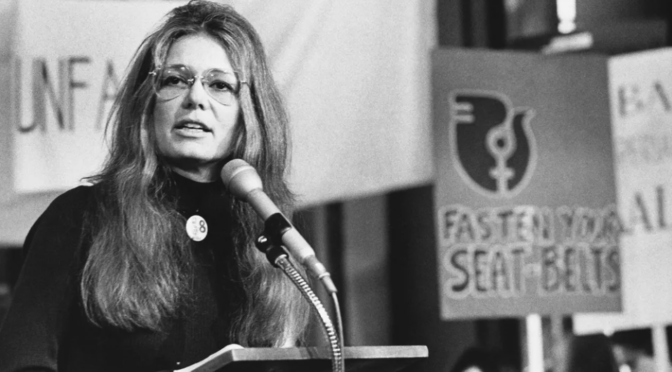
Gloria Steinem addresses a feminist rally, early 1970s
Suburbia

bill

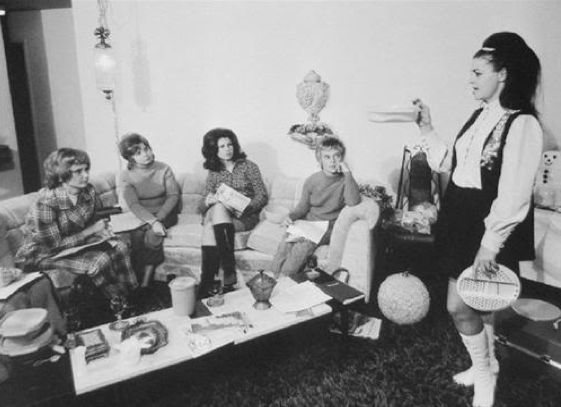
Photo of a Tupperware party by Bill Owens from his book Suburbia

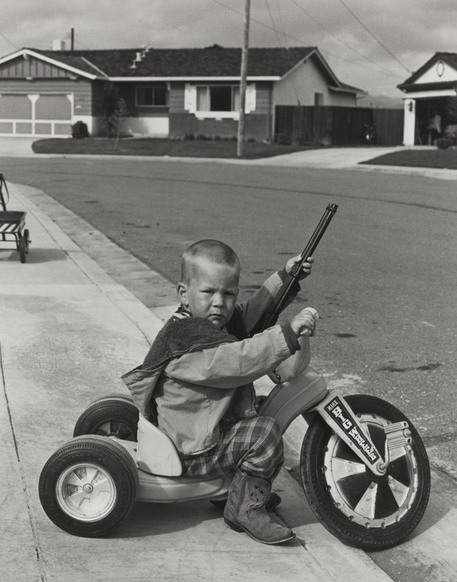
When I was a child growing up in the San Francisco suburb of Livermore, the publication of photographer Bill Owens‘s exploration of Bay Area suburban life, Suburbia, was a big deal in my home town. His book of photojournalism, published in 1973, garnered significant media attention; it was even written up in Time magazine. The book was of particular interest in Livermore because its stars were our town’s own citizens. The Tupperware ladies, toy-gun-toting little boys, Barbie-collecting girls and block party barbecuers whose black-and-white portraits  filled the book lived in the Livermore-Amador Valley. Several of my mother’s friends and our own family doctor appeared in its pages.

Even now, historians, postcard manufacturers and bloggers republish photos from the book. Art galleries, major museums and other institutions around the world include Owens’s photos in exhibitions. Gallerists and pop culture historians point to his work when they want to expose the supposedly tacky superficiality of American suburban life during that awkward period between the clean-cut, rule-following fifties and the shaggy, sexy, if-it-feels-good-do-it seventies.

Richie

Photo of six-year-old Richie Ferguson by Bill Owens from Suburbia

Bill Owens took these now-iconic photos when he was a staff photographer at the Livermore Independent News starting in 1968. My mother’s boyfriend at the time was himself a reporter at the Independent who worked alongside Owens, so I met the photographer at a party shortly after the publication of his book. He had the no-nonsense confidence of a man who is used to sizing up a situation quickly, figuring out the most visually compelling elements, and getting in and out of an event in a hurry, before his subjects have a chance to become too self-conscious or studied in their poses. News photography has always required such skills, but in the days of film photography, there was a pressing need to be able to edit one’s work on the fly and be quick about it. Film was costly, and all photos needed to be developed and cropped by the photographer on short deadlines if they were to make it into the next day’s paper. Taking too many shots or too much time was a luxury that local papers and their staff photographers could ill afford.

In the seventies, there were few television channels or news radio stations, and of course there was no Internet with which individuals could share news directly, so the local newspaper was the primary source of in-depth information on all things regional. Newspapers had to report on crime, business, sports, laws, fashion, civic and social events, so photographers like Bill Owens had to get in and out of multiple places and events daily. But while Owens came from that journalistic tradition, in his photoessays he took the time to focus not only on what people did, but also on how they felt about their lives and suburban surroundings. He let his subjects express their pride, ambivalence and concerns about living in a growing, post-war, middle-class community. It was a time of prosperity and expanding social and sexual openness, but also a time of war, increasing crime and political unrest. Our town was largely insulated from the drama and violence that was shaking bigger cities at the time, but middle-class angst and drama were plentiful.

In his photographs and in the commentary his subjects provided, Owens caught suburbanites in private moments. They questioned whether they were capable parents, or took pride in living what they considered to be the good life. Some admitted that while they’d found the money to buy a house, they couldn’t afford to furnish it. People opened up to him, agonized over whether they were setting good examples for their kids, beamed as they showed off their prosperity, or sat half-naked on the edge of a bed daring the world to judge them for being comfortable with themselves.

Ozzie Davis

Photo of Livermore’s Ozzie Davis Toyota dealership by Bill Owens from his book Suburbia

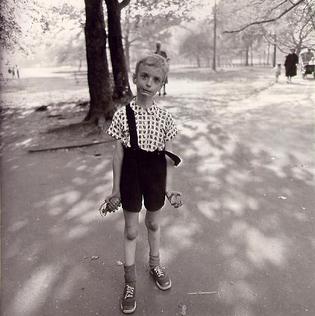
The world was used to urban photographers like Diane Arbus or Gordon Parks taking awkwardly intimate photos of people looking embarrassingly real in big, gritty cities like New York. Time and Life magazines brought images of war and rioting into our homes each week in full-color photo spreads. In comparison to large-scale photojournalistic  works about the Great Events of Our Time, a photoessay treating the inhabitants of a middle-class enclave near San Francisco as if they were significant enough to be worthy of their own project was a fresh and intriguing idea. It was exciting to be in the spotlight after always feeling like we had been on the edges of things.

Livermore is less than an hour from San Francisco, which was the hippie movement’s Ground Zero during the 1960s. Though only a half-hour from Berkeley, scene of some of the nation’s most bitter and frequent anti-war protests during the years when these photos were taken, Livermore had for many years been a bastion of traditional conservative values.

A wine-growing community dotted with ranches, Livermore was known as little more than a cow town until the early 1950s. My high school’s mascot was a cowboy, and the street behind the main school building is still called Cowboy Alley. But while the community had long been based on rancho culture, by the 1960s and 1970s Livermore’s biggest employer was what was known as the “Rad Lab,” rad being short for radiation: Livermore was and is the site of one of the nation’s largest national nuclear weapons laboratories. What is now known as the Lawrence Livermore National Laboratory opened its doors in 1952, and by the time Bill Owens’s book was published two decades later, the laboratory directly employed about 10% of the city’s population.

For six decades, Livermore has had one of the largest concentrations of top nuclear physicists in the world, meaning that my town was home to a huge number of highly educated, fact-loving scientists, their well-educated spouses, and their smart and skeptical kids. Most of those who worked at the lab were strong believers in the theory that the specter of “mutually assured destruction” by the Soviet and U.S. superpowers in case of a nuclear war would keep either side from initiating war as long as both sides kept designing, building and stockpiling more and more threatening, long-range and expensive weaponry.

The Cold War-era belief that spending billions on the development and creation of weapons of mass destruction was necessary to keep us safe from communists (who were building their own gigantic nuclear arsenal on the other side of the world) sounds like a conservative stance to us today, but there were plenty of political moderates and even liberals working at the lab. Democrats like Presidents Kennedy and Johnson were staunch anticommunists who had instigated and escalated our involvement in wars meant to stop the spread of communism. Fear of communist expansion and take-over was by no means a solely Republican fear. Engineers and physicists who prized rational thinking above all were often open-minded and modern in their thinking in many fields and they came in many political flavors, not just conservative ones.

By the time that Bill Owens set about photographing our city’s denizens, formerly rural Livermore’s population included many erudite, cultured people of all political persuasions who were curious about the world in general. Many of the problem-solvers who had descended on Livermore from around the globe brought with them great worldliness and interest in culture and erudition. Though Livermore had once been thought of as a quiet farming community out in the boonies, by the 1960s it was surprisingly full of eclectic amateur theatrical events, excellent public schools with award-winning musical ensembles and a community symphony. An ambitious annual cultural arts festival takes over much of the downtown corridor during early October every year to this day.

However, because of the popularity of Bill Owens’s book, the place where I grew up became famous for people who represented everything superficial and embarrassing about suburban American culture. The real Livermore was a lively mixture of experts in fields from agriculture and livestock to nuclear weaponry to the arts. The book that both celebrated and embarrassed us was on the coffee table of every hip and educated family in town, and we felt both pride and chagrin over the images shown within its pages. There was delight over the fame the book brought us, and recognition of ourselves in the photographs and stories told in the book, but also a bit of shame over the parts of the book that made us look like overconsuming, self-absorbed buffoons.

Another understandable but misleading aspect of the book was the fact that the long agricultural history and natural beauty of the place got lost in the focus on the tract housing developments and accoutrements of post-war Northern Californian living, so the richness of the culture and the long history of people living close to the land in Livermore and the surrounding valley all but disappeared.

Big cities like New York can handle having people think a large proportion of their citizenry is odd or tacky, but Livermore has suffered unfairly over the years by having people choose the least flattering photos and stories from our signature photoessay to represent our whole populace. Although those of us who lived in the Bay Area in the early seventies grew used to hearing that our region was rife with proto-New Age philosophies, encounter groups, redwood hot tubs, free love experimentation and all varieties of omphaloskeptic behavior, for many people (like my self-righteous hippie father) Bay Area suburbs like Livermore came to represent not the cool, sexy, mind-expanding elements of the Age of Aquarius but the shallow, consumerist, un-self-aware aspects of modern living.

In the decades since I left Livermore, the city has nearly doubled in size thanks to its proximity to the tech boom in San Francisco and Silicon Valley. My home town has long been one of the more affordable corners of an outrageously overpriced region. It is still home to one of the nation’s top nuclear weapons laboratories, as well as to Sandia National Laboratories, which develops, engineers and tests the non-nuclear components of nuclear weapons. But its economy and culture are no longer quite so closely tied to the nuclear research culture as they were when I lived there. Yet echoes of that culture reverberate in modern literature and film: the writer of the popular science fiction novel The Martian, Andy Weir, grew up in Livermore. He went to my high school, worked at Livermore’s Sandia Labs, and he is himself the son of a particle physicist who worked at Lawrence Livermore National Laboratory. It’s likely he had a literature or composition class with my mother at some point; I like to fantasize that she may have encouraged his considerable writing talent in some small way. Though Weir wasn’t even born when the first of the photos in Suburbia was taken, the influence of Livermore’s science-friendly, intellectual, problem-solving culture helped to nurture his curiosity and imagination, just as it did my own.