
Tag Archives: Documentary Film

Ms. Magazine & Gloria Steinem

Yesterday, journalist, feminist, and activist Gloria Steinem died at her home in New York City at the age of 92. As a profoundly honest, articulate, well-reasoned, tireless, and infinitely patient avatar and explainer of the need for gender equality and women’s rights, particularly during the 1970s and 1980s, Ms. Steinem was a powerful and influential voice. As founding editor of Ms. magazine, Gloria Steinem had a profound and positive impact on U.S. culture.

Last year’s HBO documentary about Ms. magazine, Dear Ms.: A Revolution in Print, explored the history and importance of Steinem and the magazine. Like Ms. Steinem herself, the documentary honestly addressed some of the magazine’s (and mainstream U.S. second-wave feminism’s) shortcomings, particularly the white, straight, middle-class focus of the magazine and the movement in its early days. Steinem and other Ms. founding mothers recognized and acknowledged that they needed to have a broader, more inclusive view of women and feminism, and relinquish some of their own personal vision in order to make room for the views of others under the wide umbrella of feminist thought.
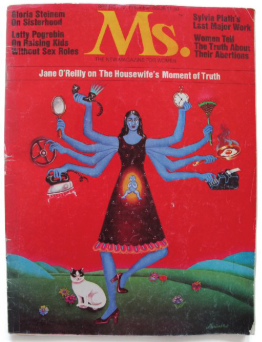
The cover of the first issue of Ms. magazine from spring 1972 features an illustration of a woman with eight arms and blue skin based on the Hindu deity Kali, but wearing a knee-length sleeveless contemporary dress and holding the avatars of modern life for women: a clock, a rake, a pan with a fried egg, a typewriter, a clothes iron, a steering wheel, a hand mirror and a telephone, under the worlds Jane O'Reilly on The Housewife's Moment of Truth. The woman stands on a green hillside next to a pet cat, the sky behind her bright red. The word Ms. is at the top of the cover in golden yellow.
The first issue of Ms. magazine was published in spring 1972

My mother was a charter subscriber to Ms. magazine, the groundbreaking feminist publication that premiered in Spring 1972. As a kid, I read every single copy the minute it arrived every month. I remember when that first issue arrived in the same mail delivery as Women’s Day, Family Circle, and McCall’s, three of the most popular women’s magazines of the day. The difference between those standard, established, housewife-oriented magazines—with their emphasis on homemaking, child rearing, cooking, cleaning, and husband-pleasing—and the empowering, infuriating, and exciting articles in Ms. was as clear as the difference between midday and midnight.

I was a latchkey kid back then, and a precocious one. My serious adult interests made me popular with teachers, but deeply unpopular with my peers. I spent a lot of time by myself at home, reading all manner of things, from literary novels and magazines to the naughty books Mom hid (not very effectively) under her bed. My young, divorced, single mom—a high school English teacher—arrived home about an hour after I did every day from the time I was six years old onward. As the first person home, I was always the one to get the mail, and that gave me first crack at Mom’s magazines. Much as I loved flipping through TIME and LIFE magazines, and searching the back pages of McCall’s to find and cut out the Betsy McCall paper dolls every month (I was, after all, still a little girl), Ms. was the first magazine I read every month. That habit continued from the initial Spring 1972 issue until I gave up on it when it was sold and changed its focus in the 1987.
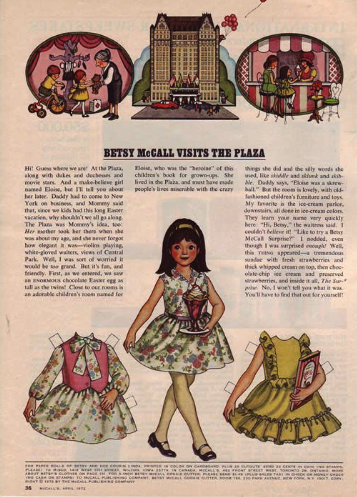
A page from a 1972 issue of McCall's magazine features an illustration showing a little girl in a dress holding an ice cream sundae. This is a paper doll, and she's flanked by two other dresses meant to be cut out and placed over the central image. The surrounding text says Betsy McCall Visits the Plaza and includes two paragraphs explaining the story of the fictional Betsy McCall's New York City adventure at the Plaza Hotel. At the top of the pge are three images from Betsy's day at the Plaza.
Every monthly issue of McCall’s magazine featured a page of Betsy McCall paper dolls for children to play with, like this one from 1972

For fifteen years, I flipped to the back of the magazine before reading another word so I could begin with the “No Comment” page. It consisted of photos of sexist, misogynistic, woman-dominating, infantilizing or pedophilic, insulting, even brutal imagery and messaging from TV, magazines, billboards, corporate PR documents, and other popular media. Seeing evidence of the relentless and ubiquitous yet socially acceptable advertising offensive against women was always shocking and enraging. The images were infuriating, and sent powerful messages about how pervasive sexism was (and still is).

Thus primed to recognize how baked into the system sexism was, I’d start over, returning to the beginning of the issue and reading through every article. There were features on sisterhood, nonsexist child rearing, abortion rights (remember, abortion wasn’t legal across the U.S. until 1973, nearly a year after Ms. first appeared on newsstands), opposing positions on pornography, cultural stereotypes of women, and gender inequality. I’d also read the interviews with feminist writers of different bents, from Andrea Dworkin to Betty Friedan to Angela Davis. I compared my nascent feminist opinions with theirs, often evolving over time as I grew up and saw the world and experienced sexual harassment directly and repeatedly in school, on the job, and simply walking down the street. Ms. helped me see that there were many different flavors, types, and branches of feminism, sometimes in opposition to each other. The magazine took the general position that opinions could, should, and did differ among people of goodwill about what feminism could and should address.
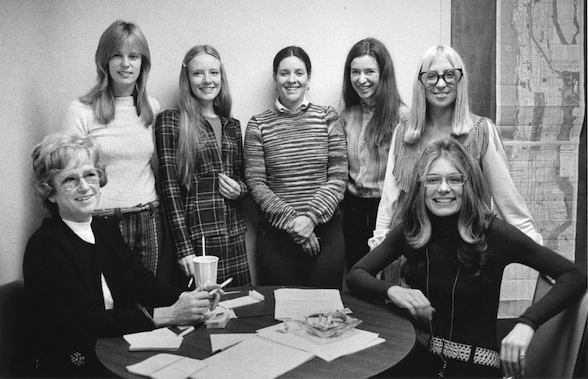
Seven of the founders of Ms, magazine smile and face toward the photographer in this staged photo by Jill Krementz. Gloria Steinem in a black turtleneck sits in a chair next to a round table at right. Letty Cottin Pogrebin and four other women stand behind the table. Another woman sits at the left of the table.
Gloria Steinem with some of the founders of Ms. magazine in 1971, shortly before the publication of the first issue of Ms. in spring 1972 | Photo by Jill Krementz

In the early era of Ms. magazine, two topics in particular were raised repeatedly. One was the definition of feminism, since so many people had negative associations with the word but didn’t understand its actual definition. The other was the proposed ratification of the Equal Rights Amendment (ERA.)

In those days, and even today, many people have refused to call themselves feminists, associating the term with loud, rude, anti-male opinions. However, the textbook definition of feminism is anything but outlandish or offensive to most of us. Feminism is simply the belief in and advocacy of social, political, and economic equality not based on gender. That’s really the whole shebang.

The proposed Equal Rights Amendment would have amended the U.S. Constitution to guarantee equal legal rights for all citizens regardless of gender. Often misrepresented as an effort by man-hating loonies to give women “special rights” or unfair advantages over men, here’s what the ERA actually said, in its entirety:

Section 1. Equality of rights under the law shall not be denied or abridged by the United States or by any State on account of sex.

Section 2. The Congress shall have the power to enforce, by appropriate legislation, the provisions of this article.

Section 3. This amendment shall take effect two years after the date of ratification.

That’s it. The ERA was a simple request for nothing more than legal equality regardless of gender or sex.

First drafted by women’s rights leaders Alice Paul and Crystal Eastman, and first introduced in Congress in December 1923, the proposed ERA went through decades of discussion and debate. In 1971, it was at last approved by the U.S. House of Representatives. After the U.S. Senate approved it the following year, in 1972, it was submitted to U.S. state legislatures for ratification, as required by the U.S. Constitution. Congress required ratification by at least 38 states within seven years. It would seem a foregone conclusion that ratification of such a simple, obviously fair, true, and just statement would have been accomplished well before that deadline. However, Congress had to extend the deadline from 1979 to 1982. And even after ten years of public debate, both deadlines passed and the ERA was still three votes short of the necessary 38 states in 1982. As of 2026, the ERA has still not been ratified, and the Constitution still does not guarantee equality to all without regard to gender.
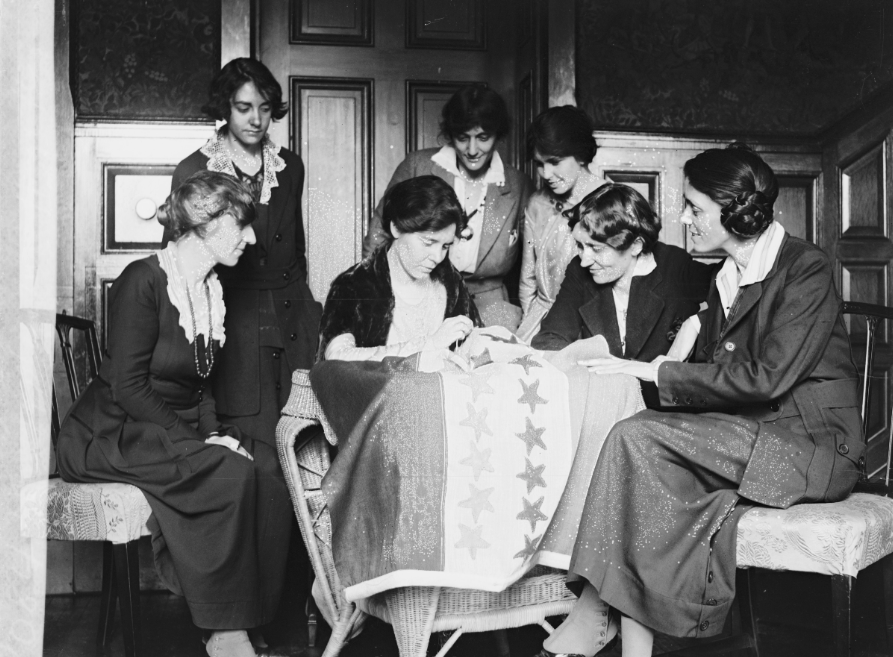
A black and white photo of seven young women sitting or standing around a wicker table over which is draped a suffrage flag, representing the fight for votes for women. Alice Paul sits at the center sewing a star on the flag.
Alice Paul, Crystal Eastman, and others sew a suffrage flag in support of votes for women, early 1920s

Gloria Steinem was certainly not the only well-spoken feminist of note to emerge as a thought leader and influencer (to use annoying contemporary terms) in the 1960s and 1970s. However, Ms. Steinem had great charisma, impressive composure and gravitas, and an uncanny ability to receive and deflect even the most egregiously offensive, condescending, insulting, infantilizing, and sexist attacks—many of them quite personal—in any setting. As the most prominent U.S. proponent of feminism in that era, she was seemingly everywhere, always responding with reason, wit, and specificity that left those who sought to degrade and wound her sputtering, red-faced, and laughable. They couldn’t hold a candle to her factual, well-reasoned, dignified message or delivery.

Ms. Steinem was conventionally beautiful enough to have passed as a Playboy bunny while undercover to write an expose about Hugh Hefner’s Playboy empire in the 1960s. But her physical attractiveness and beautifully modulated voice were actually stealth weapons against her detractors. Combined with her preternaturally calm demeanor and her skill with debate, her skills and attributes attracted positive attention, first to her, then to the subject of women’s rights and gender equality. They also gave the lie to the sexist stereotypes of feminists as being shrieking, irrational, and unattractive. It was always a joy to watch her surprise her ignorant antagonists by skillfully defending feminism in debates with everyone from sputtering attack columnists to sexist public intellectuals like Norman Mailer and William F. Buckley.

Today’s U.S. feminist discourse is more balanced, varied, and integrated across racial, cultural, and gender lines, and is more inclusive of all sexualities and multiple types of opinion than it was during Gloria Steinem’s most public era. But her life’s work continues to have a deep and lasting positive influence on feminist discourse. Ms. Steinem expanded and expressed her understanding of different feminist viewpoints, lifted up others who support the goals of feminism, and educated, inspired, and built a more egalitarian and respectful world for us all provide us all. What a powerful and lasting legacy.

At top:

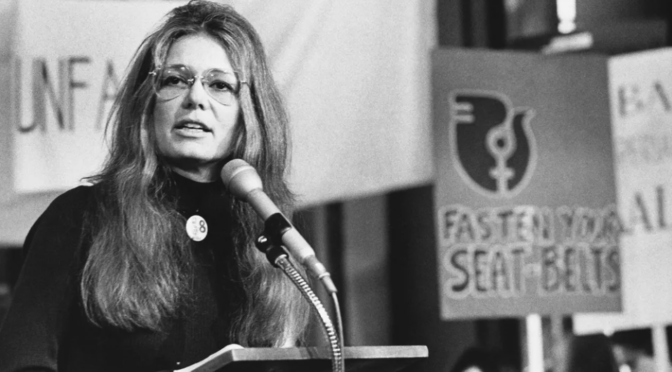
Gloria Steinem addresses a feminist rally, early 1970s

Eight Days a Week: On Tour with The Beatles

Tonight I indulged in an evening of nostalgia inspired by a viewing of Eight Days a Week: The Touring Years, the satisfying and enjoyable new documentary about  directed by Ron Howard. Though no one can doubt Howard’s ability to present stories with energy and enthusiasm, I have often found his films too mawkish and obvious for my taste. Happily, it turns out he has a knack for creating a crackerjack musical documentary. He’s put together a jaunty but detail-rich story with the full cooperation of (and incorporating recent interviews with) living Beatles Paul McCartney and Ringo Starr, and with help from the widows of John Lennon and George Harrison.

Growing up during the 1960s and being steeped in Beatles music from birth, as I was, I have always seen The Beatles as my band and my musical family members, and I’ve viewed their music as a personal treasure that I just happen to share with the world. This film brings back the best moments of my childhood, reminds me of just how fresh and delicious their music was (and still is today). This documentary is a bright, shiny reminder that no, their power, talent and influence haven’t been overblown: they really were that good and that important to world culture in the 1960s. There was an open lightheartedness and sincerity about them which this documentary displays lovingly, but without treacly reverence or false heroism. They were a force to be reckoned with, but what they wanted most of all was not to be legends to millions of young girls or to worry about what their cultural legacy would be years hence; they just wanted to create really great music and bring joy. And they did.

As meaningful as my own relationship with The Beatles’ music feels to me, I know that I share my all-time-favorite band with a literal billion other people who love them, too, and this film makes that clear: the enormity of Beatlemania, the record-breaking crowds that showed up to see them, hurled themselves into fences and onto stages, and even broke through doors and windows to get to them are all on display here. But the nature of The Beatles’ electrifying and original music, as well as their enormous personal charisma and warm connection to each other and to their fans, is that we feel an intimate connection to them and to their music. After all, their songs have been part of our personal soundtracks for over a half-century. This film makes their charisma, their discipline and their energy feel fresh and palpable, and the large amounts of color footage and clever use of still photos and black-and-white film, along with surprisingly well restored audio tracks, makes them feel breathtakingly contemporary.

The Beatles were joyful, bracingly honest, and so cheerfully rowdy that they turned all stereotypes of British primness upside-down. They were also egalitarian, working class and, when it came to race, colorblind. In Eight Days a Week, Whoopi Goldberg, who has been a huge Beatles fan since childhood and who saw them at Shea Stadium when she was a girl, says in this film that when she saw and heard The Beatles, she felt like they were her friends, that their music spoke to her, that she didn’t feel like an outsider when she played their records. She felt like they would welcome her into their world if they knew her, which was unusual and deeply touching for a young black girl to feel about a group of white English guys in 1965. And she was right; when they went to the South, they were told they could only perform to segregated audiences, and they refused. They put an antisegregation rider into their contract, and once they broke the color barrier at their concerts, those stadium concert venues stayed desegregated for other performers who came after them. When they decided to augment their recordings with an outside keyboardist near the end of the band’s life, they chose megatalented black funk star Billy Preston to play keyboard for them, creating those iconic keyboard solos in songs like “Get Back.” You can see Preston, who was the only non-Beatle ever credited for performing on any of their albums, performing with them at the end of the film as they played their last-ever live concert together on the top of their office building, as can be seen in the concert film made of their final album together, Let It Be.

Those of us who were born in the 1960s grew up with Beatles music being a constant presence in our lives, and we who were most deeply touched by them can still sing dozens, even hundreds of their songs by heart, so catchy and fresh and powerful were their tunes, their lyrics and their arrangements. (And the documentary makes clear that they owed a great debt of gratitude to producer George Martin, who died this year and to whom the documentary is dedicated.)

To the people of the United States who were introduced to the Beatles on the Ed Sullivan Show and on the radio in early 1964, The Beatles seemed to come out of nowhere and to be overnight sensations. Of course, we all know now that they’d spent years honing their craft in the underground bar in which they were discovered in Liverpool, The Cavern, and in the seediest nightclubs of Hamburg, Germany, where they polished their performance skills, practiced and performed for up to eight hours a day, and all slept in one room together with their shared bathroom down the hall, like brothers. By the time they came to the U.S., they saw each other as brothers, as the film makes clear.

The overwhelming, relentless, exhausting quality of their life on the road is displayed and narrated by The Beatles themselves in this film, but their resilience, wit, energy and powerful loyalty to each other are also evident. The excellent footage and recordings, some only discovered recently after the filmmakers put a call out to Beatles fans via social media, are masterfully arranged and edited, and despite the extremely public nature of their lives and careers, the film feels quite intimate at times.

Ron Howard is known for being somewhat obvious and superficial in the way he treats historical subjects, and that holds true here: there are few, if any, surprising facts or original insights in this film, though hearing Paul and Ringo (and George and John, in long-ago interviews) recount their stories with some pleasure is a treat. In Eight Days a Week, Howard does what he is particularly good at, and that is creating an energetic, buoyant piece of visually attractive entertainment (with enormous help from talented editor Paul Crowder) that feels immediate and real, and that leaves the audience feeling hopeful. I saw it with a full house of people aged 18 to about 80, and the college-aged people laughed at and delighted in the Beatles’ talents and antics at least as much as those of us who have been listening to Beatles music for 50 years or more. The college students in the audience were the first to break into applause at the film’s end.

If you love The Beatles as I do, make sure to stay seated throughout the end credits so you don’t miss the huge bonus at the end of the film: a newly restored, half-hour-long edited-down version of their 1965 concert at New York’s Shea Stadium, which was at that time the largest rock concert in history. Their fan base was so enormous, and the risk to safety from the huge gatherings of fans was so great, that their U.S. tours eventually had to take place only in giant stadiums. Indeed, police forces across the U.S. were regularly overwhelmed when The Beatles came to their cities, so unprecedented were their appeal and the enormity of the crowds they attracted.

During the Shea Stadium concert Paul and Ringo say they couldn’t hear a thing over the deafening noise of the crowd; Ringo had to stay in sync with Paul and John by watching them for visual cues, primarily by watching their hips. Concert footage shows what enormous stamina and determination were necessary to perform on that scale and at that pace for years on end. Every day meant hours of being rushed through hordes of screaming fans who were trying to bash in their car windows; being dragged around to photo shoots or film sets; being grilled by reporters; having perhaps 90 minutes at a studio with George Martin to test out a just-written song and bring it to full fruition on tape; and then going off to play a concert. The lack of private time was wearying. In between all the very public appearances, they would often be stuck together in a hotel room to avoid having their hair snipped and clothes ripped away by mobs of fans should they go out in public. This film shows the weariness and joylessness that this kind of life ultimately elicited, and makes clear why they decided to stop touring in 1966 and spend all of their remaining energy writing and recording rather than touring for their final five albums together.

While my lifelong love of The Beatles keeps me from being impartial in evaluating this new documentary, I can say that I felt it captured their spirit, freshness, talent and liveliness in a more visceral and emotionally stirring way than any other documentary I’ve seen about the band, and that I’ll be able to hear and enjoy their music in a deeper and even more appreciative way as a result. Many thanks to Paul and Ringo and Ron Howard for making this lively, lovely appreciation of The Beatles’ early years possible.