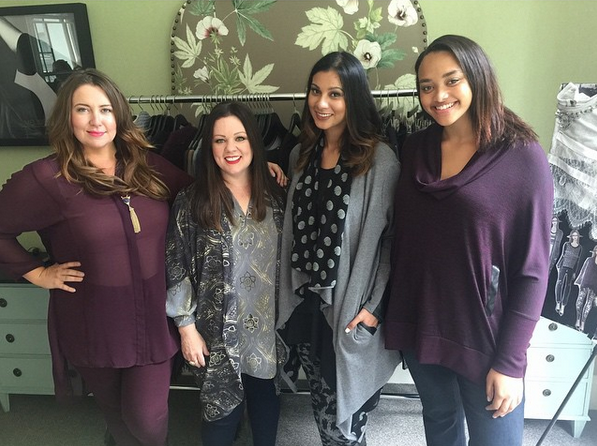
Fashion designer and Academy-Award-nominated actress Melissa McCarthy, second from left, shows off pieces from her new 7Seven fashion line, Summer, 2015
When gifted comic actress Melissa McCarthy was nominated for a Best Supporting Actress Academy Award, she went searching for an appropriately elegant evening gown to wear to the ceremony. “I asked five or six designers,” she told Redbook magazine. “Very high-level ones who make lots of dresses for people — and they all said no.” The designers demurred because Ms. McCarthy does not conform to the fashion world’s size-two-to-size-six ideal. Designers had no interest in having her wear their dresses, even though over 40 million people in the U.S. alone saw Ms. McCarthy on their TV screens in one night, because designers feared that being seen to create clothing for larger women would actually harm the reputations of their design houses.
It’s ironic that designers think designing for women size 14 and up degrades and debases their brands since fully two-thirds of women in the United States fall into that category. Over 90 million women in the U.S. alone wear size 14 or larger, yet they are relegated to smaller, sadder “plus-size” clothing departments. They are made to feel that they are not only unimportant but not worthy of attractive, comfortable clothing even though they purchase and wear billions of dollars worth of clothing and accessories each year. They are shut out of many stores and designer’s lines completely, and stores that cater to them often offer them less flattering products for more money. The funny but maddening WTF Plus Tumblr blog shows the range of hideous, sexless, embarrassing clothes designed for larger women that smaller women would never be expected to buy, let alone wear.
While Emmy-winning actress Melissa McCarthy is best known for being a popular comedian who is willing to bear the brunt of jokes about her large size, she actually started out as a fashion and textile design student at New York’s prestigious Fashion Institute of Technology before her career in entertainment took off. In August 2015 her new line of clothing, 7Seven, debuted a line of clothes ranging in size from 4 to 28. The line is in a relatively affordable price range that matches or meets the prices of retailers like Ann Taylor and Banana Republic. With her inaugural collection, McCarthy shows a great eye for proportion, fit, pattern and texture. Her designs are fashion-forward and very wearable.
McCarthy dislikes the term “plus-size.” “Seventy percent of women in the United States are a size 14 or above, and that’s technically ‘plus size,’ so you’re taking your biggest category of people and telling them, ‘You’re not really worthy.’ I find that very strange,” she says.
In response to the news of her fashion line’s availability, Internet trolls came out en masse on social media and news sites to denigrate McCarthy and others for “enabling” and celebrating larger women’s rights to enjoy their bodies. As always happens when women with bodies larger than a size 6 dare to show comfort or confidence in their appearance, people took to their computers to accuse McCarthy and others of glamorizing unhealthy lifestyle choices. Those self-elected arbiters of appropriate body shape and size would like all people size 8 and above to go about in sack cloth and ashes until they starve themselves down to a single-digit dress size.
Disapproval and disrespect shown toward plus-sized people doesn’t obviate their need to find clothes that fit, feel good and look attractive. Those who respond to Ms. McCarthy’s new business venture by denigrating those who are larger than themselves are essentially saying that allowing people to clothe themselves attractively, affordably and comfortably is the wrong tack—that we should instead shame them into looking the way we want them to and tell them that having the bodies they have is a moral failing. I wonder whether these self-appointed body shamers go out of their way to shame smokers and alcoholics, too. Those who drink or smoke bring on early death from their habits in even greater numbers than overeaters do, but our society shows them more understanding. They have the option of giving up their habits and avoiding people and places that trigger their dangerous behaviors, but EVERYONE has to eat, and every metabolism is different, so larger people can’t just stop the behavior (i.e., eating) that disrespectful trolls find offensive.
Many larger people are actually regular exercisers who are quite healthy—you can’t tell from looking who is truly unhealthy inside. Large people have higher rates of some deadly diseases, but so do coal miners, house cleaners and beauticians because they choose jobs that expose them to carcinogenic chemicals. Police officers and soldiers die in greater numbers and intentionally choose work that causes great stress that often requires taxpayer-funded medical and psychological intervention later. Do we judge them for putting their lives at risk? Do we denigrate them for their choices?
Melissa McCarthy is a multitalented woman who designs chic, comfortable and fashion-forward clothing, much of it aimed at a market that comprises over two-thirds of the nation’s adult female population. People who want to shame those women into conforming to their personal preferences are nothing more than hateful bigots who spew venomous tirades in the self-righteous belief that their discomfort over seeing bodies larger than those featured in Vogue magazine justifies their using their supposed concern about health and setting bad examples for youth so they can clobber those with different body types and sizes over the head, shaming and shunning them and telling them that they are unlovable, undisciplined and unimportant, none of which is true.
An ever-growing body of scientific literature points toward the fact that people who are deemed overweight to obese usually have very different gut biomes (intestinal ecosystems) than thinner people do, and that the varieties and sizes of bacterial colonies in their guts have an enormous impact on the speed and effectiveness of their bodies’ metabolic rates, the intensities of their cravings for food, the ways in which they metabolize medicines, and their propensity toward depression, anxiety and other emotional and psychological disorders that may manifest in a compulsion to eat in order to find comfort.
In short, the gut biomes of larger people may send intensely powerful and frequent signals to their brains telling them what, when and how much to eat. We live in a culture in which almost everyone has taken multiple types of antibiotics that distrupt gut biomes, sometimes with disastrous, even deadly results. We are also regularly bombarded with ads for unhealthy foods and drinks that further disrupt our gut biomes and our endocrine systems, making permanent weight loss exceptionally difficult for even the most determined people. But we are also surrounded with Photoshopped images of impossibly thin, unrealistically proportioned people on TV, in movies, in pornography and in computer games, making it easier to believe that there are actually many more “perfect” bodies in existence than actually occur on this or any other planet. So we compare ourselves to these pretend people we keep seeing, and to make ourselves feel less bad about our own imperfections, we glom onto the perceived failures of others and build ourselves up by ripping them apart and smarmily saying that we’re shaming and shunning them for their own good. How preposterous. It’s cruel, and it doesn’t help people to lose weight.
What does help? Making people feel confident and attractive enough to get up, get out and exercise and take good care of themselves. Helping them to feel less anxious or depressed about themselves by giving them access to clothes and accessories that allow them to feel more attractive, confident and appealing. Success breeds success; those who feel shame are more likely to retreat into self-defeating behaviors that compound difficult habits, while those who believe in their inherent worth and who have hope for a positive future are more likely to get up and take the actions that lead to healthier, happier lives. Shaming and shunning those who are heavy tends to push them toward habits that make them heavier still. Helping them to find attractive outfits for every occasion, including athletic and exercise wear, gives them ways to love the bodies they have and helps them to believe that their bodies are worth effort and care.
Yes, being obese is not healthy, but being slightly overweight actually leads to a longer life expectancy than being slightly underweight. Furthermore, many people who are significantly overweight exercise regularly and do not have either diabetes or high blood pressure, just as some very fit and thin women have serious diabetes from childhood onward and need daily insulin injections. You can’t tell by looking, and even if you could, others’ dietary habits are not your business.
Should we encourage healthy dietary and exercise habits throughout society? Yes! Should we work to eliminate junk food dispensaries from schools and increase the quality of school lunches and discourage teachers from using sodas and snacks as rewards for good work? Yes! But it does not follow from these societal goals that encouraging health requires disparaging and defaming those whose habits or bodies don’t conform to cultural ideals.
Rather than fat-shaming those among us with larger bodies, let us celebrate women like Melissa McCarthy who make larger women feel freer to be active, positive and comfortable in their bodies while living happy, productive, healthy and engaged lives.