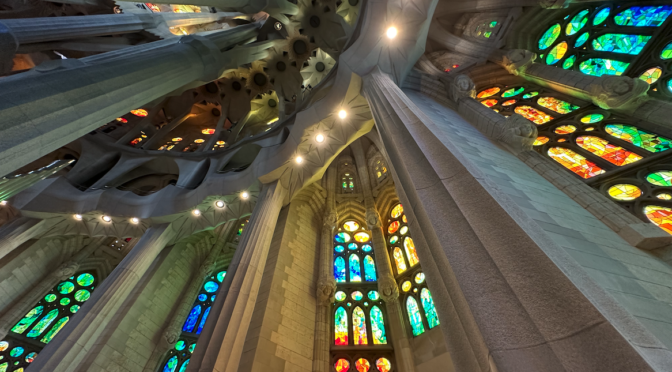
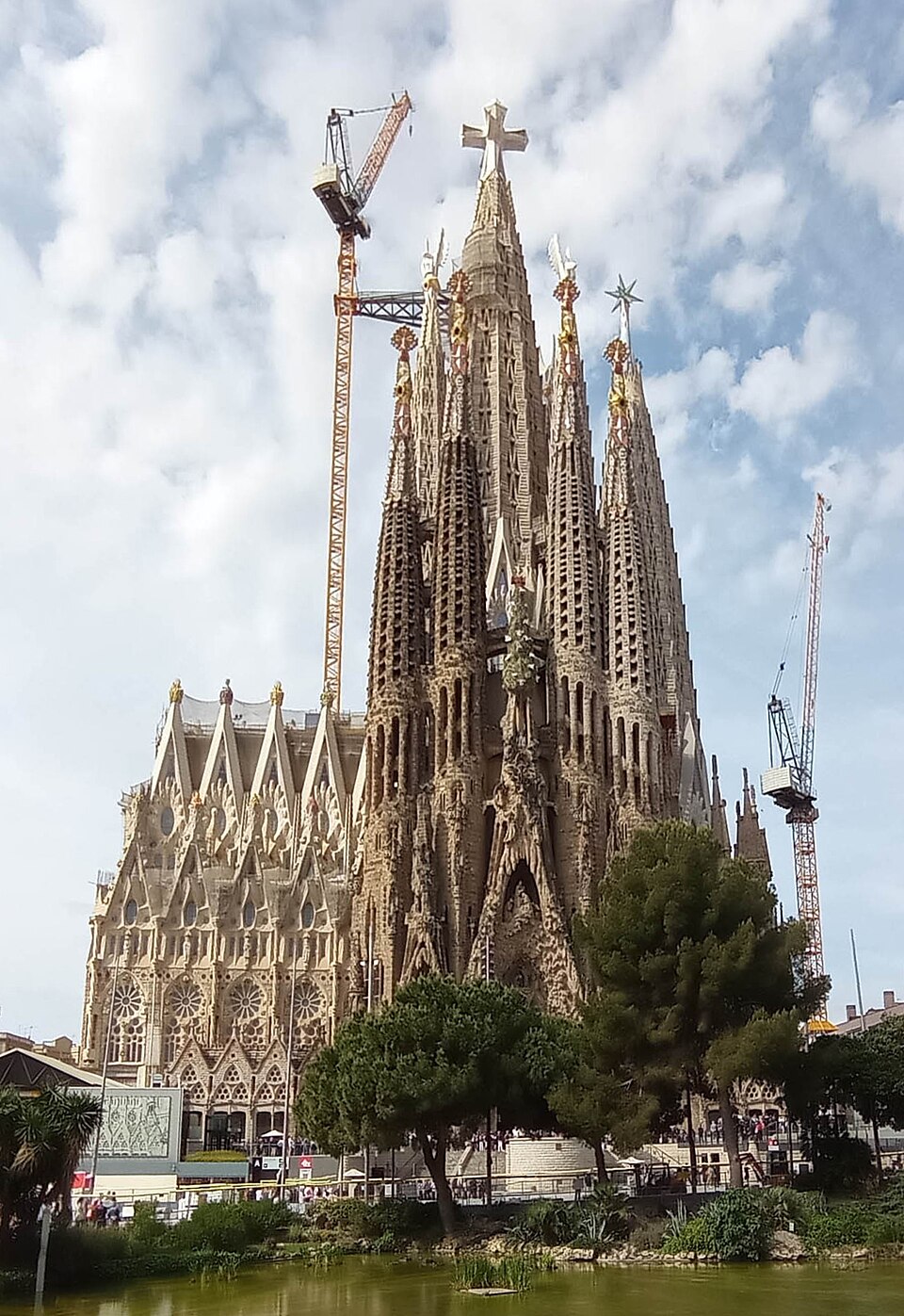
Architect Antoni Gaudí’s masterpiece, Barcelona’s enormous Basilica of the Sagrada Família (Basilica of the Holy Family)—as of 2026, the tallest church in the world—is impressive, original, remarkable. Its light-filled and colorful interior is vibrant and crisply carved; it’s hard to miss the beauty in the interior’s exuberant expressions of joy. But is its agitated, unorthodox, unsettling exterior with its surprising juxtapositions of elements in unexpected shapes, combinations, and mud-colored materials beautiful? Yes, though not in the expected, formal way that medieval Gothic cathedrals or 19th century New England Greek Revival buildings are. It is the strangeness of Sagrada Família’s beauty that makes it so extraordinary. Does that odd beauty amplify the basilica’s message of the power of Christian love? I think it does.
Though I am no longer a person of faith, I was raised in the Christian tradition. I still delight in many aesthetic elements of it—art, architecure, music, storytelling. Today, I approach religious structures like basilicas primarily as artistic and cultural marvels. However, I still feel their emotional resonance, and sense the deep spiritual impacts they have on believers. They still evoke in me strong feelings of respect and awe.
To eyes trained on the crisp lines and exact precision of medieval Gothic cathedrals, the organic and indistinct quality of this Catalan basilica’s undulating and hard-to-decipher surfaces can be confusing, bizarre—even off-putting. The Nativity Façade in particular is full of irregular figures and materials that blend strangely into one another. They do not have the crisply rendered formal expressions of Heavenly majesty and might that medieval stone cathedrals do.
Gothic cathedrals had precise verticals and evenly spaced flying buttresses, each one perfectly reproducing the one before. Gaudí’s religious dioramas are accumulations of images and shapes, some obscured by the sheer volume of activity around them. Though also carefully carved, Gaudi’s basilica gives the sense of being freely sculpted, not carved slowly and precisely into wood or stone. The three-dimensional people and scenes on the exterior feel as if they’d been gathered like mud by human hands, then pressed into the cathedral facade, instead of carved from stone. These sculpted façades have a definite gravity and weight to them; they seem to drip downward from Heaven rather like (forgive me) a muddy and collapsing hillside.
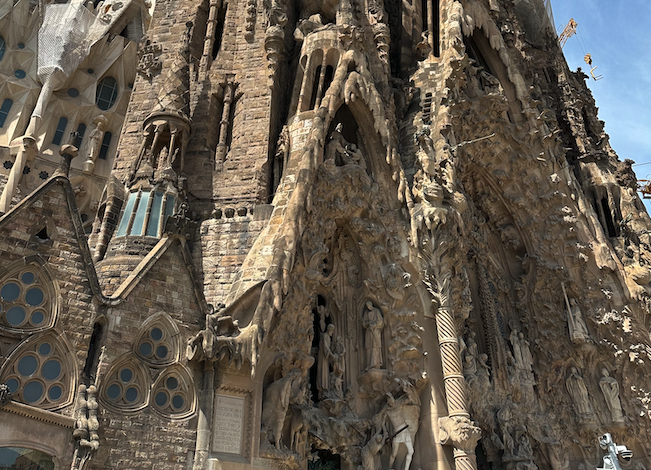
Is such an erratic, unexpected, and distinctive agglomeration of elements ugly, bad, or wrong? No! Not to the millions who love Gaudí’s personal, human, and singular vision of the beauty and wonder of his faith and his God. For them, Gaudí’s basilica accomplishes things that such grand structures rarely can. These include evoking feelings of both grandeur and intimacy, and precision and irregularity. The basilica combines the unusual combination of feelings and forces to celebrate the elevation of a human family into a holy one—the beatification and glorification of the most elemental elements of human society: a mother, a father, and a child. In Gaudí’s religious imagery, visitors can recognize their own families, as well as themselves. The greatest, most all-encompassing story in a Christian life, the story of Jesus, is made personal, real, and human by telling it through a structure both more vast than is comprehensible, and also deeply intimate and personal.
Instead of static, precisely defined features, Gaudí’s surfaces feel hand-sculpted and in motion. This quality gives Sagrada Família the feel of a living, breathing entity. It entrances some visitors, and makes them feel closer to the emotional core of Christianity—a very deep and very human love of God inspired by the sacrifice of his human son. Of course, for others, the building’s style and structure evoke feelings of the instability and impermanence that come from relying on humanity’s irregularities and imperfections.
Some visitors revel in Gaudí’s expression of the humanity of God made man in the body of Jesus. They feel the undulating unevenness of the building materials and decorations signify the humanity of Jesus, Mary, and Joseph—the Holy Family for whom the basilica was named.
Others find greater security, awe, and majesty in the precision of more traditional cathedral architecture. They look at a structure like St. Peter’s Basilica in Rome, or Our Lady of Chartres Cathedral in France, and are awed, yes. But they are also amazed that such a remarkable and precise celebration of the glories of Heaven could be accomplished on Earth by thousands of human hands over hundreds of years. They feel the humanity inherent in the majestic structure, too. Just not in the same way.
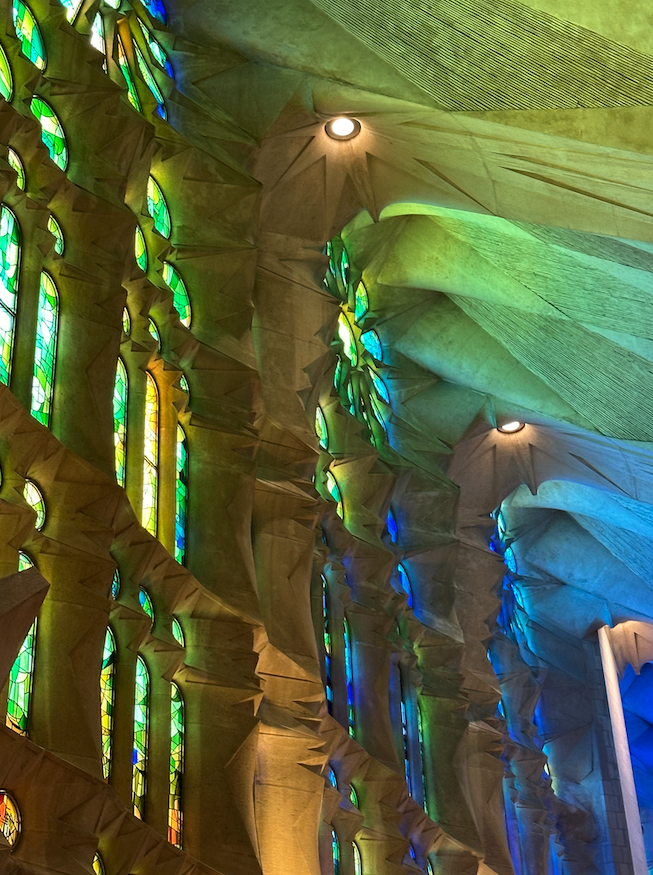
But whatever one thinks of Gaudí’s exteriors, the interiors of Sagrada Família are another thing entirely! What magical spaces full of jewel-toned light! Standing inside that magnificent space, so different from any other, one can understand how it so often inspires people to feel devotion, awe, and the sensation of a divine presence. Gaudí’s basilica may evoke discomfort because of the organic, undulating, even unstable quality of its exterior. But during the very same visit, its interior brings a sense of delight, ease, and glory through the surprisingly naturalistic forms and colors created inside, thanks to the play of light through its windows and its forest of unusual columns.
In one particular, Sagrada Família has something charming in common with the medieval cathedrals of 900 years ago. One sees evidence of lighthearted humor in Gaudí’s sculpted tortoises and turtles, small but devoted guardians of the basilica that can be found holding up several pillars. The creatures provide welcome lightness and comic relief, as gargoyles or self-portraits of sculptors and architects did on medieval façades.
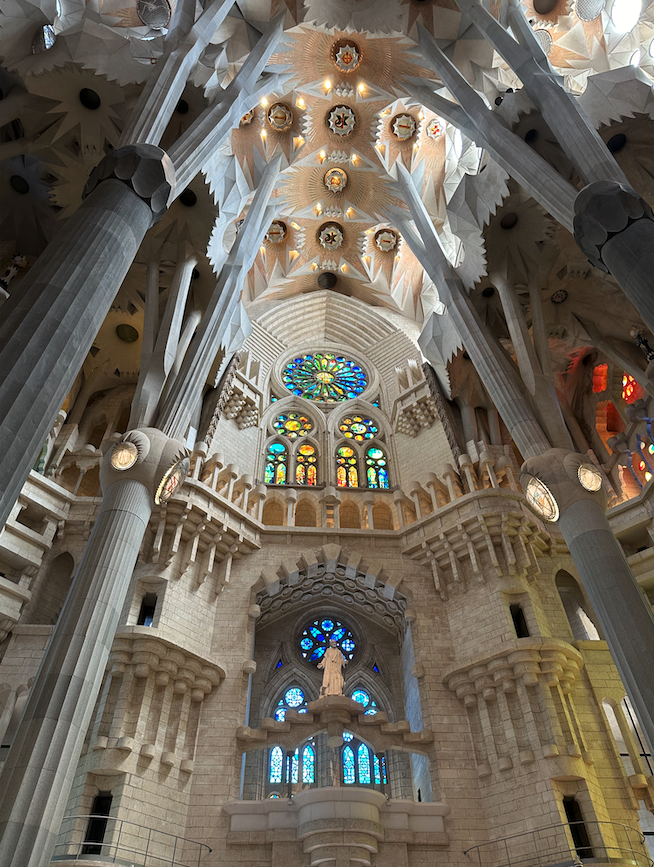
Gaudí had an extraordinary vision for the basilica, for which he became chief architect a year after building was begun in 1882. By the time he died as a result of a tram accident in 1926, he had spent 44 years reshaping the plans and implementing his Gothic and Art Nouveau-inspired designs for the building, which was only one-quarter complete at the time of his death. The basilica is still unfinished, but it is nearing completion. As of 2026, with the raising of the 566-foot-high central Tower of Jesus Christ, Sagrada Família became the world’s tallest church. It was inaugurated and blessed by Pope Leo XIV on June 10, 2026, in honor of the centenary of Gaudí’s death.
Though the cathedral was his greatest work, Gaudí managed to design and oversee the construction of a number of other major buildings, several of which hold UNESCO World Heritage status. These include the Park Güell, the Palau Güell, and the Casa Milà, Casa Vicens, and Casa Batlló; Sagrada Família’s Nativity façade, crypt, and apse; and the crypt of the Colònia Güell in Santa Coloma de Cervelló. The architect is so beloved in Catalonia that a sainthood guild has attempted to canonize him since 1992. In 2025, shortly before his death, Pope Francis declared Gaudí venerable; the Vatican described him as possessing “heroic virtue.”
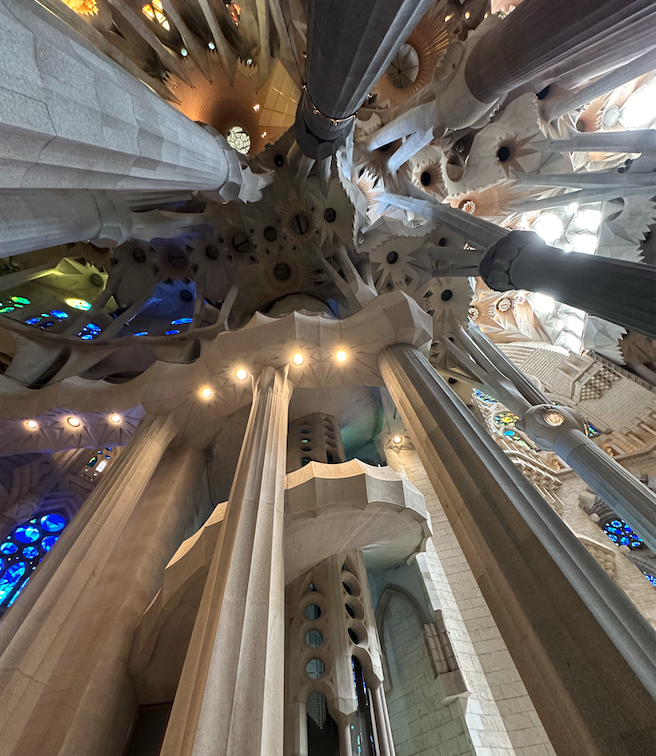
Before visiting Barcelona, I had never experienced such diametrically opposed aesthetic impressions about the interior and the exterior of a house of worship. That dichotomy is part of what makes this structure a masterpiece. There’s the fresh, strange wonder of the mind that envisioned it. And there’s his willingness to escape the linear precision of traditional cathedral architecture and explore a new, if sometimes lumpy, indistinct, even unsettling vision. The softened shapes bring this sacred space closer to the imprecise and organic shapes of nature, human bodies included. Visiting it may even make imagining the experiences of The Holy Family feel more personal and immediate to some visitors, while still expressing the grandeur of God.
But, of course, what really brought the cathedral to life was a century of talent and faith expressed by the thousands of craftspeople who forced it into being. For an architectural plan is only a dream until the muscles and sinews, eyes and mind, and sweat and strain of those who build it combine to make it real.
At top:
The interior of the basilica was designed to evoke a forest. According to Gaudí’s vision, each type of column represents a different species of tree. The light that floods the interior reminds one of a colorful garden, or the changing of light from dawn to dusk, or, for some, the glory of God | Laura Grey