Tag Archives: Best Picture Nominee

The Woman at the Heart of Hamnet

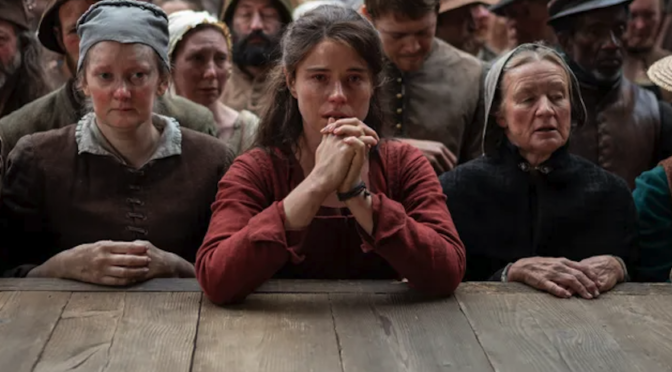
Oscar-winning Chinese filmmaker Chloé Zhao’s stunning 2025 film Hamnet and two other introspective and intimate Best Picture Oscar nominees this year feature stories of familial tension and loss. Zhao’s intense and beautiful contender for the award joins Sentimental Value and Train Dreams, all of which often convey a great deal in few words.

The film is named for the son of William Shakespeare and his wife Agnes (who was also known as Anne Hathaway). As the film tells us at its outset, the name Hamnet was often used interchangeably with the name Hamlet during Shakespeare’s time. Hamlet is, of course, also the name given to Shakespeare’s most famous character, as well as to Prince Hamlet’s father (the late King Hamlet), and to the play that bears their shared name.

Hamnet is frequently, and accurately, described as a film about how Will and Agnes handle their grief over the loss of their son. However, that spoiler (which every film reviewer and plot description I’ve seen has broadcast to the world) does not express how unusual Will and Agnes’s relationship is. A short blurb can’t convey how much the loss of a child affects a family’s world, and in this case, the world at large. Nor does it make clear that neither Will nor his son Hamnet stands at the heart of the film, as one might expect.

It is the earthy and somewhat mystical Agnes who carries the film on her strong shoulders. She immediately impresses us with her forthright nature. The film introduces Will—surprisingly and intriguingly—as her awkward, less self-assured, more inwardly focused partner. This is not the confident and winning playwright whom Joseph Fiennes portrayed in the light and comic Oscar-winner Shakespeare in Love (released in 1998 and written by the late playwright Tom Stoppard). Hamnet shows us a fragile, often melancholic version of Will, a man who loves his family deeply, but is driven by his own intense need to create, and must leave the family’s rural home to pursue his dramatic gifts in London. 

A close-up photo showing the faces of Jessie Buckley as Agnes and Paul Mescal as William Shakespeare in the movie Hamnet. Both actors are shown with their faces in closeup and their faces and eyes cast down.
Jessie Buckley as Agnes and Paul Mescal as William Shakespeare in Hamnet

Having read much about the impact that grief over the death of a child has on the story, I put off seeing the film. I feared it would leave me devastated, like William Styron‘s Sophie’s Choice and Thomas Hardy‘s Jude the Obscure did. But I didn’t anticipate how co-writers Chloé Zhao and Maggie O’Farrell (whose screenplay is based on O’Farrell’s novel) would bring their characters and audience to a point of catharsis as moving as any I’ve seen this year. 

It would be misleading to say that it is a feel-good movie. It deals with grief in heartbreaking and believable ways. The cause of characters’ pain doesn’t evaporate when they glean insights or find ways to connect to others through their grief. But Hamnet helps us see how understanding and empathy can create not only essential human connection, but also great works of art. The story examines how grief can help people discover deeper love and greater purpose in their lives and relationships. It does not argue that grief is good, nor that suffering is worthwhile. But it does help us see how even something dreadful can lead us to understand others more deeply or clearly, or impart knowledge that lets us create things we couldn’t otherwise achieve. 

The magic at the center of the production is the transcendent performance by Best Actress Oscar nominee Jessie Buckley. She plays Agnes with profound passion, honesty, and heart as the counterpart to Paul Mescal‘s moving performance as Will. In playing a woman who engages with others and the world in an open, direct way, Buckley could have come across as brash. But Agnes’s inability to play the coquette or defer to her family’s desires isn’t selfish or brazen. She simply cannot be untrue to those whom she loves, or to the things she holds dear and believes to be true. 

Agnes is bold, stubborn, grounded, and sometimes wary. But there is a purity and sincerity to her that moves her family, and us. In Hamnet, Jessie Buckley delivers an astonishing and luminous performance.
The Things We Say Without Words: Train Dreams, Sentimental Value & Past Lives

Oscars are often awarded to big, talky American movies full of rapid-fire dialog and insistent energy. But this year’s Best Picture nominees include powerful but quiet films that inspire deep emotion thanks to strong but subtle performances. Both Train Dreamsdirected and co-written by U.S.-born director Clint Bentley, and Sentimental Valuea Norwegian film directed and co-written by Joachim Trier, create their magic using surprisingly few words. The same was true of Past Lives, Korean-born director Celine Song’s moving 2023 Best Picture Oscar nominee.

Train Dreams

Train Dreams is rich with lush and imposing scenes of rural Washington State, which stands in for Idaho ably thanks to Adolpho Veloso’s Oscar-nominated cinematography. Indeed, beautiful but often-dangerous nature plays such an important element in the story, one could almost say that the landscape is one of the film’s main characters. 

Joel Edgerton’s understated performance as logger and railway worker Robert Granier is at the heart of the story. He uses few words but conveys deep feeling through gesture, tone, and his heartbreakingly expressive face. Edgerton was well cast in this role, since he’s especially gifted at expressing sadness, loss, or pain in a compelling way, without making a big, bold fuss of it. His isn’t a flashy kind of charisma, but he draws us in for exactly that reason. It’s his quiet quality that draws us closer, since we don’t want to miss a word. 

The arc of the film, which is based on Dennis Johnson’s novella,  includes a good deal of difficulty and lost opportunity. The story—full of love, loss, and longing—is episodic. It moves through a series of Granier’s introductions to people who connect, deeply but often briefly, to the introspective, quiet, often lonely man. Most are themselves introverted and comfortable being on their own for vast stretches of time. 

Yet Granier and those who move through his life connect to each other quietly but profoundly, without a lot of talk or explanation. They bond over shared kindness, sincerity, and modesty. We don’t need to be told that these are good people; we can see and feel who they are through their actions. The film does include narration, but it’s not overly intrusive. The writers trust the audience to be able to read into the characters’ words and actions without a lot of wordy exposition. The script doesn’t explain the characters’ motivations or backstory more than necessary. 

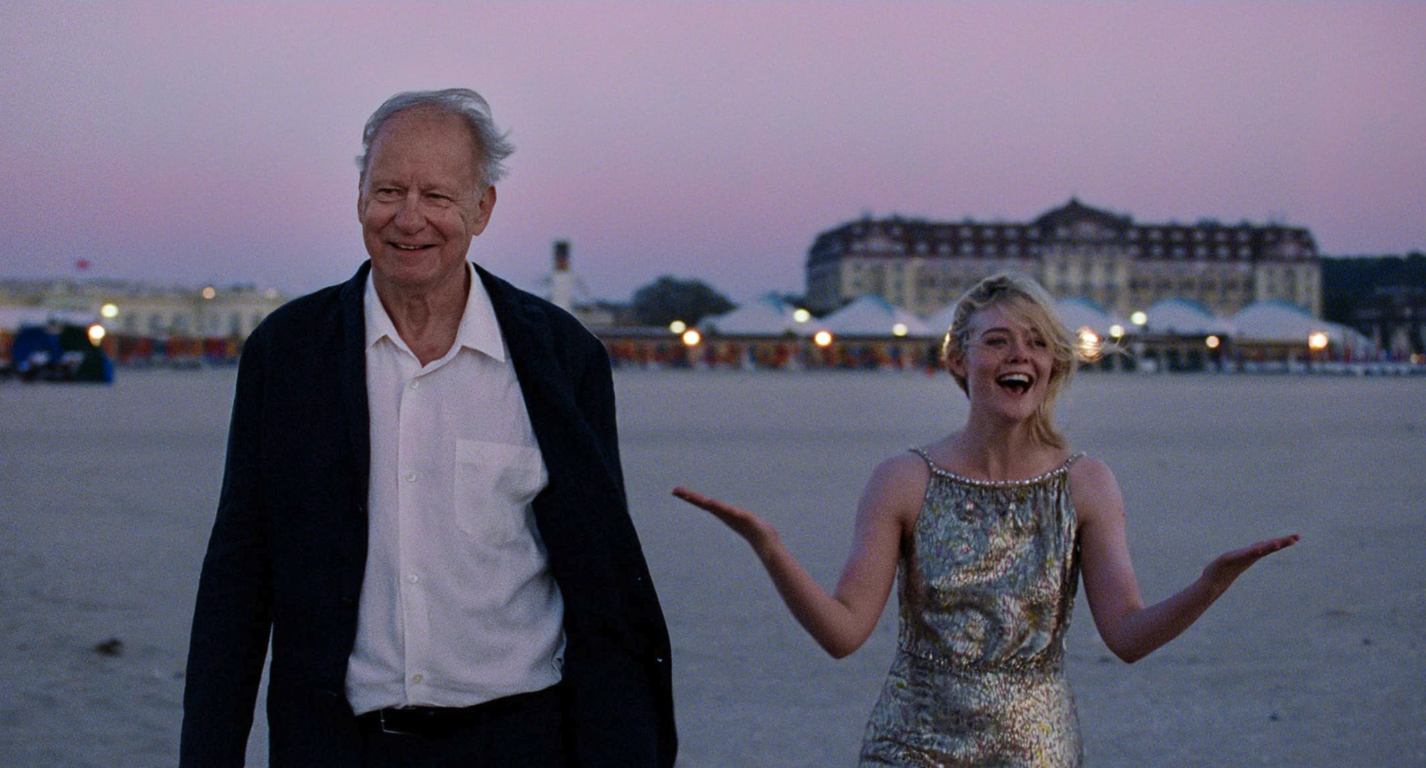
Stellan Skarsgård and Elle Fanning walk on a beach at dawn in the film Sentimental Value
Stellan Skarsgård and Elle Fanning in Sentimental Value

Sentimental Value

Swedish actor Stellan Skarsgård brings his own quiet intensity to Sentimental Value, which has earned him his first Best Supporting Actor Academy Award nomination. He portrays a famous and much-admired film director who has always had difficulty connecting emotionally with the people he loves most. 

Sentimental Value begins by introducing us to the house at the center of the story. Just as the landscape of rural Idaho plays an important role in Train Dreamsthe Borg house in Sentimental Value is an essential character from beginning to end. The film begins by introducing us to the house in the many forms it’s taken over the previous century, easing us into the story through soft humor and just enough back story. Then the players take over, speaking to each other naturally in Norwegian, Swedish, English, and Danish by turns. 

The film is very Nordic in tone, not only because of the location and primary languages spoken, but because of how much of the story is unspoken. The feelings are clearly there, but expressed over time, and through movements—the slow spread of emotions across a face, the silent exchange of looks between people, the mounting realization of what is about to happen based on seemingly simple, everyday movements that all add up to something shocking. 

Skarsgård is a master of discomfort. In so many of his best roles, we understand how he’s feeling not because of the words he says, or even the way he says them, but by the way he shifts in his chair and diverts his attention away from things he doesn’t want to deal with. He looks silently into his lap, unable and unwilling to say the one thing that most needs to be said. Here, as in his masterful performance as Detective John River in the excellent 2015 British TV miniseries River (not to be confused with the 2012 horror series The River) Skarsgård is comfortable inhabiting discomfort. In each role, he plays a highly skilled and insightful professional. As both Gustav Borg and John River, his characters’ most intense pain comes from the emotional reticence that they must face before solving their greatest professional challenges.

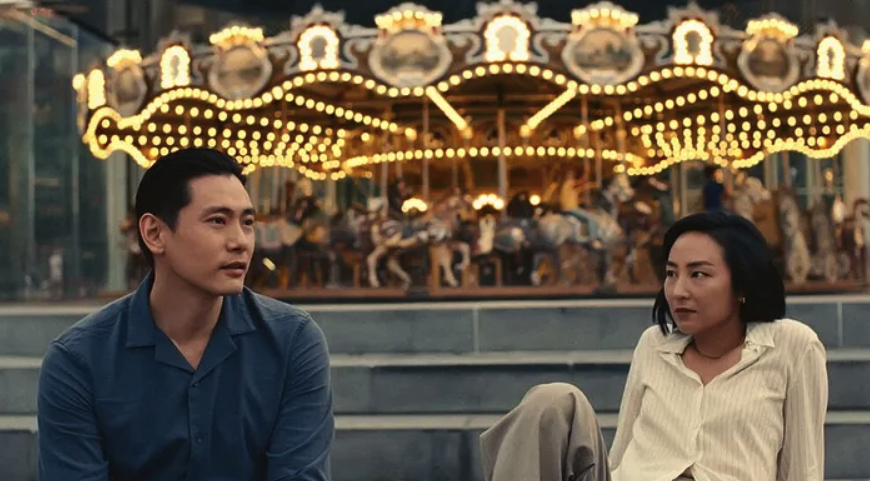
Teo Yoo and Greta Lee sit on a bench together in front of a brightly lit merry-go-round in the film Past Lives
Teo Yoo and Greta Lee in Past Lives

Past Lives

South Korean-born Canadian director Celine Song’s debut film, Past Lives, has much in common tonally with the films mentioned above. Nominated for Best Picture and Best Original Screenplay Oscars two years ago, this film shows similar restraint. Its dialog, which is mostly in Korean, is spare. Its most important feelings are often left unexpressed, but made clear to the audience in the spaces between words. 

Past Lives focuses on two characters, Nora and Hae Sung, close childhood friends in South Korea who lost track of each other when Nora’s family moved to the U.S. We first see them together in childhood, clearly enjoying being in each other’s company, but often doing so silently, or while sharing few words. We next meet up with them some two decades later, when they reconnect online, then decide to meet in person. Though some important dialog is spoken aloud, much of what passes between them is expressed through silences—eloquent and beautiful ones.

I saw Sentimental Value shortly before Past Lives. While watching actors Greta Lee and Teo Yoo give such moving performances in the latter, I was struck by the similarity between Nordic films (such as those by Joachim Trier and Ingmar Bergman) and Celine Song’s film. Though outwardly quite different in style and subject matter, they share a great deal in their characters’ comfort with silences, and in the stories’ ability to express deep feelings with few words. Both Trier and Song were born into cultures that prize emotional restraint, comfort with silence, and the belief that scenes built on tacit understanding often convey more than a page of emotionally heated dialog can. 

When expressed by talented and thoughtful writers, directors, and actors, a spare script with limited dialog can allow actors to shine if they have the restraint and comfort with nuance that makes these three films so special.

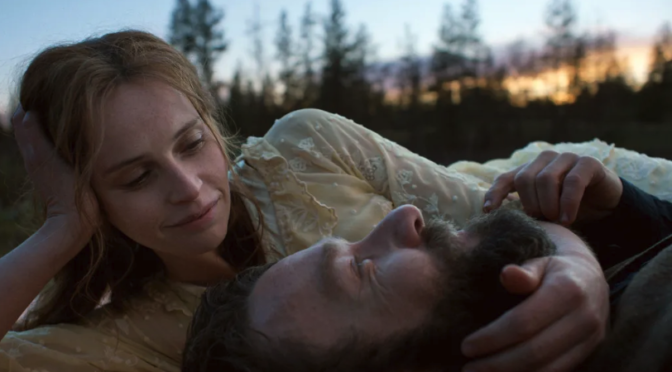
At top:

Felicity Jones and Joel Edgerton in the 2025 film Train Dreams