The World of a 1960s Housewife

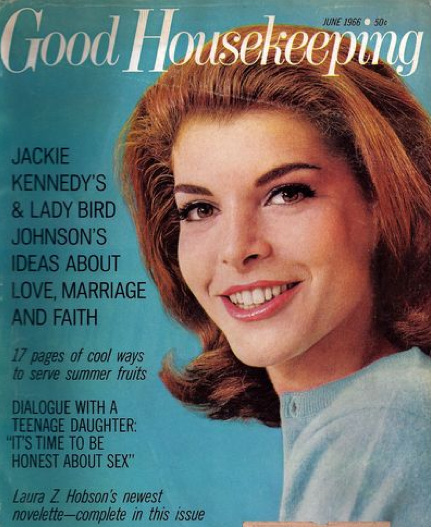
Good Housekeeping

[Revised from an article published on Laura Grey’s Little Hopping Bird blog.]

I recently purchased a cache of vintage magazines from 1960 to 1971, and have marveled at the extent to which the content,  writing styles,  focus of advertisers and willingness to talk candidly about social issues changed over the course of that decade.

The transition from the height of the Cold War in 1960 to U.S. immersion in a  very unpopular war in Vietnam in 1971 is fascinating. During this period, women’s magazines changed more than they had in any other single decade since the Depression. In 1960 they were filled with home-centered fantasies and prescriptive articles telling how to be the ideal wife and mother with perfectly starched aprons, a fresh darling dress and matching heels, an adoring husband and well-fed children who loved your latest Jello creation. By 1971 they were covering serious, formerly unmentionable subjects like sexual problems, psychiatry and psychotherapy, rising drug use among youth, and other hot-button social issues and political stories that would never have made it into a women’s magazine a decade earlier. Of course, there were still articles with titles like “17 New Designer Patterns for Fall” and “The Foods that Make You Prettier.”

I was surprised to notice how many of the products advertised in 1960 would be found to be downright dangerous in the following ten to twenty years. The archetypal housewife of 1960 had the specter of The Bomb looming over her life and she was trying to use modern chemistry and technology to provide a cleaner, whiter, safer life for her family. How ironic, then, that these fresh technologies and newly synthesized chemical compounds would later be the cause of so much unnecessary suffering.

The oldest of the magazines is an issue of Good Housekeeping from May 1960. The very first page of the issue has an ad for Ipana toothpaste touting their new germ-killing ingredient, hexachlorophene. I remembered the brouhaha caused by hexachlorophene in the early seventies, when it was discovered that the potent germ killer, chemically related to herbicides, was toxic and could cause cerebral swelling and brain damage in humans. We had pHisoHex, a very popular facial cleanser incorporating hexachlorophene, in our home when I was a child. I remember when it and other affected products were pulled from the market with much alarming media coverage in 1973. The product is actually still sold and used to prep skin for surgery and fight infections that haven’t responded to other treatment, but packaging warns against excess hexachlorophene absorption and the possible dangers to the central nervous system.

I didn’t have to look far to find another dangerous product marketed to anxious mothers with sick children. Page 4 features an article for St. Joseph Aspirin for Children, a delicious treat I remember from my childhood. Tiny orange-flavored aspirin tablets for children were chewable and so tasty, the company had to invent child-proof caps (which I remember opening for my grandmother because she didn’t my childish dexterity). Kids ate them like candy. Of course, by the 1980s it was discovered that Reye’s syndrome, a severe illness which can cause acute encephalopathy, can be caused by giving aspirin to children. When this was understood and NSAIDs like Ibuprofen began to be recommended for children’s use in place of aspirin, the number of cases of Reye’s syndrome dropped dramatically across the country. Plough was a smart enough company to change their marketing for what had been called “baby aspirin” to take advantage of the discovery that small amounts of aspirin taken daily could help ward off strokes in older people with high blood pressure. The company now markets the same product to older people who don’t have the risk of contracting Reye’s disease that children have.

Though not an advertisement, I do have to give a shout-out to the column “Foods with a Foreign Flavor,” which featured “Three festive recipes from Colonial America,” which is, of course, completely contrary to the point of having a column about international foods. Best of all was the recipe for Maple-Nut Whip Pie, which included as a primary and necessary ingredient a package of unflavored gelatin, which, as you may know, wasn’t a product found in Colonial American kitchens. A whipped cream pie based on gelatin and egg whites whipped into a near meringue—no recipe could be more foreign to an early Colonial American.

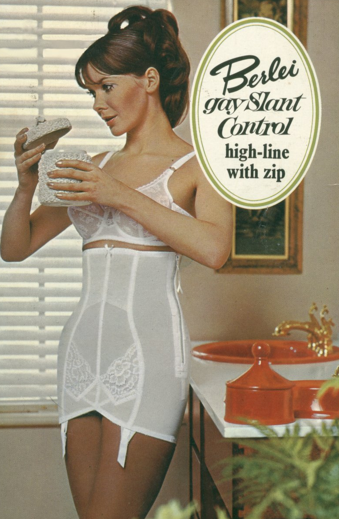
Warner’s, still a major maker of women’s undergarments, featured a lovely layout of mannequins wearing scary bras and girdles to keep women’s bodies completely jiggle-free. My favorite set? Probably the “Most famous Double-Play” high-topped girdle with built-in garters (remember, pantyhose hadn’t been invented yet) in the elegant blue pearl colorway, with “Matching pantie” and “A’Lure” bra. The ad exults, “Happy you! Your hunt-and-fret days of girdle choosing are over!” Each girdle offers some new fresh Hell of discomfort so that you might fit more snugly into that Jackie Kennedy-knock-off skirted suit made of fatteningly bumpy chenille that was so popular at the time. “Some with midriff-shaping Sta-Up-Top! Some with hip-slimming side panels; all with flattening back panels!” Because every woman wants a flat behind, right? Huh. This was an era when a natural wiggle was the sign of a loose woman, and a woman who wore a dress without a slip was an absolute hussy. The ad claims these products had “All-over slimming made magically comfortable,” but my mom’s girdles were tighter than compression bandages and lined in horrible rubber ridges. In hot weather, those ridges pressed deeply into her skin. There was little that was less magically comfortable than those horrid, tight, hot, constricting monstrosities. They were better than rib-crushing corsets, but a far cry from today’s comfy undies.

Girdle

Berlei high-line girdle ad from the 1960s

The Equitable Life Insurance ad on Page 21 features a serious, carefully dressed woman in a kitchen doing deep knee-bends next to the stove while her husband and son sit at the kitchen table ignoring their cherry-topped grapefruit halves to ogle the hot mama who has kicked off her shoes and is earnestly working to keep her fine figure. It’s like a scene right out of “Mad Men,” set in the early 1960s in the Madison Avenue ad world, where a woman’s job was to get and keep a man, and where men taught boys to look at women, even mom, as objects of desire and little else.

Do you remember Fizzies, the tablets dropped into plain water than created instantly carbonated drinks? Kids loved them, and most of us tried to get our moms to let us have some to suck on without water so we could feel the effervescent action directly on our tongues. Page 24’s ad promises “Fizzies are FUN to make and drink—and so GOOD for you!” I had to wonder how they could make this claim about the “sprizzling, sparkling goodness” of their product, which was “as up-to-date as the newest jet.” It turns out “Mothers prefer Fizzies, too—they’re two-ways better for health. No sugar—safer for teeth—won’t destroy healthy appetites.” Hmm, no sugar? They wouldn’t be sweetened with saccharin, the earliest artificial sweetener, would they? My research confirmed that yes, they were. And saccharin was the focus of yet another health scare in the early 1970s; in fact, the USDA attempted to ban the substance in 1972, as another artificial sweetener, cyclamate had been banned in 1969 after causing bladder tumors and cancer in rats. Cyclamate had been used in an earlier formulation of Fizzies. Saccharin was and remains banned in Canada while remaining the third most popular artificial sweetener in the U.S.

The attractive opera star Roberta Peters is featured in two different ads in this issue, one for St. Joseph’s Aspirin, the other for Murine eye drops. It’s hard to imagine a mainstream magazine featuring a coloratura soprano diva to sell anything at all nowadays, the art form is so much less popular among the general public. Roberta Peters was a well-known figure then, not only on the stage but also on TV and radio. Even though the average American lived on modest means in a modest home or apartment with much less education than is normal now, there was a greater ease with an interest in classical vocal and orchestral music at the time. Leonard Bernstein‘s Young People’s Concerts featuring classical music interspersed with Bernstein’s captivating commentary were televised from Lincoln Center in New York City to the rest of the country for a decade beginning in 1962, and they were enormously popular, helping people of all ages to become conversant with the classical canon.

Skipping recipes for curried fruit bake and a jeweled Bavarian (a dessert that includes raspberry “gelatine,” port wine, eggs, scalded milk and heavy cream—ugh), I find an ad for Velveeta, the “pasteurized process cheese spread” of my childhood that seems to have been melted all over everything. There’s an exciting frost-free Frigidaire (and if you don’t think a frost-free freezer isn’t exciting, you’ve never defrosted an iced-over fridge and dealt with the resulting puddles on your floor). Another ad features a woman in pearls wearing a spotless white blouse and no apron while she cleans a filthy oven. Such fantasy. My favorite product name in this issue? That would be the cream deodorant with this straightforward moniker: ODO-RO-NO.

Hey, are you old enough to remember bad home perms? Girls whose moms had left the permanent wave solution on their heads so long they ended up looking like frizzed-out poodles? Here on page 153 is Bobbi, a home perm kit that you put in at night and don’t wash out until morning. Trying to sleep while wearing hard plastic perm curlers all night is one thing; having that horrible-smelling chemical stew sitting on your head for eight hours and breathing it in is another. On page 157 is Come Alive Gray, the hair color for women who like their gray hair. Add a brilliant pearly glow, enjoy a gleaming silver, or “add lustre . . . with rich, smoky tones.” I remember these different shades of gray on old ladies: lots of slightly lavender, blue or even pink hair was popular for a time, and these chic ladies sometimes dyed their poodles to match.

Bradley Cooper

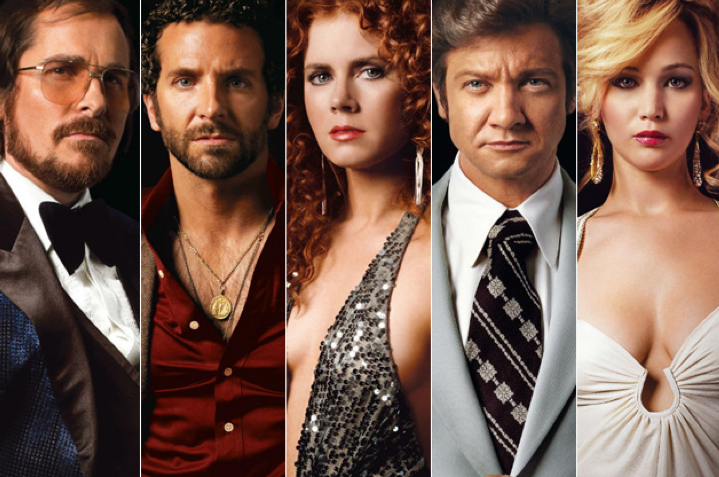
Bradley Cooper sports a head full of home permanent curlers in the film “American Hustle,” which takes place during the perm-crazy 1970s

Ah, doilies! I’d forgotten how popular they once were. Paper doilies under every cake, plastic doilies under Hummel figurines (because “Your ‘best’ looks better on plastic Roylies”), even crocheted lace doilies on backs of chairs to keep the hair oil off the furniture (that’s why they were called antimacassars—to keep the macassar men’s hair oil off the brocade). And Brillo pads! They were once so popular before nylon scrubber sponges came along to save us from quickly rusting soap-imbued metal mesh pads that stabbed one with loose, sharp aluminum points. By 1960, Brillo pads contained “Jeweler’s Polish” and produced a “richer, livelier lather.” Yes, lively soapsuds.

“Live Outside and Love It!” You can with Hudson pesticide sprayers and dusters. Wear your pretty spring dress and spray DDT all over your roses while your husband teaches your daughter to putt six feet away and your son sits at Dad’s feet, looking up adoringly. All of that is charmingly illustrated in Good Housekeeping. Of course, in 1960 gardeners had no idea that DDT was so extremely toxic that it would be banned in 1972, and so persistent that it still shows up regularly in the blood of people alive today. In the United States DDT was detected in almost all human blood samples tested by the Centers for Disease Control in 2005. It is still commonly detected in food samples tested by the FDA.

Make light work of chores indoors by playing your new miniature radio with six transistors. This tiny beauty is only four by six inches and costs just $39.95—that’s in 1960 dollars, when the average income of a four-person family was $5600 per year.

Isn’t it odd that not one but at least two tuna canners wanted to compare their tuna to chicken last century? I knew of Chicken of the Sea, but had you heard of Breast-O’-Chicken Tuna? And have you tasted Pretzel Meat Loaf? Yes, meat loaf made with the lavish inclusion of crushed pretzels, “catsup” and canned mushrooms. There’s a recipe on page 215 you won’t want to miss. (Urp.)

What other hazardous materials was advertised here? Well, there’s a baby powder that’s almost certainly made of talc, which contains asbestos and has been asserted to raise the risk of ovarian cancer in females who use it in the genital area. Nowadays pediatricians recommend avoiding talcum powder and suggest using powders with a cornstarch base instead. A few pages later is a hot steam vaporizer, the kind I scalded myself on numerous times as a kid. The glass got so hot, the steam burnt my fingers or legs as I neared it, and the whole thing had a rounded bottom so it could tip and spill nearly boiling water and hot liquid Vick’s Vapo-Rub (which was melted in the well on the top and sprayed into the air, leaving a fine petroleum-based film all over the windows and, it turns out, irritating the lungs as well). Thank goodness for today’s cool-air humidifiers.

Next page? Mothballs! Very toxic, made with naphthalene, they can cause all sorts of bad side effects with increased exposure, and can cause death when eaten. Why would you eat a mothball? Ask all the little kids who’ve tried them! A few pages later we find insect killer spray (very likely DDT-laced). Anxious about the hazards in this big, crazy world? Why not brighten up your home interiors with a coat or two of SatinTone paint? People of the Mad Men era used this (probably leaded) oil paint on the walls of baby’s rooms and the volatile vapors stunk up their homes and burn their throats for days before it finally dried. It’s hard to overstate how wonderful the invention of fast-drying, low-stink indoor acrylic paint is.

Honestly, this magazine is a minefield of health and safety disasters just waiting to happen. What a fascinating reminder of how much we’ve learned in the last fifty years about environmental toxins, hazardous home-based chemicals and healthy eating!

The Times of Harvey Milk

milk

[Revised from an article originally published on Laura Grey’s Little Hopping Bird blog.]

In 1978, San Francisco mayor George Moscone and San Francisco’s first openly gay city supervisor, Harvey Milk, were assassinated by Dan White, another San Francisco supervisor. Dianne Feinstein, now a U.S. Senator from California, was president of the board of supervisors; she witnessed the aftermath and announced the tragedy to the press, and rose to the position of mayor of San Francisco as a result of the assassination.

I remember the time vividly. When I was a young girl, I had met George Moscone, then a California state senator, at a Democratic party rally I attended with my mother, and I was starstruck to meet someone whose face I had seen smiling on our television during nightly newscasts. Beyond the fact of his familiarity was his personal charm; Moscone was energetic, charismatic and bigger than life. The assassination was shocking, happening as it did at the hands of a coworker of both of the victims, an attractive and clean-cut fellow whose blind rage inspired a dramatic and highly publicized trial in which killer Dan White was convicted of manslaughter, the lightest possible charge against him, based in part on the fact that his attorneys said he’d gone temporarily mad because of the large quantity of junk food he’d consumed prior to the crimes. This “Twinkie defense” outraged people across the country and inspired a change to California criminal law.

The murder also inspired the creation of an odd and controversial work of art by one of my favorite Bay Area artists, sculptor Robert Arneson (who received his Master of Fine Arts degree from my alma mater, Mills College). In 1980 Arneson was commissioned to create a work to memorialize Moscone in San Francisco’s new Moscone Convention Center. It is a mystery to me why the Arts Commission would ask a sculptor as famously irreverent and outrageous as Arneson, who had made a name for himself sculpting wild and ridiculous ceramic self-portraits, to commemorate someone who was best remembered for the brutal and horrible circumstances of his death. The bust of Moscone was done in Arneson’s usual style, which is to say it was bold, disturbing and unflattering, and, most shocking of all, it was placed on a large pedestal which commemorated the circumstances of Moscone’s murder. Arneson was asked to change the work and refused, nor would he consent to have the sculpture displayed with the pedestal art hidden. He returned the commission he had been paid for the piece and resold the sculpture. It is powerful and arresting, singularly disturbing and unlike any official commemorative sculpture I have ever seen.

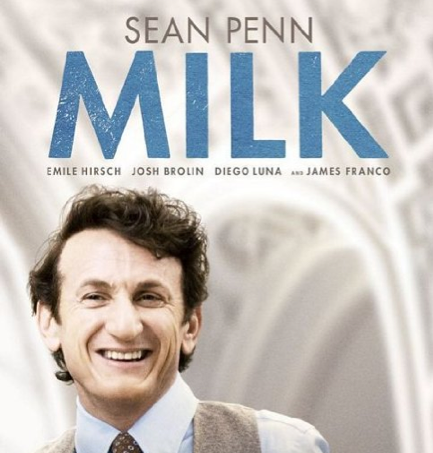
At the time of the murders, the greatest attention was given to the killing of the mayor; I was aware that another supervisor who was openly gay had also been murdered, but in the general news of the time my memory is that most Bay Area news media treated that as a decidedly secondary part of the story. Since then, however, little has been said or written about George Moscone that most people, even in the Bay Area, would know much about; few would remember much about him beyond his having been murdered and having had a San Francisco convention center named for him, while Harvey Milk has inspired a very successful, Academy Award–winning documentary, “The Times of Harvey Milk” and is the subject of “Milk,” a moving and important biopic by director Gus Van Sant starring Sean Penn as gay rights pioneer and civic reformer Harvey Milk, which won Penn his second Academy Award for the Best Performance by An Actor in a Leading Role. What makes Milk worth such attention and even adulation is of course not the nature of his death but the powerful story of his life and what he did with it during his 48 short years.

The quality of biographical films is often limited by the fact that they are usually conceived of as propaganda of some sort and are meant to elicit certain strong feelings from the audience. Biopics like “Ray” or the disappointingly inaccurate film “A Beautiful Mind” are crafted to make heroes of those they lionize and as a result their realism and subtlety are compromised and the truth is often completely distorted. The best among them may feel stilted or fake at times but may still provide opportunities for actors to make a deep impact on us by presenting audience-manipulating lines of emotionally fraught dialog and fake scenarios built on half-truths with a candor, vulnerability and freshness that transcends the stale, set-up quality of the stories that comprise the film. “Milk” is one of the better biopics, but it still suffers from a prefabricated, lionizing, misty-eyed mindset. However, Sean Penn’s performance as Milk is so heartbreakingly lovely, naturalistic and moving that I can highly recommend the film despite the weaknesses in the script and direction. It is worth seeing in order to learn the remarkable story of the man, who was so incredibly brave, and to see how, in the hands of a truly masterful actor, even a flawed script can be burnished until it breathes and glows.

Harvey Milk spent only a few short years in San Francisco, but during that time he proved himself to be a masterful manipulator of the media and an inspirational force against anti-gay bigotry. A remarkably effective community organizer, he helped the budding gay rights movement to solidify and strengthen not only in San Francisco but throughout California, which galvanized gay activists across the country and coaxed gay and lesbian people nationwide to come out, stand up for their civil rights and prove to the world in general, to people both gay and straight, that honest, openly gay people could live fulfilling, successful lives. Milk said, “If a bullet should enter my brain, let that bullet also destroy every closet door in the country.” As a tireless, charming and articulate man with an understanding of the concerns and needs of the more conservative elements of society (he had, after all, been a closeted insurance salesman and upstanding member of the establishment for many years in New York), he was particularly well-suited to the role of cross-over politician, making friends among Teamsters and drag queens alike.

While the documentary “The Times of Harvey Milk” is perhaps the better picture in showing a more accurate portrayal of the man, “Milk” will be seen by many more people and will leave a vivid impression on the world in a way that a carefully made but less popular documentary could never do, and for this I’m grateful to Gus Van Sant and Sean Penn for giving life to such an important figure in the history of civil rights in the United States.

city hall

Sean Penn (right) at San Francisco City Hall in a scene from “Milk”

Throughout “Milk” are many scenes of the beautiful San Francisco City Hall, the gorgeous beaux-arts building that is an elegant centerpiece and a virtual wedding cake of a civic building, but also the scene of the horrific murders of Moscone and Milk. I was married in San Francisco City Hall in 1990 (as Marilyn Monroe and Joe DiMaggio were in 1954—I figured if it was glamorous and gorgeous enough for them, it was good enough for me), and several of my favorite photos from my wedding day were taken on the same steps and in front of the same doors that appear repeatedly in the film. I was married on the first day of summer, and the week of the summer solstice has been designated Gay Pride Week in big cities across the country ever since world-changing riots were held by angry gay citizens in protest after the arrest of gay patrons of the Stonewall Inn in New York City on June 28, 1969. (When in Manhattan, it’s worth a detour to stop by the Stonewall on Christopher Street in Greenwich Village, as my daughter and I have. It’s not often one can stand at an epicenter of seismic social change.)

It is in part due to the efforts of Harvey Milk and his supporters that such celebrations and artworks were socially acceptable in a San Francisco civic building twelve years after Milk’s death. Another proof of his continuing influence was the presence of an ACT UP (AIDS Coalition to Unleash Power) rally which took place just outside the building on my wedding day. We in the wedding party stood behind the line of police officers who were all dressed in riot gear (all except police chief Frank Jordan, later the mayor of San Francisco, who wore his standard uniform), each of them looking grimly beyond his shield and baton at the loud but peaceful protesters outside. We who stood behind them felt we were on the wrong side of the law, so to speak. I would have preferred to be standing in my purple wedding suit outside the building alongside the green-haired protester wearing the Butthole Surfers T-shirt, but we had to wait our turn inside the building to be called to marry.

There was great pleasure in feeling solidarity with our LGBT sisters and brothers on a day when my then-husband and I celebrated our heterosexual union. Since then, laws in nearly 20 states have changed to allow the legal marriage of homosexual couples, and every time another state takes a big step forward toward marriage equality, I think of Harvey Milk and the important place he had in the early days of the struggle that has brought us so much closer to true equality for people of all sexual orientations. I think also of the fact that, over thirty years after his death, so many virulently bigoted people still feel free to spew their nonsensical hatred toward our gay brothers and sisters and to vote to keep them down. We must act up and speak up for each other, even if we are lucky enough not to have to fight this fight personally every day. As Harvey said, “Hope will never be silent.” We must never let it be.

The Robin Hood of the Art World

poster

[This article originally appeared on Laura Grey’s Little Hopping Bird blog.]

Is graffiti art? And if it is, is the defacement of others’ property ever justifiable in the service of art? When is graffiti (or “guerilla art,” or “street art”) okay? When it says something meaningful? When it’s well done? When it’s pretty? When famous people say it’s art?

Let’s suggest for a moment that it’s always wrong to deface others’ property. After a graffiti attack, once a property has already been defaced, is there ever a justification in leaving the defacement/art in place? What if it’s really great-looking, astonishingly intricate, brilliant in its message: would those circumstances justify the illegal (and some would say unethical) action that created it?

These are important questions to consider when discussing or viewing graffiti art or “street art,” and a documentary that addresses them would be fascinating. However, Exit Through the Gift Shop, the excellent new documentary on street art, doesn’t address any of them. And it doesn’t need to. Subtitled “The world’s first Street Art disaster movie,” it’s a fascinating film on its own merits, even though it leaves the ethics of all the principal characters in the film essentially unexplored. The film itself may be at least in part an elaborate hoax. If it is, it’s still worth seeing.

The most famous graffiti artist in the world, and certainly one of the most talented, is a Briton who goes by the pseudonym Banksy. Banksy is a wily and elusive character who has been creating graffiti art, first in England and then internationally, since the early 1990s. He began as a common tagger but after too many run-ins with the law, he decided he needed to develop a new style that would allow him to prep a public outdoor space, create his art as quickly as possible, then disappear before cops could show up and arrest him. He developed a system in which he created a series of stencils, then smuggled them to various spots around Britain and used one or more of them to build up intricate and often sophisticated images, sometimes adding freehand strokes to the stenciled areas. His pieces often feature wry comments spray-painted next to or within the images. Subjects have ranged from small single-color rats (a frequent motif) to huge murals of policemen in riot gear dancing with daisies. He’s often created life-sized people or animals, including policemen kissing each other and children in surprising situations. His messages are usually usually anti-war, anti-capitalist or anti-establishment.

Over time, Banksy’s wit, talent and cleverness at hiding his identity made him a cult figure, and his art became so desired and in such great demand that people began removing his works from walls, cutting chunks out of tagged buildings and selling them at auction, even on eBay. He has created a number of pieces on canvas as well, and they now sell for grand sums at no less august an institution than Sotheby’s.

Banksy often paints works that mimic the style and subject matter of old masters but which show clever twists, such as a 17th century village scene in which the buildings are covered in modern graffiti. He has repeatedly smuggled his paintings into major art galleries such as the Tate in London and New York’s Museum of Modern Art and Metropolitan Museum, then hung each piece, complete with fancy frame and descriptive placard, among famous masterpieces. Sometimes museums have taken weeks to discover the subterfuge before removing his works. In 2005 his version of a primitive Lascaux-style cave painting depicting a human figure hunting wildlife while pushing a shopping cart was hung in the British Museum. When it was discovered, the British Museum, home to such important pieces as the Rosetta Stone and the Parthenon’s Elgin Marbles, wisely added Banksy’s painting to the permanent collection.

Despite his remarkably varied artistic talent, Banksy fits well into the graffiti artist or “street artist” genre because of his guerilla-style illegal forays into public places, which he then vandalizes, albeit wittily and with great skill, leaving evidence of his cunning alongside artistic talent. Many street artists have more swagger than technical skill, and the “Screw you, society!” anarchic message their graffiti announces to the world is usually more compelling than the actual art they produce. Banksy is not unusual among graffitists in his desire to remain anonymous and avoid arrest for his illegal activities, but he does show particular skill, subtlety and cleverness.

Some of his ruses, such as cutting a red British telephone box in half, reassembling it and welding it so looks as if it’s been hacked in two and bent, and then burying a hatchet in it, take not just daring and skill but some major resources to create, transport and maneuver into place. For fun several years ago, he counterfeited a million pounds worth of British currency with the face of Princess Diana taking the place of Queen Elizabeth II, but the results were so believable that attempts to spend the faux currency were all too successful, and he ended up with boxes of funny-money that he didn’t dare distribute for fear of being prosecuted for a federal crime.

Banksy’s story is perhaps the most compelling one in the world of graffiti art, but it takes an unexpected back seat to the story of his videographer in the Banksy-made film Exit Through the Gift Shop. The documentary made a splash at the Sundance Film Festival in January and is packing arthouse cinemas around the world just a few months after its debut. The gist of the story is this: In the 1990s, Thierry Guetta, a French-born entrepreneur, ran a successful LA clothing boutique which sold vintage rock-and-roller and punky clothes which he bought for almost nothing in scrap bundles and sold for obscenely high prices. On the side, he began obsessively videotaping everything, including the illegal activities of his cousin, a French graffiti artist who made small mosaics based on bit-mapped Space Invaders videogame characters. His cousin, who called himself Space Invader, allowed Guetta to film him gluing his guerilla-art mosaics around Europe and America, and Guetta’s videotaping obsession finally had a focus. He started documenting almost all the top players in the street art movement to the exclusion of doing almost anything else throughout the 1990s and most of the 2000s.

One artist who allowed Guetta constant access was Shepard Fairey, first famous for spreading over a million images of Andre the Giant‘s face on stickers and posters around the world, all atop the word OBEY, as if he were the ubiquitous Big Brother of Orwell’s distopian classic 1984. Later Fairey became famous for the red and blue poster of Barack Obama above the word HOPE that becames an official image of Obama’s campaign and has since been endlessly parodied. Fairey is now being sued by the Associated Press because he didn’t have permission to use the AP photo he based the poster on. A likeable guy who gets around, Fairey had become friendly with Banksy. Fairey was impressed after seeing Guetta’s obsessive compulsion to document graffitists and Guetta’s willingness to put himself in harm’s way and spend his own money and time helping Fairey and other street artists create and hang their work. According to the documentary, he felt Guetta could be trusted to meet and even videotape Banksy when Banksy came to Los Angeles. Guetta proved himself an extremely willing, friendly and helpful assistant, driving Banksy around, showing him the best public walls on which to ply his craft, and making his life and his art easier. Banksy soon allowed Guetta to film him at work, trusting that Guetta would keep his identity safe, which he did.

Here’s where the questions of who is an artist and what is art get confused. If you want to keep the upshot of the documentary a mystery, you might want to skip the next three paragraphs.

Eventually, Banksy felt it was time for Thierry Guetta to edit his huge collection of Banksy videos into a documentary, something Guetta had said he would eventually do but for which he had no training or experience. According to Banksy, after six months Guetta had cobbled together a headache-inducing, chopped-and-diced fiasco of a film without any narrative at all, a barrage of undifferentiated random images from his thousands of uncataloged videotapes of Banksy and other graffiti artists. Upon seeing this mess, Banksy suggested that Thierry give over access to all the videos and Banksy himself would create a movie out of them. To distract Guetta, Banksy suggested that Guetta should go off for six months and create art of his own and then have a little show. This made some sort of sense; the videographer had started doing some stencils of himself around LA and signing them MBW, which he said stood for Mr. Brainwash. Banksy thought Guetta would have a small vanity show someplace and the distraction would get him out of Banksy’s hair while Banksy put together a reasonable documentary out of Guetta’s frightening mishmash of videotape.

However, Guetta, now consumed with the idea that he was an artiste who could make a fortune and have a giant, splashy, expensive solo show that would wow the world, mortaged his house, hired a cadre of actual artists, prop designers and contractors, and rented a huge, expensive space in downtown LA. He told other artists to make largely unattractive knock-offs of Andy Warhol-style pop art pieces and spray painted silkscreen images of pop culture icons, claimed and signed them all as his own work, and relentlessly hyped himself around LA as the next big thing. Seven thousand people lined up to see Mr. Brainwash’s opening and his hundreds of derivative paintings, many of them created by others with almost no or no input from Guetta at all.

LA loved him. He sold a million dollars worth of “art” in two weeks. So many people flooded the gallery that what had been expected to be a two-week show stayed up for two months. Madonna asked him to create a Warholesque image of her for her latest greatest hits album. Mr. Brainwash has his first New York show this spring. And the joke was on Banksy. Or was it? While it illustrates the phoniness of the art world that he’s always reviled and parodied, a significant contingent of art world critics and followers believe they recognize the clever guiding hand of Banksy himself behind this cynical, clever and amusing film; they believe he put up the money for Guetta’s show and is using Guetta as a frontman for his ruse.

Whether this is a clever con or simply a wild situation that spun out of control while Banksy was distracted by the editing down of Guetta’s archive of tapes, it is a perfect illustration of the sort of art world nonsense Banksy has always opposed. Banksy has staged it as the story of an authentic (if anarchistic) hermitic artist who hides out among us and goes by a pseudonym vs. the faux-artist con-man entrepreneur with little if any talent for art and no insight into what makes it good, important or inspiring. Even when Banksy has created art meant to be sold to the throngs angling to pay real money to own a genuine Banksy, he has happily bitten the hands that feed him.

In 2007, Sotheby’s auction house auctioned off three of his pieces for a total of over £170,000; to coincide with the second day of auctions, Banksy updated his website with a new image of an auction house scene showing people bidding on a picture that said, “I Can’t Believe You Morons Actually Buy This Shit.” In his quest to meet and videotape all the bright lights of the street art movement, Guetta, on the other hand, became so hungry to be seen as a creator and star rather than part of the supporting cast of the art world that he created a huge show out of nothing but borrowed money and chutzpah, and, horribly, pulled it off.

The question of whether what guerilla street artists do (trespassing and defacing property that is not theirs) is ethical or justifiable is never addressed in this film. That’s understandable; Banksy is an outlaw hero who probably sees himself as akin to Butch Cassidy or Robin Hood, someone who points out the flaws in the system in an outrageously public way while remaining essentially invisible, only popping out often enough to build his legend and prove his existence. There’s no reason why such a person would want to draw attention to the dark side of what he does, especially when he doesn’t appear to recognize any darkness in it.

A film this cleverly and entertainingly made adds to his allure and stature while presenting his actions in the best possible light. Without ever explaining or justifying himself, he wangles his way into the audience’s affections and makes the story unfold in a way that builds sympathy for the characters, all of whom are literal outlaws. We find ourselves rooting for them to get away with their trespasses without ever feeling like we’re being manipulated or spoonfed with obvious and unnecessary explanations or justifications. Banksy really knows how to tell and sell a story, and, like a sleight-of-hand master, how to distract us from many of the important issues without our stopping to think, hey, what about the elephant in the room?

Speaking of which, there’s a great scene in which Banksy places an actual live elephant in the middle of a gallery show in order to prove a point. Of course, the point is lost on the media; they report that PETA (and LA Animal Services) didn’t like him painting an elephant with children’s facepaints and putting it on display, which is indeed newsworthy, but they seemed to have no concern with what the point of his painting the elephant was. This example of his disdain for people who don’t think about the meaning or point of art is astute, but it also shows his arrogance in thinking that, because others don’t share his sophisticated ideas and opinions on art, their own tastes, questions and concerns about what he does and how he does it are not just debatable but abominable proof of their philistinism. While I share his disappointment that people are so happy to accept pop culture simplifications of art rather than develop opinions of their own, I find his open contempt for people who don’t share his worldview distressingly self-absorbed and arrogant.

Banksy shows himself to be a witty and articulate man, both via his art and in the speeches he makes to the camera in this documentary. He speaks and gesticulates while wearing a dark hoody that obscures his face and and has his voice altered digitally. He could have been interviewed off camera and had the documentary’s narrator Rhys Ifans, the dryly entertaining Welsh actor, repeat his words to ensure that nobody could recognize his speech patterns or accent, but Banksy clearly enjoys scooting out of the shadows just a bit, providing blurry-faced proof of his escapades to the world via Guetta’s videos, letting people hear his accent, albeit in altered form. He is playing with his anonymity here, heightening the drama yet again, just as he does in his art, working the darkness and spray cans and stencils until he’s constructed a shadowy version of himself that he can carefully control access to.

Banksy appears to have a strong system of values (often fine ones, like looking out for the little guy and avoiding governmental tyranny), but seems to have little respect for the rights of others whose values differ (such as those who own property which he would like to cover in examples of his self-expression). This places him squarely alongside other heroes of the anarchistic British punk movement who have determined that destruction and defacement of things that they don’t value is justification enough for ignoring laws which seek to respect property and and which respect the needs of a society based on the rule of law.

In an attempt to focus attention on exploitative flaws in the capitalist system, socialists or, even further to the left on the political spectrum, anarchists like Banksy sometimes feel justified in ignoring property rights entirely, saying they are an artificial and damaging construct which enslaves the poor and empowers the rich, thus denying basic human rights and dignity. If you believe that an entire system is wrong, it can be tempting to determine that you will no longer acknowledge its rules or its power over you and decide to do things your own way. But just as unfettered capitalism can lead to great selfishness and a lack of awareness or concern for the needs of others, unfettered socialism can lead to societies which refuse to give incentives or rewards for exceptional efforts or remarkable talents, and which can be perverted into unhealthy organisms which stamp out originality or innovation. Fortunately, hybrid societies with capitalistic bases and strong (though imperfect) social safety nets exist in several nations around the world. They show that a respect for the innate worth of every individual and the responsibility of society to look after its weakest members can be balanced with respect and recompense for exceptional talent and effort. They also show that respecting a person’s property rights is an important component in respecting the person herself. No nation balances these opposing needs perfectly, but it is encouraging that millions around the world still strive to perfect their systems.

A healthy and safe hybrid society runs on respect for all the people in it, as well as for their legally-obtained possessions. And while Banksy has often shown himself to have a certain integrity, pointing out flaws in the art world and questioning the values of modern society, he has also shown a willingness to profit (sometimes enormously) by engaging in the same art world he mocks. To have true integrity, one could argue that he would have to turn down chances to make money off his art, but by selling works directly through Sotheby’s, even as he mocks the process, he has become a part of the system he claims to disdain. On the one hand, I want to see someone so talented and original, someone of his wit and insight and great skill, benefit from his ability and be able to make a good living as an artist. On the other hand, it saddens me to see him revel in becoming rich off the sale of his own private possessions while feeling no compunction about messing with the possessions of others and mocking the owners in the process. He then makes those whose property he has vandalized look bad when they seek to remove his art, even though, if they leave it in place, they give a message to all graffiti artists and other vandals that if you’re famous and clever or do a good enough job at it, the rules of respecting other’s space and property no longer apply.

A society which makes exceptions for disrespect of property and laws of trespass invites evisceration of the social compact. Sad as I am to see some of Banksy’s work disappear, I cannot blame the owners of the defaced spaces for showing their resolve not to let themselves become victims of vandalism, even clever or attractive vandalism, without a fight. Furthermore, Banksy knows that much of his work will be defaced or destroyed; he has chosen his medium and locations for precisely this reason. The impermanence makes seeing it as quickly as possible imperative, and that makes him an extra hot commodity and burnishes his oppressed outlaw image. It makes him a romantic figure of brash mystery.

Banksy can act as cynical about the superficialities of the art world as he wants, but he’s making huge sums of money off that very world nowadays, so he’s benefiting from the system he finds so corrupt. His hands aren’t clean, either.

“Don’t think about making art, just get it done. Let everyone else decide if it’s good or bad, whether they love it or hate it. While they are deciding, make even more art.” —Andy Warhol

“Where are the people?” resumed the little prince at last. “It’s a little lonely in the desert…”
“It is lonely when you’re among people, too,” said the snake.
― Antoine de Saint-Exupéry, The Little Prince

Philomena Lee and the Magdalen Laundries

Philomena

Actor Judi Dench often plays unsmiling, all-knowing, uncompromising women who cannot be fooled, but in her Oscar-nominated role playing Philomena Lee in Stephen Frears’s film Philomena, she gives a unexpectedly soft, poignant and sympathetic performance that displays her versatility and range. The film is based on the true story of Philomena Lee, and Irishwoman who became pregnant as a teenager in 1951 and was sent to a remote Irish abbey during her pregnancy. There she was forced by nuns to work as a laundress alongside other unwed mothers, and was made to stay on working at the laundry without pay for four more years as penance for the sin of having had premarital sex, and to pay the abbey for the costs of caring for her during her pregnancy.

The practice of locking up young unwed mothers in what were known as “Magdalene asylums” or “Magdalene laundries” was common in Ireland and Britain in the 19th century, and it spread to other European countries and to the U.S. and Canada. The practice lasted well into the 20th century. The last Magdalene asylum in Ireland was in operation until 1996. At these workhouses girls were sometimes beaten, often locked inside against their will and sometimes forbidden to leave even after they became adults.

The Catholic Church enjoyed free labor from these women, and embarrassed parents of unwed pregnant teens were often so relieved to avoid the public shame of having their daughters’ sins paraded before society that many abandoned their children to the Magdalene sisters forever. Families often told neighbors and friends that their daughters had gone to live with family, or emigrated, or even died, all in an effort to save themselves from shame and social ostracism.

While these teen girls worked long hours in steamy laundries, their children were watched over by nuns in nurseries. At the abbey where Philomena lived, children were often adopted out to American married couples who sought children in return for generous donations to the abbey. Philomena’s much-loved son was adopted by an American couple and taken away without warning one day while she was working. She had no chance to say goodbye, she had no idea that her little boy had been flown to America, and she was not told that his named had been changed.

All her efforts to learn what became of her son were rebuffed by the abbey, which destroyed her records and denied knowledge of her son’s name and whereabouts. Ashamed by her plight but desperately sad to have lost her son, Philomena sought him secretly for a half century without luck. Finally, she enlisted the help of Martin Sixsmith, an out-of-work journalist and former government advisor to the Labour Party. Martin and Philomena traveled to America together and learned extraordinary things about Philomena’s son and the abbey’s deceptive practices. Their story of their adventure together was published by Sixsmith in 2009 in his book The Lost Child of Philomena Lee, described by the L.A. Times as “a serio-comic travelogue full of heart-rending discovery and the triumph of forgiveness over hate.”

Previews made it look like a manipulative tear-jerker about a naive old lady with a can-do attitude and a big heart, the sort of story that could turn sickly-sweet in under a minute. Happily, it stars Judi Dench and satirist Steve Coogan, two actors famous for their droll, whip-smart performances, and it benefits from the tart and clever writing of Coogan, who coauthored the screenplay. He is known for his cynical, sarcastic portrayals, and he shows his dark wit in films like The Trip and Tristram Shandy: A Cock and Bull Story. In England he’s well known for his most popular creation, a character named Alan Partridge described as “a socially awkward and politically incorrect regional media personality.”

I knew better than to expect mindless, treacly antics from Coogan or from director Stephen Frears, whose smart, often dark films include Dangerous Liaisons, My Beautiful Laundrette (which starred a young Daniel Day-Lewis), Prick Up Your Ears (with Gary Oldman) and The Grifters (a dark little masterpiece with John Cusack, Annette Bening and Anjelica Huston). Frears has no fear of difficult subjects or ugly moments. Weighing all these facts, I put aside my worries that this could be a manipulative little feel-good flick. Happily, I found it a movingly acted film about an unworldly, seemingly simple woman who turns out to be more complex and determined than people expect.

The battle between the jaded, antireligious cynicism of Martin and the every-day-is-a-gift devout positivity of Philomena is at the core of the film, but Dench’s portrayal shows the spirited openmindedness of our seemingly old-fashioned heroine. Her sense of hopefulness and appreciation for small kindnesses is nicely balanced by exasperation with Martin’s dour, dark, angry worldview. He is not won over by her endless sweet simplicity, but he is moved by her because he recognizes that she has insights into people and situations that he, with all his experience and inside information but lack of empathy, misses.

Martin recognizes that Philomena’s story is a door into a huge and devastating world of widespread, long-term institutional abuse of the most vulnerable among us: abandoned, pregnant teen girls and small children. He sees that she has a power to connect with people that he lacks because he is often closed to anything but the fulfillment of his own expectations and prejudices. The journey they take together becomes more tangled and difficult than they expect, and it becomes more personally engaging and meaningful than Martin could have guessed.

[Originally published on Laura Grey’s Little Hopping Bird blog.]

But Is It Art?

Koons

“Michael Jackson and Bubbles,” a life-sized porcelain sculpture by Jeff Koons, 1988.

I take art seriously, and often have very strong opinions about it. There are artists whose technical skill, taste or vision doesn’t match mine but whose work I can still respect and admire in some capacity. And there are a few whom I find so weak, irritating or vapid that I’ll admit to expressing some scorn for them in private. But while their work may not feel like it merits being described as art according to my internal art-o-meter, I am willing to be liberal in my acceptance of the use of the term “art.”

Multiple times, upon learning that I am an artist, I have had people tell me with big smiles and bright eyes that their favorite artist is Thomas Kinkade, and each time I bite my tongue and agree that his works are, um, quite cheerful. We can agree on that. Kinkade, the self-proclaimed “Painter of Light,” was hugely successful until shortly before his death in 2012. He was less an artist than a kitsch commercial illustrator with impressive marketing skills. He did not provide what I look for in an artistic experience, but he moved others, so when his admirers tell me how much they love his work, I do my best to show them respect. I may dislike the soft-focus, Kleenex-box-art style and subject matter of his work, but he touched people with his paintings, and their emotional reactions are real and important to them. Kinkade’s work prompts pleasing visceral reactions in people that bring them joy and comfort. So, much as his work turns my stomach, even it is art.

Essayist Joan Didion wrote, “A Kinkade painting was typically rendered in slightly surreal pastels. It typically featured a cottage or a house of such insistent coziness as to seem actually sinister, suggestive of a trap designed to attract Hansel and Gretel. Every window was lit, to lurid effect, as if the interior of the structure might be on fire.” I must admit to laughing and nodding in agreement when I read those words.

The glowing houses, churches and street lamps in Thomas Kinkade’s paintings are extraordinarily popular because they evoke an instant and comforting emotional reaction in so many people. His imitations of light were meant to bring to mind thoughts and feelings of an idealized old-time American home life: clean, cozy, quaint, old fashioned, oozing charm and warmth. As a nation our taste often runs to the sweet, the peppy, the saccharine, and we admire and appreciate those who serve up our stereotypes in the most sanitized and friendly way. A man who sells reproductions of his paintings in the hundreds of thousands, many touched up with selected highlights by worker bees so that they look more like actual paintings than the cheap copies they are (so they can be sold for hundreds or thousands of dollars each instead of the ten dollars they might be worth), Kinkade understood his market and grew rich by never underestimating the public’s desire for clichéd and emotionally manipulative imagery. According to Wikipedia, he was estimated to have made $53 million from his art works from 1997 to May 2005 alone. Yet in the last few years of his life, the manufacturing arm of his empire went into bankruptcy and he experienced a backlash from formerly devoted franchise owners who said he had misled them and knowingly ruined their finances.

Thomas Kinkade’s subject matter, style, technique and execution give me the willies, but his work is art, albeit bad art. Some disagree with me, saying that merely evoking a cheerful reaction with one’s creations doesn’t make one an artist. Art may be meant to provoke thought and emotion, to make us ask questions, to challenge, confuse, reward or transform us. And decidedly bad art like Thomas Kinkade’s does indeed challenge, provoke and confuse me—usually in ways I find unpleasant. But not every work needs to accomplish every artistic goal. Art can exist merely to delight, to embellish, to decorate, to provoke laughter or to express whatever thought, feeling or impression the artist wishes to convey. Bad art is still art.

Art can elevate or soothe, excite or inspire. Many works which I revile are still, in my estimation, important art because they successfully innovate, surprise or make me think. Beauty speaks to the soul, and each of us finds beauty in different forms. We seek out things that please our eyes and our hearts. Art does transform, but it can do that through humor or subtlety, elegance, spareness or outrageous joie de vivre. Art can also be kitsch, and sometimes that’s great fun. Takashi Murakami‘s pop-art pieces are terribly popular, and though my favorites among them look a lot like the vinyl flower power stickers found all over beat-up VW beetles circa 1970, they’re fresh and freeing. They’re genuine art.

Art asks questions of its viewers. Sometimes it’s crude and confrontational, other times sly and amusing. It provokes anger, excitement, disgust, even tears. Other times it invites laughter or thoughtfulness, or merely prods us to stand still and feel. It is not a bad thing to feel comfort or simple pleasure. Schmaltzy art may not be high art, but art it remains. Obvious, twee and soulless prints feel like caricatures of landscapes to me, but they bring joy to millions. I look down on an artist’s decisions to use technical ability in the service of creating sub-par paintings with trite subjects with no aspirations to be anything more than derivative dreck. But whether I like it or not, it is still art.

Thomas Kinkade achieved something that many artists of integrity cannot: he managed to evoke strong feelings in many of the people who view and enjoy his work. Just because those of us with art history degrees may look down on untrained eyes as having inferior taste doesn’t mean that the feelings of those without our training aren’t real or legitimate. We may denigrate Disney’s homogenized, dumbed down, often sexist animated fairy tales for blandly pandering to the lowest common denominator, but the fact remains that the technical quality of their creations is usually superlative, and their understanding of the needs and desires of their market segment has been remarkably keen for nearly nine decades. They evoke genuine strong emotion with imagery so powerful that indelible icons come to mind when we think of Disney.

Watching Disney’s simplified versions of stories and illustrations supplant the more elegant, subtle or powerful imagery found in its stories’ source materials can be upsetting. Disney’s Winnie the Pooh animation is nowhere near as gorgeous as Ernest Shepard’s original illustrations for A. A. Milne‘s books are, for example. But Disney’s work is still art. It may not be high art, it may not always be good art, but it is valid art, as are Andres Serrano’s “Piss Christ,” Robert Mapplethorpe’s S&M nudes, Picasso’s “Guernica” and Jeff Koons’s ridiculous, goofy and disturbing sculpture of Michael Jackson and his chimp Bubbles. Even Koons’s images of himself having sex with his real-life porn star ex-wife Cicciolina are works of art, if not art I’d want to own. Others’ artistic expressions don’t have to match our tastes to be valid. The art world is complex and ridiculous, but it also has endless room in it for an exciting panoply of expression—just like the rest of the world around us.

Capote

Capote

[Originally published on Laura Grey’s Little Hopping Bird blog.]

“My major regret in life is that my childhood was unnecessarily lonely.” –Truman Capote

The Truman Capote I grew up watching and reading was the Capote who appeared, usually drunk or drugged, odd but always interesting, on afternoon and evening talk shows, spinning stories about the fabulously famous and wealthy crowd with whom he ran. He was a professional personality by the time I was aware of him, but I also knew that he’d written much-admired stories that had been turned into very famous and popular films. I knew that my mother admired his work, and that he had written “A Christmas Memory,” one of the most beautiful, understated, tender stories I’ve ever read. The fact that it was based in his own experience made it all the more lovely to me. I felt sad for and protective of him at a young age, because I knew that the man who had written that story had been a tender and hyperaware child, like I had, and had seen the fear and pain in life as clearly as the joy and the secret beauties of it.

My mother taught “A Christmas Memory” to her high school English students for many years and she introduced it to me when I was about ten. I was completely taken with this story of a young boy abandoned by his parents and living with his disapproving southern aunts. This boy’s best friend was the childlike old-maid cousin with whom he also lived, a woman who flew handmade kites with him and took him to buy moonshine whiskey from Mr. Haha Jones so they could make their annual batch of fruitcakes, one of which they sent to President Franklin Roosevelt every year. Capote had taken the littlest details and moments in what others might see as an unexceptional situation and spun them into a rich and compelling story, simple and straightforward but with every word in place, every emotion sparely but elegantly woven into the words. I think it’s a short masterpiece; it is perhaps my favorite short story, and the one I’ve read more often than any other.

It was immediately clear to me that Capote got the tone, the subtleties, the story, and the total devotion of the characters for each other exactly right. That he was the model for the boy Dill in his friend Harper Lee’s story To Kill a Mockingbird, a novel that I find close to perfect, made him all the more special to me. I have read and reread “A Christmas Memory” to myself and others most of the Christmases of my life, and cry as regularly as clockwork when I come to the last bittersweet page. This was a man who clearly understood loss and loneliness, and who understood empathy and tender connection to another like few writers I’d come across. There was something beautiful and tender and true in him and in his art that I, and millions of other people, were drawn to, and wanted to believe in.

When Capote died in 1984 among swirling stories of long-term drug and alcohol abuse, he also left behind him a parade of disaffected friends who felt he’d used and abused them, that he’d betrayed their friendship and their secrets in order to steal their souls so that he might make not only his party anecdotes but his writing come to life. He had been such a wildly successful New York socialite, courting and collecting the loveliest, richest, and most prominent socialites as his “swans,” as he called them, for years. He hosted the New York social event of the decade, the famous and successful Black and White Ball, in 1966. Best-dressed list icons like Lee Radziwill and Babe Paley attended parties with him and had him to their summer homes, traveled with him and relished his delicious gossip.

Capote wangled his way into the hearts of dozens of people who felt he understood them intimately and would respect and love them not only despite but because of their foibles. When he wanted to be charming, nobody could outcharm him. He made people of all types and of any social standing believe he loved them for the tender, misunderstood people they were inside their suits of shiny invincibility; they felt not only understood by him but safe with him. And then he spilled out their secrets for everyone to see.

For years he gathered their lives into his short stories and promised a splendid, insightful book to his publisher, talk show hosts, and the world, and we all waited with bated breath, knowing that when Capote had the time to build a work, like In Cold Blood, he would carefully piece it together just so and make the wait worthwhile. He had shown his mastery of the short story form very early in life, and, when sober, he was an insightful and entertaining fellow.

He was also extraordinarily catty when he wanted to be, and, when one wasn’t on the receiving end of that acid tongue, he could be shockingly funny. But his charm was so extreme and his magical power of diverting attention from the things that everyone should have known that he was a sponge who missed no details, a writer first and foremost, insightful and ruthless when exposing the hidden motivation, the raw nerve.

So he gathered his swans’ secrets and then poured them out onto the page with such clarity, and so little effort at concealing the identities of his characters’ inspirations, that he immediately and permanently drove most of his friends and their associates away and turned their feelings for him from indulgent and loving exasperation to anger, fear, and resentment. To learn of how almost all the doors of society slammed on him one by one after he had been the toast of New York, the shining star of literary society, was to feel that, no matter how much he deserved what he got, it was still a terrible shame, that there must have been some mistake somewhere, some misunderstanding.

Knowing his downward trajectory during the last 15 years of his life makes “Capote,” the outstanding new film about his years researching and writing In Cold Blood, even more riveting. The film constructs, with not one extraneous scene or unnecessary bit of dialog, an understanding of his place in literary society, and his chameleon-like ease at blending into the lives of the people whom he wanted to capture and luring them into trusting him with their lives and stories. His ability to say exactly what a publisher, a murderer, his lover, his oldest friend wanted to hear in order to court their love or trust, and seem to mean each word he said, is juxtaposed rivetingly with his ability to cut them off at the knees, dismiss them, insult them, or ignore them when their needs don’t suit his.

The performance by Philip Seymour Hoffman is astonishing, not only because his impersonation of Capote’s strained, high, tiny voice and his fussy mannerisms is so remarkably good, but because he moves effortlessly between charm and seemingly endless empathy to self-absorption of enormous proportion so smoothly and naturally. We both admire and revile him. In their roles, excellent actors Chris Cooper and Catherine Keener show indulgence and affection for him, as well as wariness and disgust with his deceit of others, of them, of himself.

The script is often spare and the pacing, while perfect, is never rushed; what is not said by the characters is as important and full of meaning as the well-crafted dialog. We learn just enough about any character, any situation, to be able to piece together what its meaning will be to those involved. Capote’s actions and the reactions of others are carefully calibrated so that we are never in the dark as to what is going on or how his actions will reverberate, but we are trusted to be able to let the story build in our minds. The writer, director, and actors don’t spoonfeed us but deftly piece the feelings, words, and actions of the characters together so that the story builds and intermeshes exactly as it should. This is how a subtle story should be told.

Impressions on Impressionism

Scrapers

[Revised from an article originally published on Laura Grey’s Little Hopping Bird blog.]

When Americans think of art museums and so-called great art, Impressionism usually comes to mind. Impressionist artists and their work are among the most popular in traveling exhibitions and Impressionist paintings are frequently reproduced on coffee cups, calendars, posters, stationery and other gift shop items. The art section of any bookstore is likely to be well stocked with books on Impressionists; in fact, you’ll probably find more of them represented than you will artists of any other style or period. If you have children in public schools, any art education they’re likely to receive probably includes repeated lessons about and images by Monet, Van Gogh and Renoir, with some nods to Picasso, Michelangelo and Leonardo da Vinci (who should always be referred to as “Leonardo” and not as “da Vinci,” by the way, despite what Dan Brown tells you—”da Vinci” isn’t a last name, but means “from the city of Vinci”).

Is this because Impressionists are better or more important artists than those who came before or after them? Probably not. Were they revolutionary? Yes, some of them were, some of the time. They emphasized a fresh way of seeing and of expressing what they saw, although artists had used loose brush strokes and tried to capture evanescent moments, the shimmer of gold, a quick impression of a lace collar or a glinting eye hundreds of years beforehand with fully as much wit and originality, to my mind. The influence of 17th century artists like Vermeer, Frans Hals, Rembrandt and Velazquez on the Impressionists is well-known. In fact, I find those original, inspiring 17th century works more beautiful, more exciting and more inspiring on the whole. The huge popular appeal of the Impressionists is largely because they’re more accessible; the pale colors are pretty, the shapes are indistinct and inoffensive, the subject matter is usually G-rated, universally acceptable and pleasing. Dark portraits of unattractive people, who were the subjects of some of the greatest works of the old masters, don’t have the same popular appeal as fields of poppies or women with umbrellas standing in sunny Provençal lavender fields. They look nice on cards to Grandma or on the dentist’s waiting room walls or on your office calendar. Pastels are pretty. Waterlilies are nice. We all like flowers.

Of course Renoir and Monet and their pastel-fancying contemporaries did see the world with fresh eyes and provided us with a new way of seeing and of expressing what we see. They are great artists, many of their works do challenge and please, and their works are worth knowing. But there’s so much more beauty in the world to challenge the eye and delight the heart, I wish people would look beyond the easy and obvious more often and think outside the Impressionistic box.

Some Impressionists move me greatly and delight my eye, of course. George Seurat’s pointillist masterpiece, “Un dimanche après-midi à l’Île de la Grande Jatte” (“A Sunday Afternoon on the Island of La Grand Jatte”), inspired Stephen Sondheim‘s Broadway musical Sunday in the Park with George for a reason: it is bold and arresting, beautiful and unusual, and the placement of thousands of dots of paint next to other complimentary or contrasting colors in order to create a freshness, depth and a magical reaction in the eye is delightful and original.

Edouard Manet‘s portraits of demimondaines in paintings like “Le déjeuner sur l’herbe” (“The luncheon on the grass“) or “Olympia” are worldly and confrontational, darker and starker than the sweet mother-and-daughter paintings of Mary Cassatt or the rotund, soft-focus, spun-sugar nudes of Renoir, who sometimes look to me as if they were dipped in frosting and rolled in candy sprinkles. Manet handles the paint roughly and uses flatter patches of light and dark to evoke dramatic lighting and moods, and his characters face viewers unapologetically and draw us into their world with some force.

Van Gogh is justly famous for his sunflowers and irises and his starry night, and I do love them, but his more disturbing portraits of working people and of himself really prove him to be a master. His work reproduces badly because his impasto technique of applying paint so thickly to the canvas as to make it almost a bas relief is so vivid and three-dimensional, it simply can’t be adequately represented in a two-dimensional approximation. Also, we’ve become so jaded by the endless reproductions of his work, it’s hard to see them as fresh and original and world-changing the way they were when he painted them.

Among Impressionists one of my favorites is Gustave Caillebotte (roughly pronounced KY-uh-BOT). His compositions are bold but pleasing, and his mastery of perspective and prodigious technical skills are extraordinary. His angles are dramatic and add such movement and excitement to a painting, and the people within aren’t frantic even though they are active, on the go, moving toward or away from us at a steady clip and with a sense of purpose. “Jour de pluie” (“Rainy Day”) has people walking directly towards us and being cut off at the knees, they’ve come so close.

The way they’re cropped makes them seem that much nearer to us, and we see just the elbow of someone retreating, so he’s right on the edge of the picture plane, pulling us with him into the thick of the action. Then there are the smaller figures cutting across the middle and the one carriage wheel moving off to the left, so while our eyes are drawn to the couple approaching us, there’s just enough cross-traffic to keep our eyes moving through the layers of activity toward the back.

Finally, there’s that marvelous flatiron-shaped building on the left jutting toward us, and the perfectly receding wet cobblestones on the left and the modern sidewalk on the right bisected by yet another diagonal. All those diagonals and perfectly executed examples of perspective are at just the right angles to imply movement without cluttering the composition so much that we’d be left exhausted and distracted by too many competing areas of activity. There are enough places for the eye to rest before moving on to keep us from getting tired out by too much clutter, and those resting points give us enough time to satisfy our curiosity before we move on.

It’s pretty nearly perfect compositionally. Consider the languid, calm faces of the couple approaching us; they’re engaged and active but not frantic, and that keeps the attitude of the piece right, too; too much animation in their faces would feel like overkill in such a busy painting.

Another favorite painting of mine is Caillebotte’s “Les Raboteurs de Parquet” (“The Floor Scrapers”). The angles of the diagonal lines vary from left to right to accommodate the shift in our perspective because we’re standing in front of and above the planers on the right. Again, the perspective feels perfect and makes us feel we’re right in the room, part of the action, so close we can hear the wood curls being shaved up from the floor.

I love the shininess of the unplaned wood planks versus the dull pallor of the planed areas, and the fact that the planers are shirtless, their skin buttery and similar in tone to the newly planed wood. The only curves in the room are the curves of their heads and arms and arching backs, the curve of the liquor bottle and glass on the right, which promise relief from their tiring work, and the swirling arabesques of the wrought iron on the balcony shown through the glass door. The men, the bottle and the iron work look so much more sensuous and sinuous than they would otherwise because of the severe contrasting lines of the floor and the molding on the back wall.

This picture makes tiring manual labor and tedious craftsmanship look sexy. The fact that the men are shirtless also makes us think it must be a hot day, and that lets us imagine the smell of the wood shavings and sweat. The exciting combination of perfect composition and the implication of controlled but constant motion and intensity of focus of each man elevates a painting of three hot, tired workmen toiling on their knees to strip a floor, the most seemingly mundane of acts, into something extraordinary.

Again, each setting and each character within the setting is perfectly composed. Not only is the relationship between elements harmonious and pleasing, but the faces of all the people in each setting are calm, unaware of the gaze of outsiders (i.e., we, the viewers) who have burst into their presence. We’re just a short distance from them yet they remain distant from us emotionally, which lets us feel safer and less confronted by their proximity, so we can peer at them more directly without feeling challenged by them, like voyeurs. That a painter can create such realism and intimacy with imaginary characters by applying some oily pigments to a stretched piece of fabric is astonishing. To me, that is great art.