
Tag Archives: AIDS

Why We Still Need World AIDS Day

Today is the 37th annual World AIDS Day. Each December 1 we commemorate the lives of millions of people who’ve suffered and died from HIV/AIDS around the world. On this day each year, we’re reminded of the millions who continue to suffer from the effects of the illness, the trauma caused by it, and the impact that losing loved ones to AIDS has had.

2025 White House World AIDS Commemoration Canceled

The photo here shows the World AIDS Day event at the White House in 2024, when Joe Biden was president. Note that the lawn was covered in AIDS memorial quilts that honor the memories of people killed by AIDS. These quilts have been international signs of commemoration and activism against the deadly disease for four decades now. But for the first time in 37 years, the White House under Trump has canceled all 2025 World AIDS Day events, and refuses to continue the tradition of annual remembrances of those lost to the disease. Trump has also ended former President George W. Bush’s phenomenal PEPFAR program, a U.S. government initiative which saved untold numbers of lives around the world since it was launched in 2003. The President’s Emergency Plan for AIDS Relief was the largest commitment by any nation to a single disease. It focused on saving lives, preventing new infections, providing treatment and care, and strengthening health systems in over 50 countries. It provided antiretroviral treatment, pre-exposure prophylaxis (PrEP), and care for orphans and vulnerable children, among other essential services. But now it’s gone.

HIV/AIDS is still a major health threat around the world. Despite Trump’s decision not to mark or mention World AIDS Day at the White House any longer, it is still an important day to commemorate the people we’ve lost, the battles we’ve won, the research that continues to improve treatment options, and the terrible inaccessibility of necessary HIV/AIDS treatments for millions of people who desperately need it.

But Isn’t the HIV/AIDS Epidemic Over?

No; it’s a continuing worldwide health threat. AIDS was first identified in 1981, and the link from AIDS to HIV was made in 1983. As of 2024, over 44 million people had died of AIDS worldwide. HIV continues to spread and kill massive amounts of people annually. An estimated 630,000 people died of it just last year.

It’s true that antiretroviral medications have saved untold millions from suffering and death caused by HIV/AIDS. But millions more with HIV still don’t have access to such drugs, and many people can’t tolerate them. About 1.2 million people in the U.S. have HIV today, and an estimated 13% of them don’t know they have it. Without treatment, they could become very ill, unknowingly pass the illness on to others, or even die.

Early Years of HIV/AIDS Awareness & Research

AIDS was an epidemic first identified in gay men, and prominent gay men were the first public faces of the disease. Entertainers like Rock Hudson attracted attention and scorn for being outed as both being gay and having AIDS in a highly homophobic era. But they had inspiring and powerful friends, like Oscar-winning actress Elizabeth Taylor, who’d been a close friend to Rock Hudson for decades. She co-founded amfAR, the Foundation for AIDS Research, one of the nation’s most influential and important AIDS-related organizations. The UK’s wildly popular Princess Diana also made expanding awareness of and compassion for people with HIV/AIDS one of her biggest goals. Ms. Taylor and Princess Diana normalized treating people with HIV/AIDS with warmth and compassion, visiting them, hugging them, and holding their hands and laughing or crying with them, instead of treating them like pariahs.

In 1980s America, President Reagan refused to even say the word AIDS publicly for several years, while it ran rampant, eviscerating the gay community—including many of his personal friends, among whom were many closeted gay actors. But during that time, the spread of AIDS galvanized activists, who established powerful awareness groups like ACT UP. Public health giants like Dr. Anthony Fauci researched the causes of AIDS and its spread, and provided essential public health services and advice.

Fauci’s initial experiences with anti-AIDS activists were contentious. Many activists verbally attacked him for not taking their greatest concerns seriously enough. To his credit, he recognized that he was not working effectively with the people most hard hit by the AIDS epidemic. He met with them, listened, and apologized for his previous arrogance. Dr. Fauci turned leading AIDS activist Larry Kramer from an adversary to a friend by learning how to better work with communities impacted by disease through mutual respect and dialog. Over time, Fauci learned not to bristle when the famously (and necessarily) outspoken and irascible Kramer gave him hell.

AIDS Treatment in 2025

In 1992, after the death of many friends—including the 1991 death of Freddie Mercury—from AIDS, Elton John established the Elton John AIDS Foundation, which is still going strong. The foundation has raised over $650 million to support more than 3,100 projects in 102 countries to end the stigma, discrimination, and neglect associated with HIV/AIDS. Since the organization was established, the world has seen huge forward movement in the prevention and treatment of HIV.

As a result of the successes of hospitals, researchers, activists, and community health initiatives, and the excellent HIV/AIDS meds now available, it’s no longer the uncontrollable public health menace it once was. Indeed, many assume that getting HIV today isn’t that big a deal, since you can take PrEP drugs to prevent it, or antiretroviral drugs to treat it. However, about one in ten people with HIV develop intolerance to treatment, or they become drug resistant. Many more people have a lack of consistent access to healthcare or insurance, and can’t afford meds. So the need for awareness, healthcare access, affordable (or free) medications, and counseling for those affected by HIV/AIDS is still great, and the services are vital.

How You Can Help Stop HIV/AIDS

World AIDS Day is a great time to find a way to support AIDS prevention, treatment, or counseling organizations. To find reputable and successful organizations that rely on public donations in the U.S., check out Charity Navigator, which vets organizations and lets you know which ones are most reputable, reliable, and spend their money most wisely. You’ll find a link to Charity Navigator’s best AIDS charities in the comments below.
The Boys in the Band


Boys in the Band

[In honor of the Broadway revival of Mart Crowley’s 50-year-old play The Boys in the Band starring Jim Parsons, Zachary Quinto, Matt Bomer and Andrew Rannells, I’m reposting this piece I wrote in 2009.]

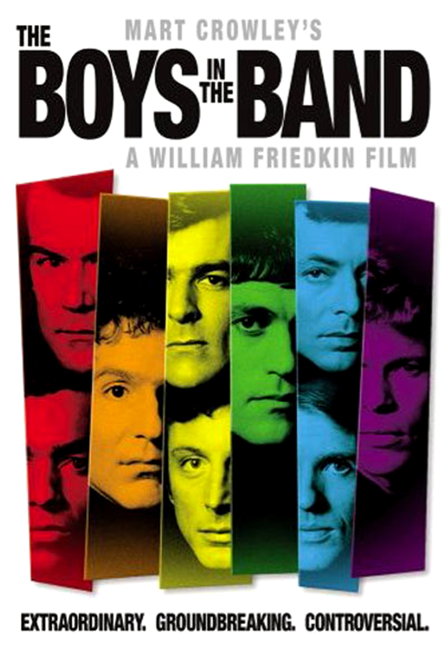
Some years ago, while watching TV in the wee hours of the morning, I happened upon a film that I’d never before heard of. I was instantly hooked. It turned out to be a milestone in gay-themed filmmaking, a cult classic that alternately (and sometimes simultaneously) delighted and appalled New York theatrical audiences in 1968 and then moved to the screen in 1970. That film was The Boys in the Band.

Written by gay playwright Mart Crowley, the play attracted celebrities and the New York in-crowd nearly instantly after it opened at a small off-Broadway theater workshop in 1968. The cast of nine male characters worked together so successfully that the whole bunch of them made the transition to the screen in 1970, which is nearly unheard of.

Crowley had been a well-connected and respected but poor young writer when his play became a smash in 1968. While still a young man, he knew how the Hollywood game was played and how to jockey his success into control over the casting of the film. Working with producer Dominick Dunne he adapted his script into a screenplay and watched director William Friedkin, who also directed The French Connection and The Exorcist, lovingly keep the integrity of the play while opening it up and making it work on the screen.

It’s hard to believe that the play opened off-Broadway a year before the Stonewall riots that set off the modern-day gay rights movement in New York and then swept across the country. The characters in the play, and the whole play itself, are not incidentally gay—the characters’ behavior and the play’s content revolve around their homosexuality. For better or worse, the characters play out, argue over and bat around gay stereotypes: the drama queen, the ultra-effeminate “nelly” fairy, and the dimwitted cowboy hustler (a likely hommage to the cowboy gigolo Joe Buck in the 1965 novel Midnight Cowboy, which was made into a remarkable film by John Schlesinger in 1969). The play also features straight-seeming butch characters who can (and do) “pass” in the outside world, and a visitor to their world who may or may not be homosexual himself.

The action takes place at a birthday party attended only by gay men who let their hair down and camp it up with some very arch and witty dialog during the first third of the film, then the party is crashed by the married former college pal of Michael, the host. A pall settles over the festivities as Michael (played by musical theater star Kenneth Nelson) tries to hide the orientation of himself and his guests. That is, until the party crasher brings the bigotry of the straight world into the room, and Michael realizes he’s doing nobody any favors by keeping up the ruse. During the course of the evening he goes from someone who celebrates the superficial and who has spent all his time and money (and then some) on creating and maintaining a reputation and a public image, to a vindictive bully who lashes out at everyone and forces them all to scrutinize themselves with the same homophobic self-hatred he feels. He appears at first bold and unflinching in his insistence on brutal honesty, but he goes beyond honesty into verbal assault, while we see reserves of inner strength and dignity from characters we had underestimated earlier in the play. Though The Boys in the Band isn’t the masterpiece that Who’s Afraid of Virginia Woolf? is, I see similarities between the two in the needling, bullying and name-calling that alternates with total vulnerability and unexpected tenderness.

The self-loathing, high-camp hijinks, withering bitchiness and open ogling made many audience members uncomfortable, a number of homosexuals among them. Some felt the story and the characterizations were embarrassingly over-the-top and stereotyped. They thought that having the outside straight world peek in and see these characters up close would only make them disdain homosexuals even more. This is a legitimate criticism; the nasty jibes, pointed attacks, and gay-baiting that goes on among and against gay characters here is the sort of in-fighting that could encourage bigots to become more entrenched in their prejudices when seen out of the context of a full panorama of daily life for these characters.

However, the play and film were also groundbreaking in their depictions of homosexuals as realistic, three-dimensional men with good sides and bad. Even as we watch one character try to eviscerate the others by pointing out stereotypically gay characteristics that make them appear weak and offensive to the straight world at large, there is also a great deal of sympathy and empathy shown among the characters under attack, and even towards the bully at times. Sometimes this tenderness is seen in the characters’ interactions. At other times, it is fostered in the hearts of the audience members by the playwright. Playwright Crowley has us witness people behaving badly, but we recognize over time how fear and society’s hatefulness toward them has brought them to this state.

These characters may try to hold each other up as objects of ridicule, but the strength of the dialog is that we in the audience don’t buy it; with each fresh insult, we see further into the tortured souls of those who do the insulting. We see how, as modern-day sex columnist Dan Savage put it so beautifully in an audio essay on the public radio show This American Life in 2002, it is the “sissies” who are the bravest ones among us, for they are the ones who will not hide who they are, no matter how much scorn, derision and hate they must face as a result of their refusal to back down and play society’s games. Similarly, to use another theatrical example, it is Arnold Epstein, the effeminate new recruit in the Neil Simon 1940’s-era boot-camp play Biloxi Blues, who shows the greatest spine and the strongest backbone in the barracks when he does not hide who he is, and he willingly takes whatever punishment he is given stoically and silently so as not to diminish his honesty and integrity or let down his brothers in arms.

The situation and premise of The Boys in the Band are heightened and the campy drama is elevated for the purposes of building suspense. This echoes the action in plays by Tennessee Williams and Eugene O’Neill, where the uglier side of each character is spotlighted and the flattering gauze and filters over the lenses are stripped away dramatically as characters brawl and wail. The emotional breakdowns are overblown and the bitchy catcalling is nearly constant for much of the second half of the film, which becomes tiresome. However, the play addresses major concerns of gay American males of the 1960s head-on: social acceptability, fear of attacks by angry or threatened straight men, how to balance a desire to be a part of a family with a desire to be true to one’s nature, monogamy versus promiscuity, accepting oneself and others even if they act “gayer” or “straighter” than one is comfortable with, etc.

It is startling to remember that, at the time the play was produced, just appearing to be effeminate or spending time in the company of assumed homosexuals was enough to get a person arrested, beaten, jailed or thrown into a mental institution, locked out of his home or job, even lobotomized or given electroshock therapy in hopes of a “cure.” In 1969 the uprising at the Stonewall Inn in New York City’s Greenwich Village by gay people fighting back against police oppression was a rallying cry. It gave homosexuals across the nation the strength to stand up for their rights and refuse to be beaten, threatened, intimidated, arrested or even killed just for being gay. However, anti-gay sentiment in retaliation for homosexuals coming out of the closet and forcing the heterosexual mainstream to acknowledge that there were gay people with inherent civil rights living among them also grew.

Cities like San Francisco, Miami, New York and L.A. became gay meccas that attracted thousands of young men and women, many of whom were more comfortable with their sexuality than the average closeted American homosexual and who wanted to live more openly as the people they really were. There was an air of celebration in heavily gay districts of these cities in the 1970s and early 1980s in the heady years before AIDS. It was a time when a week’s worth of antibiotics could fight off most STDs, and exploring and enjoying the sexual aspects of one’s homosexuality (because being a homosexual isn’t all about sex) didn’t amount to playing Russian Roulette with one’s immune system, as it seemed to be by the early to mid-1980s. Indeed, of the nine men in the cast of the play and the film, five of them (Kenneth Nelson, Leonard Frey, Frederick Combs, Keith Prentice and Robert La Tourneaux) died of AIDS-related causes. This was not uncommon among gay male theatrical professionals who came of age in or before the 1980s. The numbers of brilliant Broadway and Hollywood actors, singers, dancers, directors and choreographers attacked by AIDS in the 1980s and 1990s is staggering.

When the film was made in 1970, all of the actors were warned by agents and others in the industry that they were committing professional suicide by playing openly gay characters, and indeed, several were typecast and did lose work as a result of their courageous choices. Of those nine men in the cast, the one who played the most overtly effeminate, campy queen of all (and who stole the show with his remarkable and endearing performance) was Cliff Gorman. He was a married heterosexual who later won a Tony playing comedian Lenny Bruce in the play “Lenny,” which went on to star Dustin Hoffman in the film version. Gorman was regularly accosted and accused of being a closeted gay man on the streets of New York by both straight and gay people, so believable and memorable was his performance in The Boys in the Band.

The play is very much an ensemble piece; some actors have smaller and more thankless roles with less scenery chewing, but it is clear that it was considered a collaborative effort by the cast and director. The enormous mutual respect and comfort of the characters with each other enriched their performances and made the story resonate more with audiences than it would have otherwise. The actors saw the film and play as defining moments in their lives when they took a stand and came out (whether gay or straight) as being willing to associate themselves with gay issues by performing in such a celebrated (and among some, notorious) work of art. When one of the other actors in the play, Robert La Tourneaux, who played the cowboy gigolo, became ill with AIDS, Cliff Gorman and his wife took La Tourneaux in and looked after him in his last days.

In featurettes about the making of the play and the film on the newly released DVD of the movie,  affection and camaraderie among cast members are evident, as is a great respect for them by director William Friedkin. Those still alive to talk about it regard the show and the ensemble with great love. As Vito Russo noted in The Celluloid Closeta fascinating documentary on gays in Hollywood which is sometimes available for streaming on Netflix, The Boys in the Band offered “the best and most potent argument for gay liberation ever offered in a popular art form.”

According to Wikipedia, “Critical reaction was, for the most part, cautiously favorable. Variety said it ‘drags’ but thought it had ‘perverse interest.’ Time described it as a ‘humane, moving picture.’ The Los Angeles Times praised it as ‘unquestionably a milestone,’ but ironically refused to run its ads. Among the major critics, Pauline Kael, who disliked Friedkin and panned everything he made, was alone in finding absolutely nothing redeeming about it. She also never hesitated to use the word ‘fag’ in her writings about the film and its characters.”

Wikipedia goes on to say, “Vincent Canby of the New York Times observed, ‘There is something basically unpleasant . . . about a play that seems to have been created in an inspiration of love-hate and that finally does nothing more than exploit its (I assume) sincerely conceived stereotypes.'”

“In a San Francisco Chronicle review of a 1999 revival of the film, Edward Guthmann recalled, ‘By the time Boys was released in 1970 . . . it had already earned among gays the stain of Uncle Tomism.’ He called it ‘a genuine period piece but one that still has the power to sting. In one sense it’s aged surprisingly little — the language and physical gestures of camp are largely the same — but in the attitudes of its characters, and their self-lacerating vision of themselves, it belongs to another time. And that’s a good thing.'” Indeed it is.


[Originally published in June 2009.]