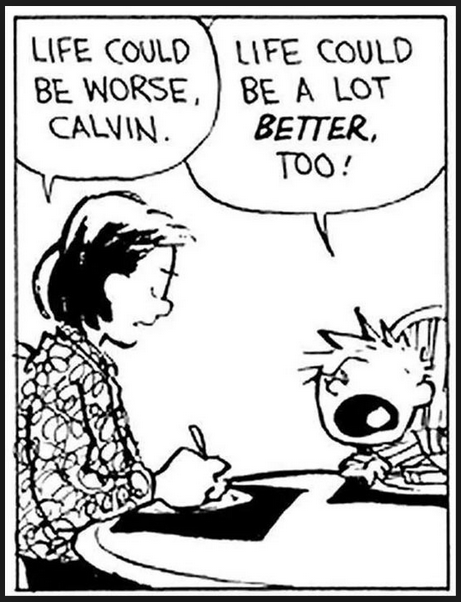
From Bill Watterson’s classic comic strip, “Calvin and Hobbes”
“At least” is a mitigating phrase used to begin a response to another person’s expression of difficulty, distress or dissatisfaction. The phrase is often followed by a statement that minimizes the extent, importance or validity of another person’s unpleasant feelings: “At least you weren’t hurt when the hit-and-run driver totaled your car.” “At least you have insurance to pay for the things stolen from your apartment.” “At least you’ve got enough savings until you can find another job.” This is a phrase a listener uses when trying to discount the seriousness of another person’s concerns.
The phrase “at least” may also be used to try to lighten the tone when a listener is uncomfortable dealing with someone else’s difficulty. It may introduce a sentence about how someone else has had worse problems, or may lead to a joke about how much more awful the outcome could have been, both of which undercut the validity and depth of feeling held by the person who expressed dismay.
When a listener stays with the discomfort of the speaker for just a few more seconds and responds with an empathetic phrase like “Wow, that must have hurt!” or “That’s so frustrating,” or just “I’m sorry that happened to you,” the speaker feels respected and acknowledged. Allowing a person to sit with his or her discomfort for a few seconds and responding not by shutting the speaker down but by letting that person know that you wish things were different provides comfort, a sense of support and a validation that yeah, this is a cruddy thing and we all have a right to feel disappointment when things go badly. This fosters camaraderie and feelings of having been understood. This simple shift in response to another person’s difficulty can help those who express dismay to move forward feeling supported instead of thwarted or ignored.
People who use “at least” as a way to discount others’ feelings may believe they are lightening the load of others by being funny or by looking on the bright side. However, their unwillingness to acknowledge others’ pain without immediately providing a distraction acts as a distancing maneuver. Some feel that people who complain are weak or self-indulgent for expressing pain or disappointment. Those who find such honest expressions discomforting justify shutting down others’ expressions of difficulty or upset by telling them they’re lucky things weren’t worse. Those who are uncomfortable with honest expressions of disappointment say they’re just trying to get others to buck up and find their inner strength and move on instead of “wallowing,” by which they mean acknowledging and expressing true feelings. Some people who use “at least” to respond to bad situations with comic rejoinders may feel that providing comic relief will make others see that their problems aren’t as bad as they thought.
Either of these responses is inherently unsympathetic.
Sometimes those who rely on “at least” do so because they find sticking with their own discomfort too great, and they feel immediate awkwardness when others are suffering. Others’ complaints or hurts look to them like weakness, or remind them of their own vulnerability. Many people are terrified of looking weak, and they look down on those who embrace and acknowledge vulnerability in any form. Those who have difficulty showing empathy for others may feel scared of showing vulnerability, since for them empathy is a form of shared pain and thus shared weakness.
Instead of seeing that showing empathy is an essential element of diplomacy and building healthy relationships, and is something that leads to tolerance and peaceful negotiation in both private and public spheres, some believe that life is a zero-sum game and one can never let down one’s guard without risking defeat. They don’t understand that when we lend others our strength by being willing to help them shoulder their load, we build bonds and make others feel safer with and more trusting of us.
Those who lack empathy see vulnerability as a failing and sharing others’ pain as weakness. But true and lasting connection, whether between human beings or nations, comes from refusing to diminish the importance of others’ feelings, beliefs and experiences. And that means not belittling others by dismissing their concerns, whether on a national level or when speaking one-on-one. So please, no more “at least.”
Former Acting U.S. Attorney General Sally Yates is a genuine American hero. She has at least twice in the past month stood up to the president to champion the Constitution and the rule of law as well as to warn him of the treachery of one of his appointments. Was she lauded for her patriotism and insight? No: She was promptly fired and excoriated by Donald Trump for doing her job.
In the wake of Trump’s executive order banning the entry of people from seven Muslim-majority countries into the U.S., Yates wrote, “I am responsible for ensuring that the positions we take in court remain consistent with this institution’s solemn obligation to always seek justice and stand for what is right. At present, I am not convinced that the defense of the Executive Order is consistent with these responsibilities nor am I convinced that the Executive Order is lawful. For as long as I am the Acting Attorney General, the Department of Justice will not present arguments in defense of the Executive Order, unless and until I become convinced that it is appropriate to do so.”
Also, in January, Yates warned the White House that National Security Adviser Michael Flynn was misleading others in the Trump Administration about his interactions with Russia’s ambassador to the U.S.; that he did not divulge that he had made deals with Russia promising to lift U.S. sanctions levied against them by President Obama for interfering in the U.S. presidential campaign even before Trump was elected president; and that he was highly vulnerable to blackmail by the Russian government. Recordings provided by U.S, security operatives proved that Flynn had colluded with a foreign government to undermine the strength of then-President Obama’s sanctions. That gave an enemy state an incentive to undermine a U.S. presidential election in order to prop up a friendly U.S. regime that would bow to their will, and gave them something to use against Flynn in order to blackmail him. By engaging in these conversations, Flynn broke his oath to support the Constitution of the United States. He is, quite simply, a traitor, and Sally Yates warned Trump’s White House of that weeks ago.
The Trump White House did not believe Flynn’s treachery should prompt his ouster, which implies that Trump or his advisers had already been aware of his interactions with the Russian ambassador, or that the White House supported them, or both. They did not evict Flynn from his post until news video of Vice President Mike Pence looking like he was unaware of what was going on behind his back made Pence look clueless and out of the loop. Clearly, being beholden to the Russians is no sin in their eyes, but looking weak.
Last month Yates, a holdover from the Obama administration, was abruptly dismissed by the White House after directing Justice Department lawyers not to defend the new administration’s travel ban against seven Muslim-majority countries. Why? Because she knew it was unconstitutional as written, would never hold up in court and would violate the oaths that she and the president had taken to uphold the Constitution. She was doing her job, had no choice but to oppose defending an illegal edict, and she was proved right in her assessment when the travel ban was later struck down as unconstitutional by a three-judge panel. For her efforts to do the right thing, Trump said Yates “betrayed the Department of Justice” and fired her. But Yates is exactly the sort of brave and conscientious person I want watching over my freedoms and rights and holding my government accountable.
Above is the beginning of the letter that civil rights leader (and widow of Martin Luther King Jr.) Coretta Scott King wrote to segregationist Senator Strom Thurmond about Jeff Sessions in 1986 when she was protesting his nomination for a position as a federal judge. On the cover page of her nine-page letter, Mrs. King wrote, ‘“Anyone who has used the power of his office as United States Attorney to intimidate and chill the free exercise of the ballot by citizens should not be elevated to our courts. Mr. Sessions has used the awesome powers of his office in a shabby attempt to intimidate and frighten elderly black voters. For this reprehensible conduct, he should not be rewarded with a federal judgeship.”
Thurmond was supposed to make the letter a part of the Senate record, but he failed to do his duty in an attempt to the hide the filthy history of a fellow believer in white supremacy. Thurmond’s action hid the fact of the letter from the public for 30 years. It was recently rediscovered and shared by the Washington Post.
Tonight Senator Elizabeth Warren was reading it aloud on the floor of the U.S. Senate when Republican Senator Mitch McConnell shut her down, saying she was breaking Senate rules against impugning the name of a fellow member of the Senate by sharing historical facts about his long history of racism, facts necessary to properly assess his worthiness for one of the most powerful posts in the nation.
Jeff Sessions has spoken on behalf of segregationists and white supremacists. He has gone out of his way to stand by bigots and against racial equality in his public as well as his private life. Now Donald Trump wants him to be our Attorney General.
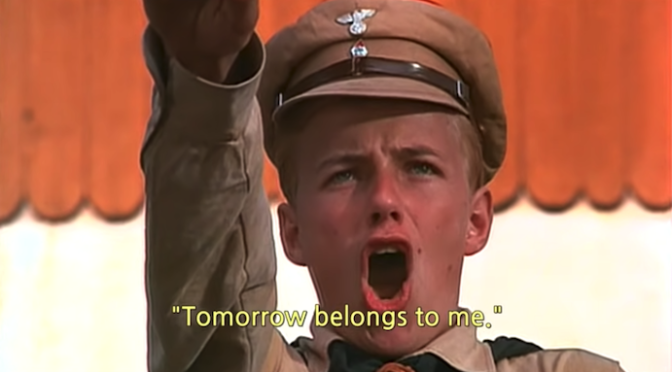
Here is a chilling scene from the musical film Cabaret by composers John Kander and Fred Ebb. In this first week of the Trump presidency, when our freedoms are already being ripped from us and a dark, xenophobic hatred is settling on our nation, sharing this troubling work of art feels particularly and horribly apt and important.
Kander and Ebb wrote a number of musicals, including Chicago, together. Their biggest hits were stories of darkness and decadence in which the music, though catchy and clever, eloquently underscored the sordid qualities of the worlds in which their stories took place. Their songs (including “Cabaret,” “New York, New York,” “Maybe This Time” and “All That Jazz“) are so pleasing that they can be pulled from their context and enjoyed as great tunes whenever and wherever you like. But in context, Kander and Ebb’s songs enrich and amplify the plays’ messages and power and make them two of the most important creators in the musical theater canon.
As gay Jews born in the 1920s, both Kander and Ebb had seen and experienced antisemitic and homophobic bigotry personally. One imagines that those difficult experiences can only have deepened their understanding of and sympathy for the characters for whom they wrote.
Please watch this clip to the end to experience its full, chilling power. Far from being a simple musical comedy, Cabaret is the story of life around a Berlin cabaret during the rise of the Nazi party during the early 1930s. It shows how evil infiltrates a cultured and cosmopolitan nation, and how no amount of retreating to the cabaret for distractions can keep the evil truths of the outside world from overtaking a once-beautiful culture.
We all know that the witty, insightful actress and writer Carrie Fisher, who died today at age 60, began her career as an actress in the 1970s. She became a Hollywood star at age 20 when Star Wars was released in 1977. While many know that she went on to write books, screenplays and stage shows, far fewer people know that she was also a sought-after Hollywood script doctor. During the 1990s, she was frequently hired to repair weak screenplays, working on such movies as Hook, Sister Act, Lethal Weapon 3 and The Wedding Singer. The work was lucrative, but she was never credited by name as a writer for any of the films whose scripts she saved. (She is said to have been one of the script doctors who tried but failed to bring life to all three of the Star Wars prequel scripts, too.)
Fisher’s writing talents are evident from her memoirs, in her one-woman theatrical show, Wishful Drinking, and in the screenplay based on her autobiographical novel Postcards from the Edge. In late 2001, when the nation was deeply shaken after the September 11 attacks and frightened lawmakers began urging each other to limit Americans’ freedoms, Carrie Fisher donated an autographed copy of the screenplay for Postcards from the Edge to an auction of celebrity artifacts to benefit the American Civil Liberties Union. I was the winner of that auction, and my Carrie Fisher-autographed script is one of my prized possessions.
Fisher grew up as Hollywood royalty, the child of popular singer Eddie Fisher and America’s sweetheart, Debbie Reynolds, and was later the stepdaughter of Elizabeth Taylor and wife of musician Paul Simon. Despite such privilege, she also grew up seeing the seedy side of fame: her parents’ scandalous and very public divorce (her father left Debbie for Elizabeth); her father’s addiction to speed; and her mother’s financial catastrophes brought on by marriages to faithless gamblers who stole her money, diverted Debbie’s savings to their mistresses and brought prostitutes into their home.
In Fisher’s first big film role (in Warren Beatty’s film Shampoo,) she played a jaded teenager who propositions the much older character played by Beatty. Her character’s world-weary attitude and hard-edged directness in Shampoo show up again in her portrayals of Princess Leia in the first three Star Wars films. By her twenties, she was self-medicating and addicted to drugs. It was only when she learned that she had bipolar disorder that the reasons for her mood swings, depressions and hunger for intoxicants became clear to her. She sought to wean herself from her addictions and began to divert her insecurities and keen observations into her writing.
To the benefit of her readers, she shared her stories of her own depression, self-loathing, addictions and mental disorders, first through her art, then through memoirs and interviews. Fisher fought to destigmatize mental illness and encouraged people to be honest with themselves and others, to get help and to accept themselves as imperfect but worthy of love and understanding. For a woman who had grown up believing that putting on a perfect façade and never letting the world see her sweat was of paramount importance, her journey toward self-acceptance and her willingness to tell the world of her flaws and illness and her ultimate freedom from addiction was a brave one.
From her earliest days, Fisher had a steely confidence on screen and spoke in an authoritative voice that didn’t jibe with her fresh, youthful beauty. Her world-weary delivery and seeming steeliness made her a compelling Leia Organa. On screen she was a princess and the leader of a galactic rebellion, but behind her seeming confidence was enormous self-doubt. While her insecurities led her to dangerously self-defeating impulses in her youth, they also brought her to deep insights which she used to fuel the raw, honest, hilarious but brutally true stories she wrote of her life. She showed us how smart, beautiful, rich and talented people could be just as fearful, self-defeating and confused as the rest of us.
Carrie Fisher was a woman who spent her life creating fictions through her acting and writing, but she lived her own life as fiercely and honestly as she was able. She laid herself bare in her writings, one-woman shows and interviews, including her recent discussion of her life and work with NPR’s Terry Gross. She laughed at herself before anyone else had a chance to, and let us know that it was okay to fail, to fear, to fall. Even a Hollywood princess is only human.
Just this year, the Harvard Humanist Hub gave Fisher the Outstanding Achievement Award in Cultural Humanism, saying that “her forthright activism and outspokenness about addiction, mental illness, and agnosticism have advanced public discourse on these issues with creativity and empathy.”
In Carrie Fisher’s memory, I’m making a donation to the ACLU today, because the leader of the rebel alliance would want us to keep up the good fight against the demagogues who hope to round us up, wall us off and shut us up. Carrie Fisher was, after all, the woman who embodied Princess Leia Organa, leader of the rebellion against the ruthless Empire. Making a donation to keep civil liberties safe seems like a small but meaningful thing to do to honor someone who spoke her mind, made us laugh and brought us so much joy through her work. Won’t you join me?
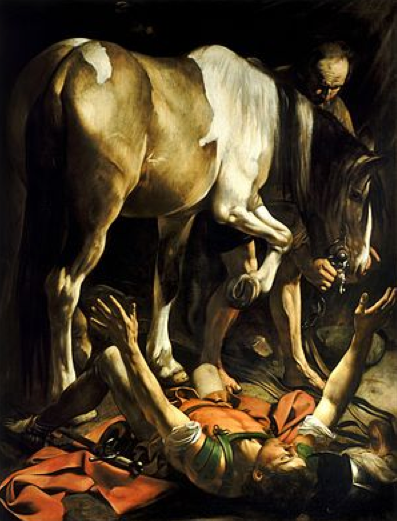
Caravaggio’s “The Conversion of St. Paul on the Road to Damascus,” painted for the Cerasi Chapel of the church of Santa Maria del Popolo in Rome, 1601
When Stendhal, the 19th century French author, visited Florence in 1817 he became so overwhelmed by the city’s glorious art that, overcome by a surfeit of visual splendor, he had a temporary psychological breakdown. He’s not the only one to react to extreme beauty in this way. Art lovers have found being in the presence of tremendous beauty so moving and emotionally taxing that they’ve suffered confusion, tachycardia, dizziness and hallucinations in art museums frequently enough for psychiatrists to give a name to this cluster of responses: Stendhal Syndrome.
Tourists occasionally experience breakdowns while overcome by the beauty of Botticelli‘s paintings in the Galleria degli Uffizi or at the foot of Michelangelo’s David at the Galleria dell’Accademia. Some are sent to Florence’s Santa Maria Nuova Hospital‘s psychiatric ward for evaluation. The syndrome was named in 1979 after an Italian psychiatrist observed more than 100 cases among tourists in Florence. Apparently American tourists are not known to suffer the syndrome as Europeans do; some say that perhaps this is because as a culture, we don’t experience the same immersion and attachment to masterworks of art as Europeans. As a rule, Europeans believe we derive neither the ecstatic joy in being surrounded by profoundly beautiful and important masterworks, nor the psychological trauma of being overwhelmed by it. When they find an American who is deeply touched by their heritage and art, most Europeans are surprised and delighted. I have found that many will go out of their way to help a visitor enjoy immersion in their glory.
Most U.S. tourists visiting Europe simply lack the frame of reference and familiarity with European art and history that Europeans have, and without such a frame of reference there is less build up of anticipation or depth of understanding, and these are the underpinnings of emotional reaction. Faced with the exhaustion of travel, the unforgiving pace and the breadth of new experiences that most packaged tours provide to Americans overseas, the majority of my compatriots can be forgiven for being too numbed and overwhelmed by the fatigue and novelty of European tourism for great meaning to sink in. It’s not that emotional reactions to beauty and meaning are lacking in our makeup, but that most of us have simply not been exposed to either the depth or breadth of art historical experience and understanding that many Europeans enjoy. This is, of course, partly because of our physical distance from the majority of masterpieces of Western art, and also because of the relative novelty of our national history and treasures.
While the U.S. has many European masterworks in museums, one must make an effort to visit them. We are not surrounded with them as most urban Europeans are. Turn a corner in any major European metropolis and you may find that treasure troves of art and architecture await you. In Italy especially, the sheer volume of exquisite historically and artistically important works is staggering. In Rome or Florence, it seems as if nearly any random block offers a world-class repository of culture to rival anything Americans could muster. One city after another (not to mention little villages and gorgeous hill towns) boasts ancient treasures, Roman monuments, priceless works of every kind. So it is no wonder that people steeped in stories and photos of such masterworks who enjoy and remember their history should be overwhelmed when immersed in the glories of Europe’s cultural centers.
I have never had a nervous breakdown in a museum (or anywhere else, for that matter), but I have several times been moved to tears and wonderment before a work of art which I have studied and loved from afar. Here is my favorite example.
When I was 21, my mother and I spent several hectic weeks traveling through the art centers of Italy together in honor of my having completed college. For both my senior theses (I wrote one for my history major and my art history minor) I wrote on art historical subjects. One essay was on 15th century Florentine architecture; the other compared the impact of different sources of patronage (e.g., Italian popes, Spanish monarchs, Flemish churches, Dutch merchants) on the styles and subject matter found in works painted or sculpted by major 17th century Italian, Spanish, Dutch and Flemish artists.
I took night school classes in Italian, since Mills College didn’t offer that language, to enrich my art historical studies. When I went to Italy with my mother two months after graduation, all my art historical research and Italian language studies were still fresh in my head, and I was aching to see all the pieces whose photographic representations I’d spent four years swooning over. I had been to Italy on multi-country package tours of Europe in my teens, but this time we were focusing on one country alone and spending days on end in magical cities where we had enough time to seek out the tinier churches that tours usually missed. We were women on a mission.
My mother was as crazy for 16th and 17th century art and architecture as I, and as determined to cram as many masterpieces into our free days as I was. On one swelteringly humid July day in Rome, she and I visited so many churches we lost count. We crisscrossed the city on swollen legs and blistered feet, determined to get one more painting in, view one more astonishing Bernini sculpture, admire another set of volutes or one more baldachin or another monument or reliquary or crumbling edifice. At last, dehydrated and aching, we dragged ourselves into Santa Maria del Popolo in search of a painting neither of us wanted to leave Rome without seeing: Caravaggio’s Conversion of St. Paul on the Road to Damascus.
We hobbled all around the church looking for the chapel we sought, so overwhelmed by pain and fatigue that we had to poke each other to make sure we admired and appreciated the other masterworks all around us. Then we walked around a corner and into the Cerasi Chapel of Santa Maria del Popolo only to find St. Paul lying on the road to Damascus before us. The painting was darkened by time, covered in dust and obscured around the edges by layers of cobwebs. With one of the greatest paintings anyone will ever paint before us, enormous, filthy and exquisite, we simultaneously burst into tears and hugged each other in relief and delight. This painting alone was worth every blister, every step, every night of study, every set of endless marble steps we had climbed throughout the city for six long, hot days.
Finding my way to this painting distilled all I love about art into one perfect moment, just as Caravaggio distilled all that was important about Paul’s conversion into one perfect image. For Caravaggio, the moments of most pathos and meaning come when holy figures are brought down to their most elemental humanity and humility. He humbles Christ, the Virgin Mary (whom he painted as bare- and dirty-footed and swollen in death) and St. Paul in his paintings to bring their essential humanity closer to us, so we see that as we are now, so once were they. Unlike someone like Rubens, who elevates powerful human beings to lofty heights, Caravaggio brings holy personages down to the human level so we can empathize with them and love them in a more completely human and heartfelt way.
As painted by Caravaggio, Saul becomes Paul while lying in the dirty, dark road, nearly trampled by his oblivious horse. He is literally knocked off his high horse and blinded so he can be humbled enough that his soul might be exalted in times to come. My experience in making my way to the piece was similar on a small but meaningful scale; my little pilgrimage exhausted and humbled me so that in the midst of all the glories around me after days of being bombarded by the endless masterworks of Rome, I could still be touched profoundly by one old, dusty and perfect painting.
Other works of art have moved me to tears, but I think no first moment with any work of art can surpass the joy I felt in the perfection and purity of that moment with that work of art. Unlike Stendahl in the Uffizi Gallery, I did not need to fall to the floor with arms outstretched in my ecstatic moment. Paul did that for me in his eternal ecstatic moment on the wall of a dark Roman chapel.
[This article originally appeared on Laura Grey’s Little Hopping Bird blog.]
“Better stay away from those
That carry around a fire hose
Keep a clean nose
Watch the plain clothes
You don’t need a weather man
To know which way the wind blows”
—From “Subterranean Homesick Blues”
The Nobel Committee’s decision to honor folksinging musical legend Bob Dylan with a Nobel Prize in Literature is inspired.
One of history’s most influential songwriters and lyricists, Bob Dylan has meandered through the musical disciplines of folk and protest songs, blues, pop and rock and come out the other end with his own amalgam of raw, bleating authenticity, intimacy, cynicism and wordplay. It’s hard to think of a voice that has threaded its way into the world’s consciousness more powerfully over the past half century.
The Nobel Committee has long sought out fresh voices that speak to the human condition in original and insightful ways. In past years the committee has honored writers who have explored enduring topics including folk tales, race and feminism, violence, poverty, segregation and myth through prose, poetry, reportage and social criticism. This year marks the first time a Nobel Prize in Literature has been awarded to a musician for his lyrical output. Since the prize was established in 1901, the Nobel Committee has sought to celebrate voices that express eternal conflicts, awaken minds and deepen compassion, and the work of Bob Dylan encompasses all of these themes.
Dylan’s voice was the urgent social conscience of the 1960s. The stripped-down simplicity of his musical messages was disarming, yet he convinced the world to recognize folk as a sophisticated medium and a driving social force. With his storytelling, Dylan altered the way we think and hear, and in so doing he changed the world.
The star of the second presidential debate was neither former Secretary of State Hillary Clinton nor Donald Trump. It was moderator Anderson Cooper, who addressed Donald Trump with the following question:
Throughout the two days since the release of the videotaped 2005 recording featuring the voice of Donald Trump bragging to Access Hollywood host Billy Bush about sexually harassing a married woman, kissing women he’s just met without permission, even groping women’s genitalia without warning, politicians and commentators have repeatedly described Trump’s recorded bragging about his repulsive and predatory behavior as “lewd talk.” The truth is that the actions he bragged about are not only distasteful and vulgar, they are also criminal. Kissing, fondling and groping people against their will are offenses that can result in arrest, sometimes imprisonment, and in some cases a lifetime spent on the sex offender registry. Donald Trump’s self-described behaviors were not just sexist and misogynistic; he bragged about engaging in criminal sexual predation and assault.
According to Newsweek, at least two women have publicly stated that Trump approached them in exactly the obscene manner he describes on the tape. One sued him for just such behavior: “Jill Harth, a pageant owner trying to work with Trump in the mid-1990s, filed suit against him in federal court in Manhattan in 1997, describing a ‘relentless’ campaign of sexual harassment and assault including an incident in which he reached under a table, put his hands on her thighs and grabbed her ‘intimate private parts’ during a meeting at a New York restaurant.”
Have we heard the last of Trump’s history of sexual harassment and even sexual assault of women? Surely not. It has taken great courage for women to stand up to Trump in the face of his ruthless counter-attacks and character assassination, but one hopes it will be easier for his victims to feel safe speaking publicly about their experiences thanks to reporters like the Washington Post’sDavid Fahrenthold and CNN’s Anderson Cooper who take these reports seriously and describe Trump’s behaviors as the criminal offenses that they are.
Kudos to Anderson Cooper for his excellent work at the debate working alongside formidable and talented co-moderator Martha Raddatz of ABC News, and many thanks to Cooper for reminding the candidate and the nation that bragging about assault is not mere “lewd talk” or “locker room boasting.” Assault is assault. Period.
Tonight I indulged in an evening of nostalgia inspired by a viewing of Eight Days a Week: The Touring Years, the satisfying and enjoyable new documentary about directed by Ron Howard. Though no one can doubt Howard’s ability to present stories with energy and enthusiasm, I have often found his films too mawkish and obvious for my taste. Happily, it turns out he has a knack for creating a crackerjack musical documentary. He’s put together a jaunty but detail-rich story with the full cooperation of (and incorporating recent interviews with) living Beatles Paul McCartney and Ringo Starr, and with help from the widows of John Lennon and George Harrison.
Growing up during the 1960s and being steeped in Beatles music from birth, as I was, I have always seen The Beatles as my band and my musical family members, and I’ve viewed their music as a personal treasure that I just happen to share with the world. This film brings back the best moments of my childhood, reminds me of just how fresh and delicious their music was (and still is today). This documentary is a bright, shiny reminder that no, their power, talent and influence haven’t been overblown: they really were that good and that important to world culture in the 1960s. There was an open lightheartedness and sincerity about them which this documentary displays lovingly, but without treacly reverence or false heroism. They were a force to be reckoned with, but what they wanted most of all was not to be legends to millions of young girls or to worry about what their cultural legacy would be years hence; they just wanted to create really great music and bring joy. And they did.
As meaningful as my own relationship with The Beatles’ music feels to me, I know that I share my all-time-favorite band with a literal billion other people who love them, too, and this film makes that clear: the enormity of Beatlemania, the record-breaking crowds that showed up to see them, hurled themselves into fences and onto stages, and even broke through doors and windows to get to them are all on display here. But the nature of The Beatles’ electrifying and original music, as well as their enormous personal charisma and warm connection to each other and to their fans, is that we feel an intimate connection to them and to their music. After all, their songs have been part of our personal soundtracks for over a half-century. This film makes their charisma, their discipline and their energy feel fresh and palpable, and the large amounts of color footage and clever use of still photos and black-and-white film, along with surprisingly well restored audio tracks, makes them feel breathtakingly contemporary.
The Beatles were joyful, bracingly honest, and so cheerfully rowdy that they turned all stereotypes of British primness upside-down. They were also egalitarian, working class and, when it came to race, colorblind. In Eight Days a Week, Whoopi Goldberg, who has been a huge Beatles fan since childhood and who saw them at Shea Stadium when she was a girl, says in this film that when she saw and heard The Beatles, she felt like they were her friends, that their music spoke to her, that she didn’t feel like an outsider when she played their records. She felt like they would welcome her into their world if they knew her, which was unusual and deeply touching for a young black girl to feel about a group of white English guys in 1965. And she was right; when they went to the South, they were told they could only perform to segregated audiences, and they refused. They put an antisegregation rider into their contract, and once they broke the color barrier at their concerts, those stadium concert venues stayed desegregated for other performers who came after them. When they decided to augment their recordings with an outside keyboardist near the end of the band’s life, they chose megatalented black funk star Billy Preston to play keyboard for them, creating those iconic keyboard solos in songs like “Get Back.” You can see Preston, who was the only non-Beatle ever credited for performing on any of their albums, performing with them at the end of the film as they played their last-ever live concert together on the top of their office building, as can be seen in the concert film made of their final album together, Let It Be.
Those of us who were born in the 1960s grew up with Beatles music being a constant presence in our lives, and we who were most deeply touched by them can still sing dozens, even hundreds of their songs by heart, so catchy and fresh and powerful were their tunes, their lyrics and their arrangements. (And the documentary makes clear that they owed a great debt of gratitude to producer George Martin, who died this year and to whom the documentary is dedicated.)
To the people of the United States who were introduced to the Beatles on the Ed Sullivan Show and on the radio in early 1964, The Beatles seemed to come out of nowhere and to be overnight sensations. Of course, we all know now that they’d spent years honing their craft in the underground bar in which they were discovered in Liverpool, The Cavern, and in the seediest nightclubs of Hamburg, Germany, where they polished their performance skills, practiced and performed for up to eight hours a day, and all slept in one room together with their shared bathroom down the hall, like brothers. By the time they came to the U.S., they saw each other as brothers, as the film makes clear.
The overwhelming, relentless, exhausting quality of their life on the road is displayed and narrated by The Beatles themselves in this film, but their resilience, wit, energy and powerful loyalty to each other are also evident. The excellent footage and recordings, some only discovered recently after the filmmakers put a call out to Beatles fans via social media, are masterfully arranged and edited, and despite the extremely public nature of their lives and careers, the film feels quite intimate at times.
Ron Howard is known for being somewhat obvious and superficial in the way he treats historical subjects, and that holds true here: there are few, if any, surprising facts or original insights in this film, though hearing Paul and Ringo (and George and John, in long-ago interviews) recount their stories with some pleasure is a treat. In Eight Days a Week, Howard does what he is particularly good at, and that is creating an energetic, buoyant piece of visually attractive entertainment (with enormous help from talented editor Paul Crowder) that feels immediate and real, and that leaves the audience feeling hopeful. I saw it with a full house of people aged 18 to about 80, and the college-aged people laughed at and delighted in the Beatles’ talents and antics at least as much as those of us who have been listening to Beatles music for 50 years or more. The college students in the audience were the first to break into applause at the film’s end.
If you love The Beatles as I do, make sure to stay seated throughout the end credits so you don’t miss the huge bonus at the end of the film: a newly restored, half-hour-long edited-down version of their 1965 concert at New York’s Shea Stadium, which was at that time the largest rock concert in history. Their fan base was so enormous, and the risk to safety from the huge gatherings of fans was so great, that their U.S. tours eventually had to take place only in giant stadiums. Indeed, police forces across the U.S. were regularly overwhelmed when The Beatles came to their cities, so unprecedented were their appeal and the enormity of the crowds they attracted.
During the Shea Stadium concert Paul and Ringo say they couldn’t hear a thing over the deafening noise of the crowd; Ringo had to stay in sync with Paul and John by watching them for visual cues, primarily by watching their hips. Concert footage shows what enormous stamina and determination were necessary to perform on that scale and at that pace for years on end. Every day meant hours of being rushed through hordes of screaming fans who were trying to bash in their car windows; being dragged around to photo shoots or film sets; being grilled by reporters; having perhaps 90 minutes at a studio with George Martin to test out a just-written song and bring it to full fruition on tape; and then going off to play a concert. The lack of private time was wearying. In between all the very public appearances, they would often be stuck together in a hotel room to avoid having their hair snipped and clothes ripped away by mobs of fans should they go out in public. This film shows the weariness and joylessness that this kind of life ultimately elicited, and makes clear why they decided to stop touring in 1966 and spend all of their remaining energy writing and recording rather than touring for their final five albums together.
While my lifelong love of The Beatles keeps me from being impartial in evaluating this new documentary, I can say that I felt it captured their spirit, freshness, talent and liveliness in a more visceral and emotionally stirring way than any other documentary I’ve seen about the band, and that I’ll be able to hear and enjoy their music in a deeper and even more appreciative way as a result. Many thanks to Paul and Ringo and Ron Howard for making this lively, lovely appreciation of The Beatles’ early years possible.
When I was a teen, I used to read Shakespeare plays aloud with my mother, a high school English teacher, for fun during summer vacations. Mom and I tended toward the tragedies, but when my own daughter and I read Shakespeare’s plays during her high school summer vacations, we read most of his comedies together. We’d take two different well-footnoted editions of his works and our dog with us on a walk to the park. There the three of us would sit in the sunshine while Lily and I read through an act or two of As You Like It, Much Ado About Nothing or A Midsummer Night’s Dream.
Lily and I usually only got through one act a day because as we read, we compared the footnotes in each edition to better understand the allusions and puns and to get pronunciation suggestions along the way. Together we delighted in just how funny Shakespeare’s plays really are—how bawdy, how full of puns and mischief and made-up words! Lily had a knack for understanding Shakespeare, but we both benefited greatly from reading the footnotes so we could catch the jokes and puns and historical background that we otherwise would have missed. Pronunciation and word meanings have changed so much over 400 years that even Anglophiles and literature fans can miss a great deal of Shakespeare’s naughty wit without a bit of context.
This fascinating little video featuring English linguist David Crystal and his son, actor Ben Crystal, gives examples of how Shakespeare’s plays sounded when spoken during the playwright’s own lifetime, and explains some of the jokes that modern audiences miss. Give it a listen.